

Chengran (Felix) Guan
2026-07-03 · 6 min read
How a Real Estate Photographer Went from 5 Videos to 50 Videos Per Week
How a Real Estate Photographer Went from 5 Videos to 50 Videos Per Week
Six months ago, Mark was a solo real estate photographer editing 5 listing videos per week by hand. Each video took 3–4 hours. He was making decent money, but he was capped — there were only so many hours in a day, and every new client meant longer nights. Today, his media company produces 50 videos per week with the same three-person team. Here's exactly how he did it.
Key Takeaways
- Scaling video production isn't about working faster — it's about changing your workflow from manual editing to automated pipelines.
- AI real estate video editing tools cut per-video editing time by 60–70%, making volume production feasible for small teams.
- The key bottleneck for most photographers isn't shooting — it's the post-production pipeline. Fix that, and you 10x output.
- Real estate video AI tools are rapidly gaining traction among agents and photographers, creating a first-mover advantage for those who adopt early.

The Bottleneck: Why Most Photographers Get Stuck at 5–10 Videos Per Week
Mark's story isn't unusual. Most real estate photographers start by editing every video manually — trimming clips, adjusting color, adding music, syncing transitions. A typical 60–90 second listing video takes 3–4 hours from raw footage to final export. At 5 videos per week, that's 15–20 hours of editing alone. Add shooting time, driving, client communication, and admin, and you're already at 50+ hour weeks.
The math doesn't work for scaling. Hiring editors helps, but good real estate video editors cost $25–$50 per video (often more for premium work), which eats into margins. Many photographers outsource video editing — the scaling challenge becomes managing that outsourcing pipeline, not editing faster yourself. But outsourcing at scale brings its own problems: consistency, turnaround time, quality control, and communication overhead.
This is the exact problem that real estate video production costs articles often miss — the bottleneck isn't just cost, it's throughput. You can't pay your way to 10x output with manual editing alone.
Phase 1: Auditing the Production Pipeline
Before adding any new tools or hiring help, Mark spent two weeks tracking every minute of his production process. He broke it down into stages:
- Shooting (1–2 hours per property): Walking through, capturing wide shots, detail shots, room transitions.
- Ingest and logging (30–45 min): Transferring files, organizing clips, marking selects.
- Editing (2–3 hours): Trimming, sequencing, transitions, color grading, music sync.
- Review and revisions (30–60 min): Client feedback, tweaks, re-exports.
- Export and delivery (20–30 min): Rendering, uploading, sending links.
The biggest time sink was clear: manual editing took 55–60% of the total pipeline. Every video required the same repetitive sequence of trimming, color correction, and pacing decisions. This is where automation would have the most leverage.

Phase 2: Introducing AI into the Editing Workflow
Mark evaluated several approaches. He looked at traditional editing software with templates, tried hiring freelance editors, and tested a few AI tools. The breakthrough came when he adopted an AI real estate video editor that automated the repetitive parts of his workflow.
Here's what changed:
- Scene detection: AI automatically identified room changes, eliminating manual clip-splitting. What took 20 minutes now happens in seconds.
- Auto color grading: The AI analyzed footage and applied consistent color across all clips. No more matching color between rooms manually.
- Music and pacing: AI synced transitions to music beats and adjusted pacing based on property type. Luxury listings got slower, deliberate pacing. Family homes got brighter, faster cuts.
- Template-based branding: Intro/outro sequences, agent logos, and contact cards were applied automatically from saved brand kits.
The result: editing time dropped from 3 hours per video to under 1 hour. Mark could now produce 15 videos per week with the same effort that used to yield 5.
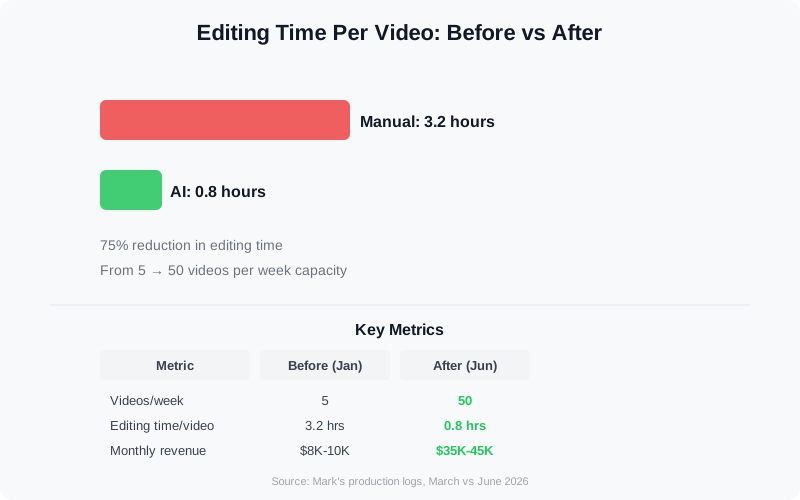
Manual editing on the left (3.2 hours avg), AI-assisted on the right (0.8 hours avg). Source: Mark's production logs, March vs June 2026.
Phase 3: Building a Team Around the AI Pipeline
With editing time slashed, Mark faced a new bottleneck: shooting capacity. He couldn't be at three properties simultaneously. The solution was a small team model:
- Two shooters: Part-time photographers who handled on-site filming. Each could shoot 3–4 properties per day.
- One production manager: Handled client communication, scheduling, and final quality review before delivery.
- Mark (owner): Oversees the AI pipeline, handles complex edits, and focuses on business development.
The AI did the heavy lifting on editing, so the team didn't need a dedicated video editor. That alone saved $3,000–$4,000 per month in salary or contractor costs — the difference between profitable scaling and breaking even.
This is the model that AI video effects for property tours makes possible: the technology doesn't replace the photographer — it replaces the hours of manual post-production that used to cap output.

The Numbers: Before and After
After three months with the new workflow, here's where Mark landed:
| Metric | Before (Jan 2026) | After (Jun 2026) |
|---|---|---|
| Videos per week | 5 | 50 |
| Editing time per video | 3.2 hours | 0.8 hours |
| Team size | 1 (solo) | 3 (shooters + mgr) |
| Monthly revenue | $8K–$10K | $35K–$45K |
| Client turnaround | 3–5 days | 24–48 hours |
The revenue jump came from two things: volume (more clients served) and pricing. With faster turnaround, Mark could charge a premium for expedited delivery. He also added video services to clients who previously only ordered photos — something many photographers find challenging without the right workflow.
The Virtual Staging Upsell
Once Mark had the video pipeline running smoothly, he added AI virtual staging as an upsell. For vacant properties, he offered virtual staging in the video — AI-furnished rooms that made empty spaces feel lived in. This added $150–$300 per listing with minimal extra work, since the AI handled staging automatically.
The combination of video + virtual staging became his premium package, and 40% of new clients opted for it. Beyond video, AI-powered photo editing tools — one-click declutter, furniture swap, and decor changes — gave him an additional service tier for listing photography that integrated with his video workflow.
Common Pitfalls When Scaling (and How Mark Avoided Them)
Pitfall 1: Quality drops with volume
When you're producing 50 instead of 5, consistency suffers. Mark solved this with saved brand templates and AI color profiles that ensured every video — regardless of which shooter captured the footage — looked the same. The production manager reviewed final exports against a quality checklist before delivery.
Pitfall 2: Costs scale faster than revenue
Hiring editors is the obvious solution, but it's expensive. By using AI for 80% of the editing work, Mark avoided hiring a dedicated editor. His shooters required minimal training — they just needed to capture clean footage; the AI handled the rest. This kept his cost-per-video low even as volume increased.
Pitfall 3: Communication overhead
More clients meant more emails, more revision requests, more chaos. The production manager role was critical — one person owned all client communication, freeing Mark to focus on the pipeline and business growth. The AI tools also batch-processed multiple videos, so the production manager could review 5–10 finals at once instead of waiting for one-at-a-time exports.
Video: Eli Jones — How to Scale Your Real Estate Photo Business from $15K to $50K/Month
The Verdict
Mark's story shows a clear pattern: the photographers and media companies that scale successfully don't work harder — they redesign their pipeline around automation. The AI tools that are gaining traction across the real estate industry aren't replacing the human element; they're removing the mechanical, repetitive work that capped production at 5 videos per week.
For real estate photographers looking to make the same leap, the playbook is straightforward: audit your pipeline, find the biggest time sink, apply AI to that stage, then build a small team around the automated core. The volume will follow.
Ready to scale your own video production? Try VideoGuru — the AI real estate media platform that turns raw footage into finished listing videos in minutes.