

Chengran (Felix) Guan
2026-07-20 · 10 min read
Real Estate Photo Editing:
AI vs Human Side by Side
Key Takeaways
- AI photo editing delivers consistent results in under 5 minutes per image — compared to 20-40 minutes for manual editing by a professional.
- Cost per edited image runs $0.50-2.00 with AI versus $5-25 per image with a human photo editor.
- Photo quality directly impacts days on market — listings with professionally edited photos sell 32% faster, according to NAR research.
- The best approach for most agents combines AI speed with human oversight — use AI for the bulk workflow and human editing for high-value luxury listings.
- AI is not replacing human editors — it's shifting the workflow so editors focus on creative decisions instead of repetitive corrections.
Real estate agents are caught between two pressures: buyers expect polished, magazine-quality listing photos, and sellers want properties to go live within 24 hours of the shoot. The old choice was simple — hire a professional photo editor and wait days, or skip editing and settle for average photos. AI photo editing has created a third option that sits somewhere in between. This guide breaks down the real differences between AI and human photo editing for real estate listings — cost, quality, turnaround, and where each approach makes sense for your business.
What AI Photo Editing Actually Does
AI photo editing tools like VideoGuru analyze each image and apply corrections automatically. The technology has matured significantly in the last 18 months. Here's what modern AI photo editing handles well:
- Exposure and white balance correction — fixing under-exposed interiors and mixed lighting sources.
- Color grading and saturation — making rooms look warm and inviting without oversaturating.
- Sky replacement — turning overcast exterior shots into bright blue-sky photos.
- Lens distortion correction — straightening vertical lines in wide-angle shots.
- Basic decluttering — removing small objects like power cords, trash cans, or personal items.
- Virtual twilight effect — converting daytime exterior shots to dramatic dusk scenes.
- Window pull — balancing bright window views with dimmer interior exposures in the same shot.
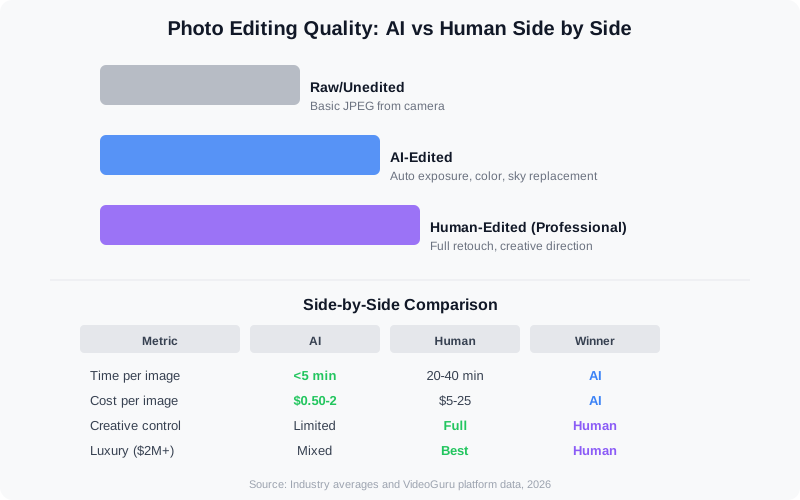
Side-by-side comparison: raw camera image (left), AI-edited result (center), professional human edit (right).
The key distinction is that AI excels at technical corrections — the repetitive, rule-based adjustments that a human editor makes on every single image. Where AI falls short is in creative decisions — choosing which elements to emphasize, making judgment calls about a room's feel, or handling complex compositions.
Cost Comparison: AI Photo Editing vs Human Editors
The cost gap between AI and human photo editing is the most obvious differentiator. But the full picture includes not just per-image cost but volume scalability, consistency, and hidden overhead.
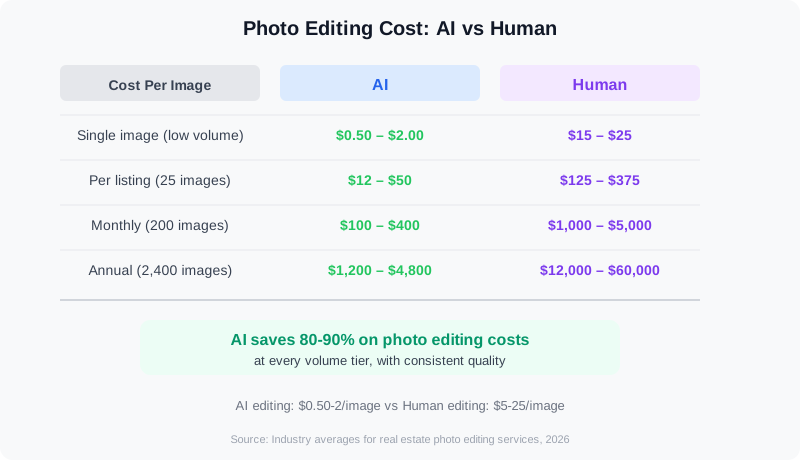
Pricing comparison: AI vs human photo editing across different volume tiers.
For a standard 25-photo listing package, here's how the costs break down:
- Human editor: $125-375 per listing ($5-15 per image) — includes color correction, HDR blending, window pulls, and object removal. Turnaround: 24-72 hours.
- AI photo editing (e.g. VideoGuru): $12-25 per listing ($0.50-1.00 per image) — automated color correction, exposure, sky replacement, and basic declutter. Turnaround: 5-10 minutes.
- Hybrid (AI + human review): $25-50 per listing — AI handles the bulk pass, a human reviews and makes selective corrections on 5-10 key images. Turnaround: same day.
For agents shooting 10-15 listings per month, switching from fully human editing to an AI workflow saves $1,500-5,250 per month based on the comparison above. For photographers and media companies processing 50+ listings monthly, those savings compound significantly. Learn more about photo editing pricing models and how to choose the right plan.
Quality and Consistency: Where Each Excels
Quality is the area where the AI vs human debate gets nuanced. Experienced human editors bring artistic judgment that AI simply doesn't replicate — yet. But AI brings something humans struggle with: pixel-level consistency across an entire listing set.
Where Human Editors Win
- Complex subject removal — removing a person, a large piece of furniture, or a full staging setup requires understanding context, not just pattern recognition.
- Artistic color grading — a skilled editor can create a specific mood or style that becomes a signature look for the agent or brokerage.
- Handling challenging lighting — rooms with mixed natural and artificial light, extreme shadows, or reflections require judgment calls that AI can miss.
- Luxury listing detail work — high-end properties need every finish, texture, and architectural detail preserved with care. Human editors inspect each image at 100% zoom.
Where AI Photo Editing Wins
- Color consistency across a set — AI applies the same correction algorithm to every photo, so a 25-image set has uniform color temperature, exposure, and saturation. Human editors can drift between images, especially in large batches.
- Speed — AI processes a full listing in under 10 minutes. A human editor takes 8-15 hours for the same volume.
- Sky replacement reliability — AI sky replacement has become remarkably accurate, blending edge detection and depth mapping to produce natural-looking results in most conditions.
- Bulk consistency — if you need 200 listings edited to the same standard, AI delivers identical quality on image 1 and image 2,000.
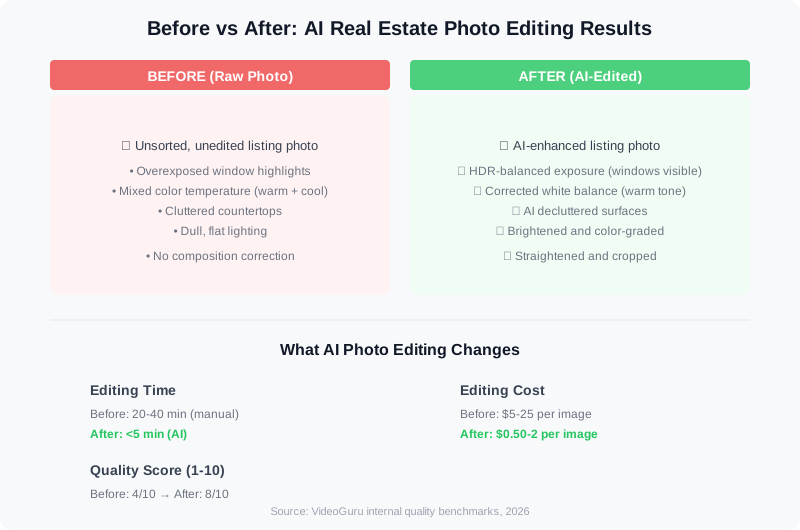
Before and after comparison of AI photo editing on a typical living room. The AI corrected exposure, balanced white balance, and enhanced natural light in under 3 minutes.
Turnaround Time: The Hidden Factor
In real estate, every hour a listing spends waiting for photos is a day the property could be on the market. Turnaround time has a direct business impact, and this is where AI has the clearest advantage.
According to the National Association of Realtors, properties with photos that go live within 24 hours of listing receive 61% more online views in the first week. Every day of delay costs visibility during the critical initial marketing window. AI editing eliminates the editing queue bottleneck — there's no waitlist, no backlog, no "I'll get to it tomorrow."
For the typical agent listing cycle, a shoot on Tuesday means online by Wednesday afternoon with AI editing — versus Thursday or Friday with a human editor who may have a 48-hour queue. Over 20 listings per month, that adds up to 20-40 hours of extra marketing time.
When to Use AI vs a Human Photo Editor
The smartest approach isn't choosing one over the other — it's knowing when each makes sense. Here's a practical framework:
Use AI Photo Editing When:
- You need photos live same day — price-point listings under $500k where speed matters more than bespoke editing.
- You're handling high volume — 15+ listings per week where human editing costs would eat your margins.
- The listing has good natural light and standard room layouts — AI handles these perfectly.
- You want consistent branding across every listing — AI applies your preferred correction settings automatically.
- You're creating social media content from listing photos — quick edits for Instagram or Facebook don't need human-level polish.
Use a Human Photo Editor When:
- The property is luxury ($2M+) — every detail matters and buyers expect flawless presentation.
- The space has challenging architecture — unique angles, complex lighting, or unusual room shapes.
- You need creative compositing — combining multiple exposures (advanced HDR), removing complex objects, or creating stylized artistic looks.
- The listing will be used in print materials — brochures, magazines, and high-end marketing collateral demand pixel-perfect quality.
- Photos need extensive restoration or repair — fixing damaged elements, reconstructing missing details.
Video comparison: AI photo editing vs professional human editing — workflow, quality, and turnaround time.
The Hybrid Workflow: Best of Both Worlds
Most successful real estate agents and photographers aren't choosing AI or human editing exclusively. They're building hybrid workflows that get the speed and cost benefits of AI while preserving the quality ceiling that human editors provide.
Here's what a typical hybrid workflow looks like:
- AI bulk pass — Run all 25-40 listing photos through AI editing. This handles exposure, color, white balance, basic window pulls, and sky replacement. Time: 5-10 minutes. Cost: near zero per image.
- Quick human review — The agent or photographer reviews the AI output in 10-15 minutes, flagging 3-5 hero images that need more attention.
- Selective human edits — Send those hero images to a human editor for advanced retouching — complex object removal, creative grading, or luxury-level finish work. Time: 20-30 minutes per image. Cost: $10-20 per image for only the key shots.
- Final delivery — Combine the AI-processed bulk images with the human-edited hero shots. Total turnaround: hours instead of days. Total cost: fraction of full human editing.
This approach is particularly effective for photographers scaling their business. As we covered in how agents should prioritize photo vs video for each listing, the media mix matters — and your editing pipeline needs to support both photos and videos efficiently. VideoGuru's platform handles both, so your photo editing and virtual staging workflow lives alongside your video editing in a single tool.
What the Data Says About Photo Quality and Sales
The choice between AI and human editing matters because photo quality directly affects selling outcomes. Multiple industry studies have quantified the impact:
- Listings with professional photos sell 32% faster than those with amateur photos, according to the NAR.
- 87% of home buyers say photos are the most important feature on a listing site, ahead of floor plans, square footage, and property descriptions. (NAR Profile of Home Buyers and Sellers)
- Homes with high-quality listing photos receive 61% more online views in the critical first week, directly impacting how many buyers tour the property. (Realtor.com Research)
- $2,000-6,000 higher sale prices are associated with listings that use professional photography, according to a Redfin analysis covered by Entrepreneur.
The data supports a clear conclusion: good editing is non-negotiable. The question is simply how to achieve it most efficiently for each listing. For a deeper dive on how photo quality affects your business economics, read our post on the cost of low quality listing photos.
What AI Can't Do Yet: Real Limitations
Being honest about AI's current limitations helps you make informed decisions. Here are the areas where human editors still outperform AI consistently in 2026:
- Complex scene reconstruction — removing a large object (a sofa, a full wall unit) and filling the background coherently. AI often creates artifacts or blurry patches in the reconstructed area.
- Understanding context — AI doesn't "know" what a room should look like. It applies statistical patterns. When a living room should feel cozy vs open vs dramatic, a human makes that choice based on the property and target buyer.
- Fine detail preservation — AI sharpening and enhancement algorithms can create unnatural textures, especially on faces, fabric, and natural materials like wood grain or stone.
- Bespoke color grading for brand identity — if you want every listing to have a specific look that matches your personal brand, you need a human to build and maintain that style guide.
- Edge cases and rare shooting conditions — extreme fisheye distortion, unusual lighting, or niche property types (boats, horse farms, commercial spaces) where the training data is thin.
These limitations are narrowing every quarter. The gap between AI and human editing quality shrinks noticeably with each major model update. For a broader view of where AI is heading in real estate marketing, see our analysis of AI in real estate marketing trends for 2026.
Frequently Asked Questions
Can AI photo editing replace a professional real estate editor?
Not entirely — not yet. AI handles 70-80% of the editing work automatically, including exposure, color correction, and basic enhancements. But the final 20-30% — complex object removal, creative grading, luxury-level detail work — still requires human judgment. The best results come from using AI for the bulk pass and reserving human editing for hero images and complex scenes.
How much does AI photo editing cost compared to a human editor?
AI photo editing typically costs $0.50-2.00 per image, while professional human editing runs $5-25 per image depending on complexity and volume. For a standard 25-photo listing, AI editing totals $12-50 compared to $125-375 for human editing. Many platforms like VideoGuru include photo editing in their subscription alongside video editing, making it even more cost-effective for agents who produce both photo and video content.
Can buyers tell if a listing photo was edited with AI?
In most cases, no — modern AI photo editing produces natural-looking results that are indistinguishable from professional human editing for standard room shots. The giveaway artifacts that plagued early AI editing (fake-looking sky replacements, over-sharpened edges, inconsistent shadows) have been largely eliminated by newer models. Buyers can tell when a photo has been edited — but they can't reliably distinguish between AI editing and human editing.
Does AI editing work for before-and-after renovation photos?
Yes, AI photo editing is excellent for renovation before-and-after comparisons. The AI's consistency algorithms ensure both photos have identical exposure, white balance, and color tone, making the transformation visible and honest. This is actually an area where AI can outperform human editors, who might introduce slight color drifts between the before and after shots that undermine the comparison's credibility.
Do I need to disclose AI editing on MLS listings?
MLS disclosure rules vary by board and region. Standard exposure and color correction typically don't require disclosure. Virtual staging and significant alterations (adding furniture, changing wall colors, replacing room contents) increasingly do require disclosure. Check your local MLS rules — many now have specific AI disclosure requirements. Most commonly, standard photo editing (exposure, color, HDR) is fine without disclosure, but virtual staging must be labeled as such.
The Verdict
AI photo editing has crossed the threshold from "good enough" to "genuinely useful" for real estate listings. For standard rooms with good light, the output rivals human editing at a fraction of the cost and time. For complex scenes, luxury properties, and brand-defining creative work, human editors still hold the advantage.
The winning strategy for most agents and photographers is a hybrid approach: use AI for the bulk editing workflow — which saves 80% of editing time and 90% of editing cost — and reserve human editors for the hero images that define how buyers perceive the property.
Ready to upgrade your listing photos with AI editing that works alongside your human workflow? Start free at VideoGuru — photo editing, virtual staging, and video editing in one platform designed for real estate.