

Chengran (Felix) Guan
2026-07-07 · 7 min read
Real Estate Video Marketing Strategy:
A Step-by-Step Guide for Agents

A structured video marketing plan helps agents convert more listings into sales.
What Is a Real Estate Video Marketing Strategy — and Why You Need One
A real estate video marketing strategy is a documented plan that defines what types of video content you create, where you publish it, how often you post, and how you measure results — all aligned to the goal of winning more listings and closing more sales. Agents who follow a structured video strategy see up to 73% higher engagement on social media and generate 2.5x more listing inquiries than those posting randomly, according to real estate marketing benchmarks.
Most agents start making videos without a plan: a walkthrough here, a testimonial there, an open house clip when they remember. The result is inconsistent content that fails to build a recognizable brand or drive measurable results. A documented strategy solves that by giving you a repeatable framework — one that turns video from a sporadic task into a consistent lead-generation engine.
Key Takeaways
- Strategy beats randomness: A documented video plan generates 2.5x more listing inquiries than unstructured posting.
- Six video types work: Walkthroughs, neighborhood tours, testimonial interviews, market updates, behind-the-scenes clips, and FAQs cover every stage of the buyer journey.
- Platform matters: Instagram Reels and YouTube Shorts drive discovery; longer content belongs on YouTube and your website.
- Consistency is the multiplier: Posting 3-4 times per week outperforms sporadic high-production content by 4x in overall reach.
- ROI is measurable: Track views → leads → showings → offers per listing to prove video's impact and refine your approach.
1. Choose Your Video Content Types
The most effective real estate video marketers don't create one type of video — they build a content mix that serves buyers and sellers at different stages. Here are the six proven formats:
Listing Walkthroughs (The Foundation)
Every listing gets a walkthrough. These are your highest-ROI videos because they directly support the sale. A well-shot 60-90 second tour showing the flow of a property generates more engagement than static photos. For tips on creating walkthroughs that actually get watched, see our guide on how to make real estate videos that get views.
Neighborhood Tours
Buyers don't just buy a house — they buy a location. Show the local coffee shop, park, school, and commute route. These videos position you as a local expert and get shared by community members, extending your organic reach.
Client Testimonial Interviews
Nothing builds trust like a happy client telling their story on camera. Record a 2-3 minute interview after closing. Ask about their fears, what you did to address them, and the outcome. These convert sellers better than any other format.
Market Update Videos
Weekly or monthly market snapshots establish authority. Cover median price trends, days on market, inventory levels, and your take on what it means for buyers and sellers. A 60-second market update posted every Monday can become your most consistent lead-generation tool.
How top real estate agents structure their weekly video content calendar.
A weekly content calendar ensures consistent posting without last-minute scrambling.
2. Choose Your Distribution Platforms
You don't need to be everywhere. Pick two or three platforms and do them well. Here's how the major platforms perform for real estate video:
| Platform | Best For | Video Length | Post Frequency |
|---|---|---|---|
| Instagram Reels | Discovery, brand awareness | 15-60 seconds | Daily |
| YouTube | Full walkthroughs, SEO | 3-10 minutes | 2-3x per week |
| Facebook / Marketplace | Local audience, older buyers | 1-3 minutes | 3-4x per week |
| TikTok | First-time buyers, trends | 15-60 seconds | 1-2x daily |
| Referral network, credibility | 1-3 minutes | 2-3x per week |
Our recommendation for most agents: Instagram Reels + YouTube + your website. Reels drive discovery. YouTube captures search traffic with long-form content. Your website becomes the portfolio hub where serious buyers go deeper. If you're short on time, start with Reels and repurpose the same footage into YouTube Shorts — the same clip can serve both platforms with minimal editing adjustments.
3. Set Your Posting Cadence
Consistency matters more than perfection. Data from National Association of Realtors research shows that real estate professionals who post video at least 3-4 times per week see 4x more organic reach than agents who post sporadically with higher production value. Here's a realistic weekly schedule:
- Monday: 60-second market update video (your take on last week's data)
- Wednesday: New listing walkthrough or "coming soon" teaser
- Friday: Client testimonial or sold property showcase
- Saturday/Sunday: Neighborhood tour or lifestyle content (local restaurant, park, event)
Four posts per week sounds like a lot — and it is, if you're editing each one by hand. That's where an automated workflow makes the difference. Using a tool like VideoGuru's AI video editor, you can turn 15 minutes of raw footage into a polished walkthrough in under an hour, freeing up time to create the other three posts. For more detail on turnaround, read our analysis of real estate video costs and the AI alternative.
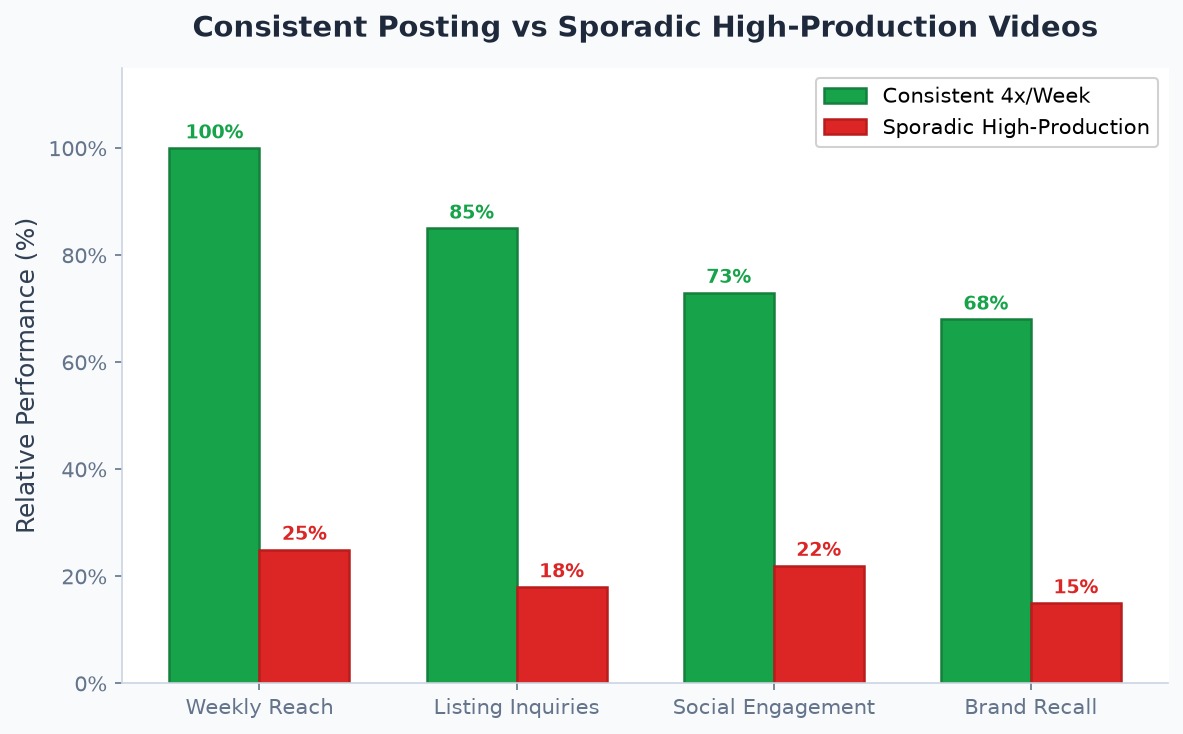
Consistent 4x/week posting generates 4x the reach of sporadic high-production videos.
One Video, Multiple Formats
The most time-efficient agents shoot once and distribute everywhere. A single listing walkthrough can become: a 60-second Reel (horizontal crop for Instagram), a 15-second TikTok teaser, a 3-minute YouTube video with intro/outro, an embedded video on your listing page, and a sound-bite clip for LinkedIn. Batch content creation like this makes the 4x/week cadence achievable without spending every evening in front of editing software. Our guide on how to create real estate videos that actually get views covers repurposing strategies in more detail.
4. Measure What Matters
Video marketing ROI isn't about vanity metrics. Here's what to track and why:
- Views and watch time — Tells you whether the content is engaging. On YouTube, videos with over 60% average watch duration get boosted in search results. If your walkthroughs lose viewers in the first 15 seconds, the opening needs work.
- Leads per video — Track how many inquiries each video generates. A video that consistently produces 3-5 inquiries per listing is outperforming most listing photos.
- Showings → offers — This is the core business metric. Listings with video walkthroughs generate 403% more inquiries than those without, according to real estate listing data aggregated across major MLS platforms. Track the conversion rate from showing to offer for listings with video vs. listings with photos only.
- Listing wins — When you pitch a seller, how often does your video marketing playbook help you win the listing? This is the most meaningful ROI metric because it ties directly to revenue.
Set up a simple spreadsheet with columns for listing address, video type, platform, views, inquiries, showings, and offers. Review it monthly. After three months, you'll know exactly which video types and platforms drive the most business for your specific market.
5. Build Your Video Production Workflow
The difference between a strategy that works and one that collects dust is the production pipeline. Without a repeatable workflow, even the best content plan falls apart after week two. Here's the five-step pipeline used by agents who sustain 4x/week posting:
- Shoot in batches. Spend one afternoon per week filming all content for the next 7-10 days. Shoot the walkthrough, the neighborhood clips, and your face-to-camera market update in a single session.
- Upload to your editing tool. Use an AI editor designed for real estate to handle trimming, color correction, and transitions automatically. VideoGuru AI video effects for property tours can add branded intros, logo overlays, and property title cards in seconds — tasks that take 30-40 minutes manually.
- Export platform-specific cuts. Export a 60-second landscape version for YouTube and a 9:16 vertical version for Instagram/TikTok. AI tools with auto-crop features do this in one click.
- Schedule. Use a social media scheduler (Meta Business Suite, Buffer, or Later) to queue posts for the week. Batch this once per week.
- Review and adapt. Every Sunday, check which videos performed best. Double down on what works and drop what doesn't.
The right tool for this workflow can cut your per-video editing time from 4 hours to under 1 hour. For a deeper look at available options, check our roundup of the best AI video editors for real estate in 2026.
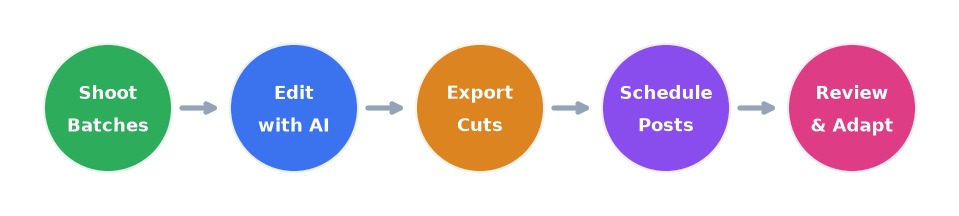
The five-step video production pipeline: shoot in batches, edit with AI, export for each platform, schedule, and review.
The Verdict
A real estate video marketing strategy doesn't have to be complicated, but it does have to be documented and consistent. The agents who dominate their markets with video are not necessarily the best on-camera talent or the most creative editors. They're the ones who follow a repeatable system: produce consistent content types, distribute across the right platforms, maintain a steady cadence, and measure what works.
Start with one video type — listing walkthroughs — and one platform — Instagram Reels. Post three times this week. Track inquiries. Next week, add YouTube. The week after, add market updates. Build the strategy one layer at a time, and within three months, you'll have a system that generates consistent leads without requiring you to become a full-time video producer.
If you want to see how AI can automate the production side of this workflow, try VideoGuru — it handles the editing so you can focus on creating content that gets results.