
Chengran (Felix) Guan
2026-09-16 · 13 min read
Commercial Real Estate Video Marketing:
A Practical 2026 Guide
Commercial real estate video marketing is the practice of using video to lease, sell, or promote a commercial property — office, retail, industrial, multifamily, or hospitality — to the people who make the decision: tenants, investors, and their brokers. It is not residential listing video with a bigger building in the frame. A homebuyer watches a walkthrough and pictures living there; a tenant or an investor watches and runs numbers — rent, terms, access, tenancy, and fit for their use. This guide covers what a commercial property video has to prove, what each production route costs in 2026, and how to produce a credible property video from photos you already have.
The answer changes with your seat at the table. If you represent a landlord, the video has to fill space — it needs to make a vacant unit legible to a tenant who cannot picture their operation inside it. If you represent an owner selling the building, the video has to support the offering memorandum: income, tenancy, and the story behind the numbers. If you are the broker building a reputation, the video is evidence that you know the submarket. One property, three different videos — and the most common commercial marketing mistake is making none of them and posting a slideshow of listing photos instead.
Key Takeaways
- Commercial video sells a deal, not a feeling. Tenants, investors, and brokers each need a different first 15 seconds, so one generic building tour serves none of them well.
- Market context belongs in the video. NAR's September 2026 commercial insights show retail vacancy holding at 4.3% while office stabilizes unevenly — a Class A story and a Class B story are not the same pitch.
- Published 2026 rate guides put a standard walkthrough at $300–$800 and a scripted brand film at $3,000–$5,000, with drone coverage adding $100–$1,500.
- The AI route changes the math: a narrated walkthrough built from listing photos you already own runs $8.94–$12.00 per video on VideoGuru's annual plans when every credit is used.
- Distribution is where most commercial videos fail. In Wistia's 2026 State of Video Report, 57% of teams said they spend more time creating videos than promoting them.
What Is Commercial Real Estate Video Marketing?
Commercial real estate video marketing is video used anywhere in the leasing or sales funnel for a non-residential property. That includes a two-minute tour of a vacant suite for a tenant rep, a five-minute building film embedded in an offering memorandum, a market update an industrial broker posts every quarter, and a 45-second vertical cut that reintroduces a listing that has been sitting for six months.
Three audiences matter, and they watch for different reasons:
- Occupiers and tenants. They are trying to picture their operation inside the space — ceiling height, loading access, parking ratio, how customers or staff arrive. They ask "can we work here?"
- Investors and buyers. They are underwriting. They ask what the rent roll supports, how long the leases run, and whether the story in the video matches the numbers in the deal room.
- Brokers, lenders, and the local market. They are judging your credibility. A well-produced property video is a calling card that keeps your name attached to the asset long after the tour.
Get those audiences straight and the format decisions get easy. A "we do commercial, too" video cut from residential templates lands nowhere, because neither the tenant nor the investor hears their own question answered.
How Commercial Video Differs From Residential
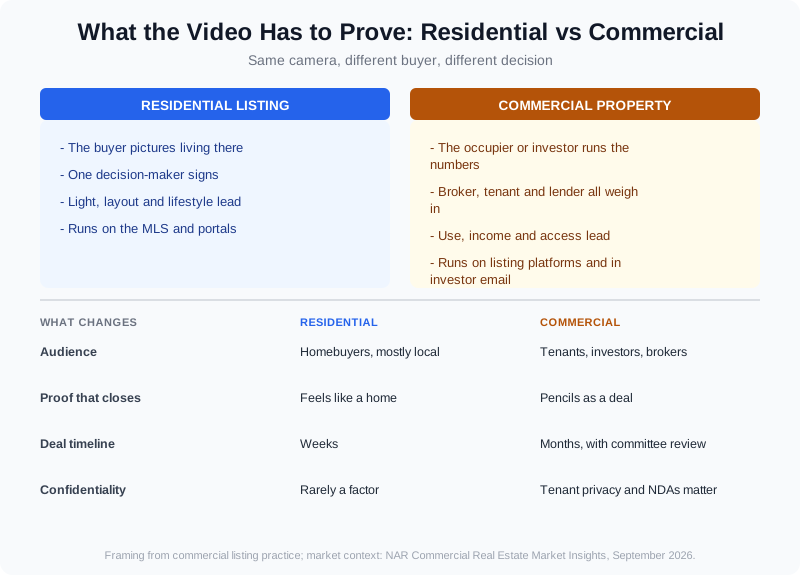
The same tools, a different burden of proof. Commercial video has to make a business case, not just a first impression.
Residential listing video is a marketing asset. Commercial property video is closer to a sales document — it sits next to the rent roll, the floor plan, and the lease abstract, and it has to survive being rewatched by a committee.
| Residential listing video | Commercial property video | |
|---|---|---|
| Primary audience | Homebuyers, mostly local and emotional | Tenants, investors, brokers — analytical and comparative |
| Decision structure | One buyer or couple signs | Committee, lender, and sometimes a board |
| What the video proves | The home feels worth the asking price | The space works for a use, or the asset works as a deal |
| Typical deal timeline | Weeks from tour to offer | Months, with multiple tours and a diligence period |
| Compliance and privacy | Rarely an issue | Tenant privacy, signage limits, and NDA-bound financials |
| Where it runs | MLS, portals, social feeds | Listing platforms, investor email, LinkedIn, the deal room |
That last row is why commercial video marketing rewards a different distribution plan, not just a different edit. The post lives on listing platforms and in a broker's own pipeline; the asset lives for months.
There is also a legal habit residential agents rarely think about: anything you show about a tenant's space or income needs to be cleared before it is public. The disclosure habits covered in our guide to MLS video requirements for 2026 apply to residential listings — the commercial version is stricter, because the financials are private.
The Five Videos Worth Making for a Commercial Property
1. The Space Tour (the workhorse)
Walk the unit the way a prospective tenant would: entry sequence first, then the floor plate, then the services — power, docks, ceiling height, HVAC zones. Keep it 90 seconds to three minutes. Narrate it with the facts a broker would say out loud on a tour, because the person watching is doing a first-pass screen before they call.
2. The Building and Location Film
This is the asset-level video: exterior, amenities, access roads, transit, the neighbours that matter. Drone coverage earns its place here — a single rising shot that places the building inside its submarket does more than twenty static frames of a parking lot. Our breakdown of drone photography for listings covers the rules and the shot discipline; commercial sites usually have more airspace freedom than residential streets.
3. The Market and Investment Update
A quarterly market video positions you as the local expert, and it recycles your own deal experience into content. NAR publishes monthly commercial market insights you can fold in — the September 2026 edition notes retail vacancy holding at 4.3%, office absorption turning positive but concentrated in Class A, and multifamily absorption outpacing deliveries for the first time in nearly five years. Those are three different client conversations from one asset.
4. The Broker or Owner Introduction
Thirty to sixty seconds, direct to camera, about the submarket you cover and the type of deal you handle. This is the video that gets watched before a listing presentation, and it is the one most commercial brokers never make.
5. The Case Study or Occupier Testimonial
A tenant explaining why they leased, or a landlord explaining how a repositioning leased up, is the strongest asset you can put in a pitch. Keep it specific: the mandate, the constraint, the outcome.
One practical note for all five: shoot or assemble once, then cut different lengths. A single property shoot should give you a full tour, a vertical teaser, and a set of still frames for the deal room. If you want the shot list discipline behind that, our walk-through video guide lays out what to capture in one pass.
What a Commercial Property Video Costs in 2026
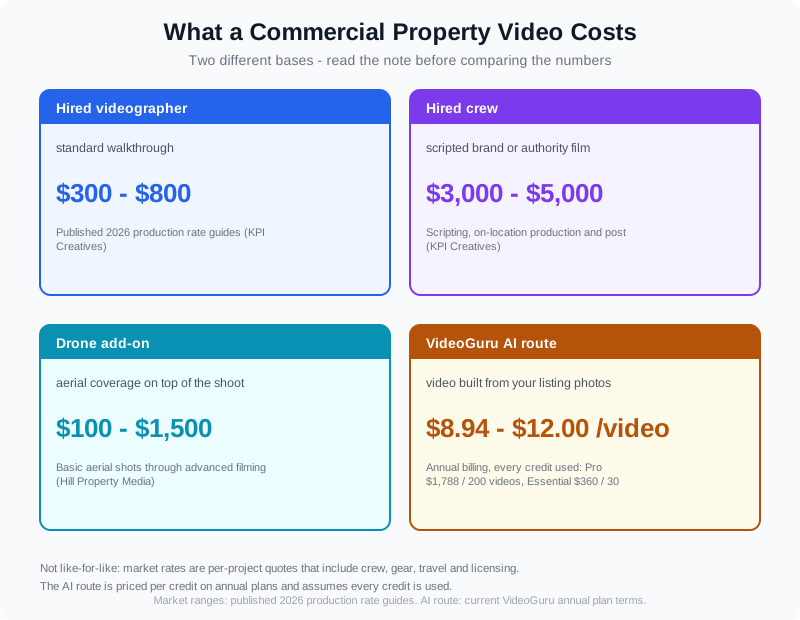
Two different pricing bases. Market rates are per-project quotes; the AI route is priced per credit on annual plans.
Published 2026 production rate guides put a standard property walkthrough at $300–$800, and a fully scripted brand or authority film at $3,000–$5,000 when you include scripting, on-location production, and post (KPI Creatives, 2026). Drone work adds $100–$1,500 depending on complexity (Hill Property Media, 2026).
Those are per-project quotes, and they include things a credit-based platform does not: crew, gear, travel, licensing, and a shoot day on the calendar. Treat any comparison as directional rather than like-for-like, and price the routes against your own volume — a team producing one commercial video a quarter and a team producing twenty a year are not solving the same problem.
| Route | Typical basis | Best fit |
|---|---|---|
| Hired videographer | $300–$800 for a standard walkthrough; $3,000–$5,000 for a scripted brand film | Flagship assets, offering-memorandum films, anything needing crew on site |
| Drone add-on | $100–$1,500 on top of a shoot | Placing a building in its submarket; large sites and land |
| Broker-shot video | Your time, a phone, and an afternoon | Fast suite tours and market updates you publish weekly |
| AI photo-to-video | $8.94–$12.00 per video on annual plans, using every credit | Volume: every listing gets a video, not just the flagship |
For a deeper look at how these routes compare once you normalize for volume, including where a human editor still earns their fee, see our commercial-aware video marketing strategy guide.
The AI Route: Build the Property Video From Photos You Already Have
Most commercial listings already have a professional photo set — exterior, interior, amenities, signage, and often drone frames from the last campaign. That set is the raw material for a narrated walkthrough you can turn around the same day.
On VideoGuru, you upload the listing photos and the platform assembles a paced walkthrough — motion on the stills, transitions, music, and a voiceover — distributed in 16:9, 1:1, or 9:16 so the same asset works on a listing platform, in an investor email, and as a vertical social cut. Each video accepts up to 20 photos, and you can mix in your own video clips — drone passes, a walk-through someone filmed on site, a real-person clip — rather than working from stills alone. Filming is optional, not required.
Two capabilities matter specifically for commercial work:
- Presenter and voice. The platform can place an AI avatar generated from an uploaded headshot, speaking in your own cloned voice, inside the property walkthrough — one integrated video, not a separate talking-head clip. It is available on any paid plan with no separate avatar subscription, which is the piece most presenter tools charge their own monthly tier for.
- Photo-side editing. The same platform handles still images: one-click virtual staging for empty suites, declutter, furniture swap, and decor changes, so the hero photographs in the deal room look finished before the video ever gets built.
The economics are what make the volume argument work. On annual billing and using every credit, VideoGuru works out to roughly $12.00 per video on Essential, $10.20 on Growth, and $8.94 on Pro — with the annual tiers including 30, 100, and 200 videos respectively, and 4K output from Growth upward. There is a free tier that covers photo-to-video with effects at 720p if you want to see the output before committing. You can check the current plan detail in the product docs and start from the VideoGuru workspace.
Where the AI route does not replace a shoot: a building with a story that needs a person walking the space, a construction progress film, or a flagship repositioning that will carry the asset for a year. Use the hired crew where the property justifies it and the AI route to make sure the other nineteen listings are not shipped as photo galleries.
Where Commercial Video Actually Gets Seen
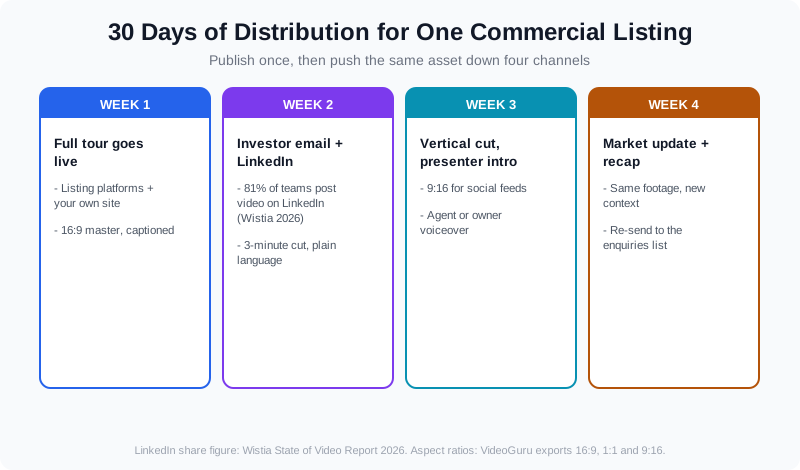
One property, four pushes. Production is a single afternoon; distribution is the part that takes discipline.
Commercial buyers and tenants do not live in one feed. In Wistia's State of Video Report 2026, 81% of teams share video on LinkedIn and 76% on YouTube, and 76% adjust the aspect ratio for wherever they post. Both habits translate directly to commercial work.
- Listing platforms and your own site. The full tour goes where the property is listed, plus a landing page you control and can measure.
- Investor and occupier email. A three-minute cut in the body of an email to your pipeline outperforms a link to a photo gallery, because the decision-maker can watch without signing in.
- LinkedIn. The vertical cut with a presenter intro — the format most commercial brokers still skip — is the one that travels outside your existing list.
- The deal room. The building film sits in the offering memorandum and the pitch deck, where it gets rewatched by everyone in the committee.
- Market updates. Reuse property footage in your quarterly submarket video, which is the cheapest distribution you have.
Then close the loop: the same platform that builds the video also produces the stills and vertical cuts you need to keep feeding each channel. If you want the measurement side of this, our video analytics guide covers which numbers are worth watching — for commercial, that means qualified tour requests, not view counts.
A 30-Day Workflow for One Commercial Listing
- Days 1–3: assemble the raw material. Pull the professional photo set, the drone frames, the floor plan, and the lease facts you are allowed to publish. Decide which of the five video types this listing needs — usually a space tour plus a building film.
- Days 4–7: build and cut. Produce the full tour, then cut the vertical teaser and the still frames for the deal room. Write the voiceover as the tour you would give in person, not as marketing copy.
- Days 8–14: publish and push. Full tour live on the listing platforms and your site, three-minute cut into the investor email, vertical teaser on LinkedIn with the presenter intro.
- Days 15–21: react and requalify. Watch which units or features drew the questions, then cut a short response video or add a text-overlaid frame that answers the most common objection.
- Days 22–30: reissue with context. If the space is still vacant, re-release the same footage with a market update attached. The footage does not expire; the context does.
How to Tell Whether It Worked
Views are a vanity metric in commercial. Track four things instead:
- Qualified tour requests — enquiries that match the use case you were marketing to, not every form fill.
- Time to first qualified tour — the gap between publishing the video and a real showing, measured per property, not per campaign.
- Deal-room engagement — whether investors who receive the offering memorandum open the film, and how far they watch.
- Cost per qualified enquiry — the number that lets you compare a $4,000 production against a $10 per-video build honestly.
Five Mistakes That Make Commercial Video Look Amateur
- Leading with the building instead of the use case. The first 15 seconds should tell a tenant or investor what the space is for, not show a drone orbit over a roof.
- No captions. A meaningful share of your audience watches on mute in an office. Every property video needs text on screen.
- Chasing a brand film when you need a tour. A cinematic asset film with no floor plate, no access shots, and no unit detail looks expensive and answers nothing.
- Uneven quality between the stills and the video. Faded photos next to crisp video reads as a distressed asset. Fix the photo set first.
- Publishing once. Commercial deal timelines run for months. One post on one platform is not a marketing plan.
Frequently Asked Questions
What is commercial real estate video marketing?
It is the use of video to lease, sell, or position a commercial property with the people who decide: tenants, investors, and their brokers. It covers space tours for vacant units, building and location films for offering memoranda, quarterly market updates, broker introduction videos, and occupier testimonials. Unlike residential listing video, its job is to support a business case — rent, terms, access, and tenancy — not just to create a first impression.
How much does a commercial real estate video cost in 2026?
Published production rate guides put a standard property walkthrough at $300–$800 and a scripted brand or authority film at $3,000–$5,000, with drone coverage adding $100–$1,500. Producing from photos you already own is a different pricing model: on VideoGuru's annual plans, using every credit, a video works out to about $8.94–$12.00 depending on tier. The right number depends on how many properties you market a year, not on the single flagship listing.
Do commercial properties still need video if the listing already has photos?
Photos prove what a space looks like; video proves how it works. A tenant needs to see the entry sequence, the walking distance between the front desk and the floor plate, and how the building sits relative to the road. That said, you do not need a film crew to get there — a video assembled from the existing photo set plus your own drone or on-site clips covers most leasing enquiries, and you can reserve a full production for the assets that justify it.
How long should a commercial property video be?
Plan for two lengths from one shoot: a 60 to 90-second teaser for email and social, and a two to four-minute full tour for the listing page, the deal room, and serious enquiries. Anything longer than four minutes should be a market update or a case study with its own structure, not a property tour.
Can AI make a commercial property video from existing photos?
Yes, and it is now the fastest route for the listings that would otherwise ship as a photo gallery. Upload the photo set and the platform assembles a paced, narrated walkthrough, and you can mix in your own drone or real-person clips. On VideoGuru the presenter and voice-cloning features sit inside any paid plan and are composited into the same property video, so a broker can appear in the walkthrough without travelling to the site.
Putting It All Together
Commercial real estate video marketing is not about bigger budgets — it is about matching the video to the decision. Decide who is watching, make the video that answers their question, price the route against your annual volume rather than one flagship asset, and push the same footage down every channel your audience actually uses.
A practical starting point: take the next commercial listing you would normally market with photos alone, build the space tour from that photo set, cut the vertical teaser, put the presenter intro on LinkedIn, and send the three-minute cut to your investor list. You will learn more from that one property than from another round of research.