
Chengran (Felix) Guan
2026-09-26 · 13 min read
Commercial Real Estate Video Production:
Costs, Process, and AI Shortcuts
Commercial real estate video production is not sold off a rate card. It is quoted per project from five inputs - shoot days, crew size, drone and specialty coverage, pre-production, and edit hours - and two quotes for the same building often differ by a factor of two or more because of those five alone. A one-day, two-person shoot with aerial coverage commonly quotes in the low four figures in most U.S. metros; a multi-day brand film with on-camera talent and licensed music runs well past that. Here is what each line in that quote buys you, what the production process actually looks like, and which of those lines you can delete by building the walkthrough from the photography and clips you already have.
Key Takeaways
- Commercial video is quote-priced, not list-priced. Five inputs set the number: shoot days, crew size, drone and specialty coverage, pre-production time, and edit hours. Move any one of them and the quote moves with it.
- Runtime is the multiplier. A residential listing tour sells a feeling in 60-90 seconds. A commercial video has to make a business case - occupancy, tenant mix, access, the investment story - which means interviews, graphics, and a longer cut to edit.
- You rarely need the whole shoot. When the property photo set already exists, a walkthrough can be assembled from it - up to 20 photos and 40 clips in a single video - so the camera budget goes only to the shots that genuinely need one.
- The AI route has a published cost. VideoGuru's free tier is 2 videos a month at 720p with a watermark. Paid plans start at $59/mo (Essential, 1080p) and reach 4K on Growth and Pro. On annual plans, using every credit, that is $12.00 per video on Essential, $10.20 on Growth, and $8.94 on Pro.
- You can appear in the video without a second shoot. An AI avatar built from a photo you upload, with your cloned voice narrating, is composited into the same property video - one integrated video, not a separate talking-head clip - and it ships on any paid plan with no separate avatar subscription.
- Three things still deserve a camera: aerial or site-context footage you already own, any spoken client testimonial, and the facade at the right hour. Everything else is assembly.
What Commercial Real Estate Video Production Actually Costs
Ask five commercial videographers for a price on the same building and you will get five different numbers, because each one is pricing a different scope. The way to read a quote is to break it into its inputs. Almost every commercial production estimate is built from the same six lines.
| Line in the quote | What it buys | What drives the number | How the line goes away |
|---|---|---|---|
| Shoot days | Crew on site, once per day | Day rate multiplied by days; weather and occupancy windows add days | Build the walkthrough from the photo set instead of booking a day |
| Crew size | Camera, lighting, audio, direction | Every additional head is a day rate plus kit rental | Single-operator coverage for static rooms; photo-to-video handles interiors |
| Drone / specialty | Aerial context, site and neighborhood | A certified pilot is usually a separate vendor and a separate day | Mix existing drone footage into the same video rather than commissioning a new flight |
| Pre-production | Script, shot list, scheduling, permits | Hours spent before anyone books a day; the least visible line on the invoice | A shot list derived from the floor plan and the existing photo set |
| Edit / post | Assembly, graphics, color, sound | Usually the largest line, and the one that scales with runtime | Automated assembly, then one pass of AI effects and captions |
| Licensing | Music, talent, releases, legal | Per track and per person, plus review time | Platform music library and the owner's own cloned voice |
Put those together and you have a model you can run on your own market: (shoot days x local day rate) + crew adjustment + drone + (edit hours x local hourly rate) + licensing. Substitute your own rates and your own crew assumptions - the point is not the total, it is that every line in that formula is a line someone can delete. The rest of this article is about which ones to delete and which ones to keep. Note also who has to be convinced: investors and lenders underwrite in metrics such as cap rate and debt-service coverage, and the reference material that audience studies - CCIM Institute, for example - is a good guide to what the finished video has to state out loud.
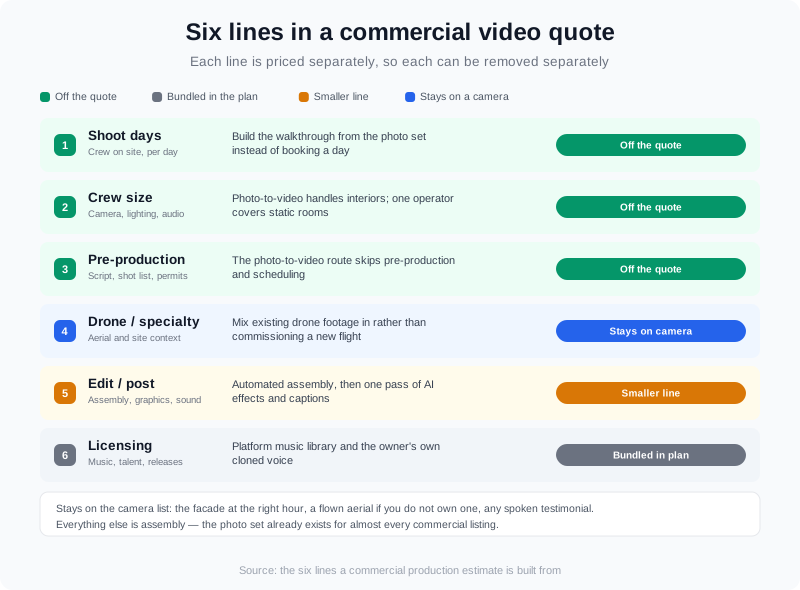
Fig 1 - A commercial production quote is six lines, not one price. Three of them disappear when the walkthrough is assembled from photos and existing clips.
For the residential side of the same math - what a listing video really costs once you count editing hours, not just the shoot - our breakdown of real estate video production costs in 2026 runs the numbers line by line. Commercial work is the same stack with a longer runtime and more people attached to it.
Why a Commercial Property Video Costs More Than a Listing Tour
The gap between a $40,000 listing and a 40,000 square foot retail center is not the camera. It is the burden of proof. Three things change the production and therefore the price.
The video has to argue, not merely impress
A residential tour is a feeling: light, space, flow. It can be sold in 90 silent seconds. A commercial video is a pitch to a tenant, an investor, or a lender, and each of those audiences wants different evidence - access and parking for the tenant, tenant mix and lease roll for the investor, condition and capital plan for the lender. That usually means graphics for the numbers, drone for the site context, and a voiceover that states the case rather than just describing the rooms.
Context matters here too. Commercial practitioners track a different set of conditions than residential agents - occupancy, lease roll, cap rates, leasing velocity - and the National Association of Realtors maintains a separate commercial research stream for exactly that reason: see NAR's commercial insights. If the video is going to argue a case, it should argue it in the terms that audience already reads.
Runtime compounds every line of the quote
Every extra minute of finished runtime is more footage to capture, more to review, more to color, and more rounds of client notes. This is why the edit is normally the largest single line on a commercial invoice, and why a three-minute cut can cost several times a 90-second one even though both were filmed on the same day.
Access, scheduling, and releases are harder
You cannot film a leased retail unit at 2 p.m. on a Tuesday without coordinating with the tenant. Vacant office space often means coordination with a property manager, a construction schedule, or a security escort. Any person recognizable in the final cut needs a release. None of that is creative work, and all of it is billable time. On the residential side the same problem exists in miniature, which is why even simple shoots stall - our guide to getting listings faster covers what aerial footage and shoot logistics add to a listing package.
What the Production Process Actually Looks Like
1. Pre-production: the shot list is the budget
The cheapest thing you can do on a commercial shoot is over-plan it. A shot list built from the floor plan and the existing photo set tells the crew which rooms matter, which elevations sell the building, and what time of day each exterior needs. It also gives the editor a spine. When a shoot arrives without a shot list, the crew films everything and the editor sorts it out later - and both of those hours are on the invoice.
2. The shoot day: sequence by light, not by script
A practical commercial day runs exteriors first at the hour they look best, then interiors, then anything that needs people in frame. Rooms are usually shot clean, and moving shots are kept short so they can be cut against each other. Communicating that discipline to whoever is on camera is a skill in itself - the technique below is the one worth copying before your next tour.
Filming a property walk cleanly - staying out of your own shot is the difference between footage an editor can cut together and footage nobody can use.
3. Post-production: assembly, graphics, sound
Post is where the business case gets built. The editor assembles the sequence, adds the graphics that carry the numbers, balances the sound, and grades the color. This stage also absorbs client revisions, which is why the scope of revisions should be agreed in writing before the first cut - a phrase like the guide to what a real estate video editor actually does puts it, the editor's job is to make one story out of a hard drive of footage, and every rewrite of the story re-opens the assembly.
One production tip that carries straight over to the AI route: shoot or select vertical and horizontal coverage deliberately. Commercial buyers will watch on a laptop, but a leasing agent will repost on a phone. Deciding that at the start costs nothing. Deciding it after delivery costs a re-edit.
Which Parts of the Shoot AI Can Delete, and Which It Cannot
This is the part that changes the budget conversation. When the property already has a photo set - and a commercial listing almost always does, because the stills were shot for the flyer and the listing platform - the video does not have to start with a camera crew. Photo-to-video in VideoGuru assembles a finished walkthrough from the images you already own, and it is not limited to stills: you can add your own video clips - a drone pass over the site, a walk-and-talk in the lobby - and they are mixed into the same property video rather than cut separately.
The same workspace carries the commercial details that normally need a graphics vendor. A single video holds up to 20 photos and 40 clips, and the effects library covers the shots commercial clients ask for by name: virtual twilight for the facade, virtual staging and declutter for vacant suites, restyle when a space needs to read to a different tenant type, and camera motion to give static frames movement. Output is available in 16:9 for the listing site and pitch deck, 9:16 for social, and 1:1 for the feed - three deliverables from one build.
Two capabilities decide whether a commercial video needs a presenter on site. First, the owner or broker can be in the video without a second shoot: an AI avatar generated from an uploaded photo, narrating with a cloned version of the speaker's own voice, is composited into the property video itself. Second, brand kits lock the logo, colors, intro and outro cards so a broker's whole portfolio comes out consistent. Both are on any paid plan, and there is no separate avatar subscription to buy. If you want to see how fast the build itself is, the 10-minute listing video walkthrough walks through it end to end, and the product docs cover editing, export, and credits.
| VideoGuru plan | Price | Videos per cycle | Max resolution | Effective cost per video (annual) |
|---|---|---|---|---|
| Free | $0 | 2 / month (up to 15 seconds, watermarked) | 720p | - |
| Essential | $59/mo, or $30/mo billed annually | ~3 / month (30 / year annually) | 1080p | $12.00 |
| Growth | $129/mo, or $85/mo billed annually | ~10 / month (100 / year annually) | 4K | $10.20 |
| Pro | $249/mo, or $149/mo billed annually | 25 / month (200 / year annually) | 4K | $8.94 |
Set that against the quote model above. A single shoot day consumes the annual cost of a Pro plan several times over. The honest reading is not that AI replaces commercial production - it does not replace a tenant testimonial or a properly flown aerial sequence - it is that AI removes the interior walkthrough and the still-frame styling from the quote, and those are the lines that were buying coverage rather than evidence.
Crew, Solo Shoot, or AI: Matching the Route to the Job
The right answer depends on what the video has to prove, not on what the last vendor sold you. Three routes cover most commercial work.
| Route | Cost basis | First cut | Best for | What to watch |
|---|---|---|---|---|
| Full crew | Per project: days, crew, drone, edit | Weeks | Brand films, investor decks, talking-head client stories | Revisions and licensing are where the quote grows |
| Single operator | One day rate plus edit hours | Days | Small buildings, leasing suites, quick-turn listing updates | Moving shots need discipline; no second angle coverage |
| AI photo-to-video | Per video / per plan credit | Minutes to an hour | Interior walkthroughs from an existing photo set, portfolio volume, social cuts | Still needs any footage only a camera can make - and a human check before it ships |
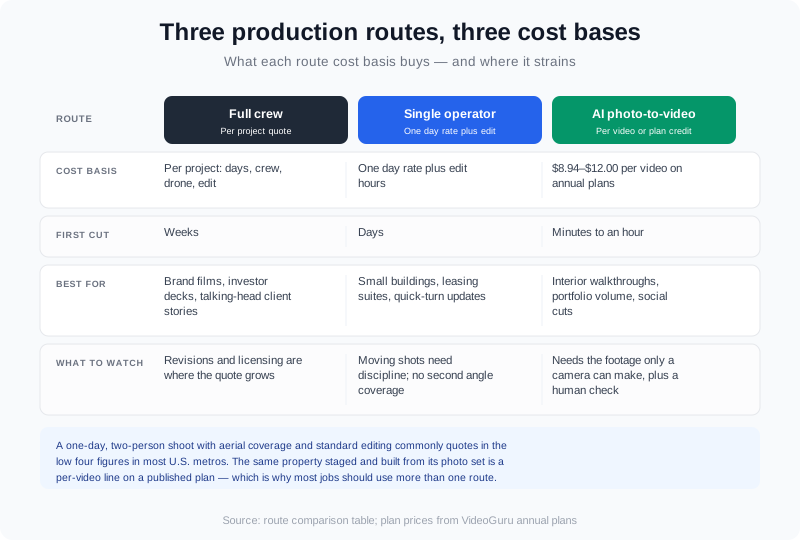
Fig 2 - Three routes, three cost bases. Most commercial jobs are best served by more than one of them, not by choosing a side.
In practice, the strongest commercial package is a hybrid: shoot the facade, the aerial, and one interview; assemble the interiors from the photo set; then reuse the whole thing across 16:9, 9:16, and 1:1. That is the version that gets a property in front of tenants and investors repeatedly instead of once. It is also the version most brokers never order, because the two halves sit with different vendors. Our guide to commercial real estate video marketing covers what to do with the finished asset once it exists - which channels actually reach a commercial audience, and how to keep the campaign running after launch week.
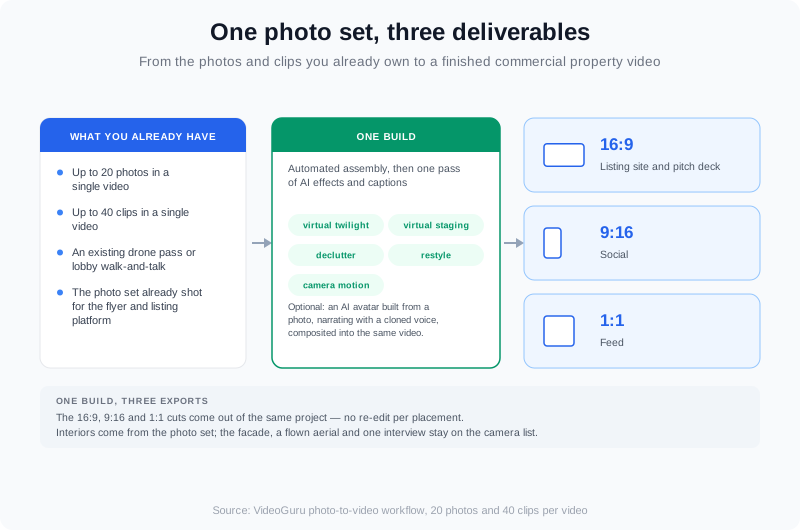
Fig 3 - One photo set, three deliverables: the walkthrough is assembled once, then exported for the listing site, the pitch deck, and social.
Frequently Asked Questions
How much does a commercial real estate video cost?
It depends entirely on scope, which is why you should ask for the quote broken into lines rather than a single number. A single-day, two-person shoot with aerial coverage and standard editing typically quotes in the low four figures in most U.S. metros; a multi-day brand or investor film with talent, licensed music, and motion graphics runs well beyond that. If the property already has a photo set, assembling the interior walkthrough from those images instead of filming it removes the largest multi-day line from the estimate - on VideoGuru that route costs $8.94 to $12.00 per video on the annual paid plans.
How long does commercial video production take?
Plan on roughly two to four weeks from approval to final delivery for a crewed shoot: about a week of pre-production and scheduling, one to three shoot days, and five to ten business days of editing with one or two rounds of revisions. The edit is usually the long pole, and revisions are what extend it. A photo-to-video walkthrough skips pre-production, scheduling, and the shoot entirely - the build takes minutes, and the only real wait is review.
Do you need permits or releases to film a commercial property?
You need permission from whoever controls the property - owner, property manager, or tenant - and a signed release from any identifiable person who appears in the final cut. Drone work adds a certified remote pilot and any local restrictions over the site, and some municipalities require notice for commercial filming. Get all of it in writing before the shoot day, because a reshoot caused by a missing release is the most expensive kind of second visit.
Can AI make a commercial real estate video without a shoot?
For the interior walkthrough, yes - a finished video is assembled from the photos and clips you already have, and an AI avatar with the speaker's cloned voice can be composited into that same video so a broker presents it on screen. What it does not replace is footage only a camera can produce: a flown aerial sequence, a genuine tenant or client testimonial, or the facade at the right hour. Mix those in when you have them, skip them when you do not.
What should a commercial property video actually include?
Enough for the audience to make a decision. For a tenant: access, parking, layout, ceiling height, condition, and neighboring tenants. For an investor: the site in context, the tenant mix, and the numbers as on-screen graphics. For everyone: the facade at the right hour. Anything that does not serve one of those three jobs is runtime you are paying to shoot, edit, and store.
If the client is a developer or a leasing team, the same rule applies one level up. The industry body those teams turn to for market research is NAIOP - read a page of it and you will see the vocabulary a commercial video should be echoing back to its audience: absorption, occupancy, tenant demand. A property video that speaks that language stops being a nice-looking file and becomes a usable asset in the campaign.
Final Thoughts
Commercial video production is priced like custom work because it is custom work - and the fastest way to control the cost is to stop treating it as a single purchase. Break the quote into its six lines, decide which of them buy evidence and which of them merely buy coverage, and the budget conversation gets much shorter. Facade, aerial, and one interview stay on the camera list. Interiors, styling, and the three social crops come out of the photo set you already paid for.
That is the shift worth making this quarter: the stills are no longer the end of the deliverable, they are the first input to it. You can build your first commercial walkthrough here - upload a property's existing photos, add a drone pass if you have one, and see what the finished piece looks like before you decide whether the shoot day is worth booking.