

Chengran (Felix) Guan
2026-10-09 · 10 min read
Facebook Video for Real Estate:
The 2026 Playbook
Yes — Facebook video still works for real estate in 2026, but not the way it worked in 2020. Agents who pull leads from Facebook now run a steady rhythm of short vertical videos, keep a smaller number of longer walkthroughs for the feed, and end every clip with one clear next step. Facebook rewards watch time and shares, and a neighbourly listing video is exactly the kind of thing local buyers share. This playbook covers what to post, how often, which format fits which goal, and how to produce the videos from the listing photos you already own — without booking a shoot.
Three kinds of readers get value here. The solo agent needs a posting habit that survives a busy week. The team lead wants one format template every agent on the roster can follow. The photographer or media company wants to add Facebook deliverables to a package they already sell. The formats are the same for all three; where the build differs, this guide says so.
Key Takeaways
- Video is still the highest-reach format for a local business on Facebook. Reels reach people who do not follow you yet; longer feed video deepens trust with the audience you already have.
- Three formats cover almost everything. A short vertical Reel, a one-to-three-minute walkthrough or market update for the feed, and a live or Story clip for open houses.
- A realistic cadence is three to five short videos a week plus one longer video. That is enough to stay visible without a production team.
- You can make the videos from the listing photos you already have. An AI photo-to-video platform assembles a narrated walkthrough in about ten minutes, and you can mix in drone or real-person clips you have shot.
- Put one call to action in every video, and disclose any AI-generated imagery. A comment prompt, a DM request, or an open-house invite converts far better than a silent clip.
Does Facebook Video Still Work for Real Estate?
Facebook is no longer just a place people go to see friends — it is a discovery feed too, and video is what it pushes hardest. For a real estate agent the arithmetic is simple. A listing video can reach people who do not follow you yet, and the people who do follow you are your warmest local audience. Cold discovery and warm reach sitting in the same feed is why agents keep coming back to it.
What changed since 2020 is the format, not the value. Long landscape videos still have a role, but the reach now lives in vertical, captioned, short video. Meta’s own small-business resources lean on short-form video and Reels for reaching new audiences, and NAR’s Profile of Home Buyers and Sellers has charted for years that buyers start their search online — which is exactly where a listing video does its first work. One caveat worth stating plainly: organic reach is smaller than it once was, so treat Facebook video as a habit that compounds, not a faucet you turn on for a single listing.
The 6 Types of Facebook Video Every Agent Should Post
1. The listing Reel (9:16, 15–30 seconds)
This is your workhorse. One property, six to ten quick cuts, a text hook in the first two seconds, and a call to action at the end. Vertical, captioned, and short enough to finish on a phone. Reels are the format Facebook pushes to people outside your follower list, so it is the one that can actually grow your reach.
2. The walkthrough (1–3 minutes, feed video)
A slower, narrated tour of one listing or one neighbourhood. This is where a buyer decides you know the market. It performs best in the feed, where people expect a little more substance, and it doubles as the video you embed on the listing page and send by email.
3. The market update
Days on market, inventory, a rate move, a neighbourhood note. Short, data-led, and specific to your area. These build authority between listings and give you something to post when you have nothing new to show.
4. The open-house clip
Thirty seconds from the doorway: the best room, the light, the street, and the date and time. Post it the morning of the open house and again as a Story that afternoon. It is the lowest-effort clip you can make and the easiest to turn into a reminder.
5. The client hand-off or testimonial
A buyer at the walk-through, a seller at the closing table, a short thank-you from a client. Real people saying real things outperforms every polished stock clip. Get a two-line release and keep it under twenty seconds.
6. The agent intro (your face, your voice)
The one video that makes every other video land harder. A fifteen-second introduction — who you are, the area you cover, one reason to call — is the piece new followers watch first. Clip it as a Reel, pin it, and reuse the same card everywhere.
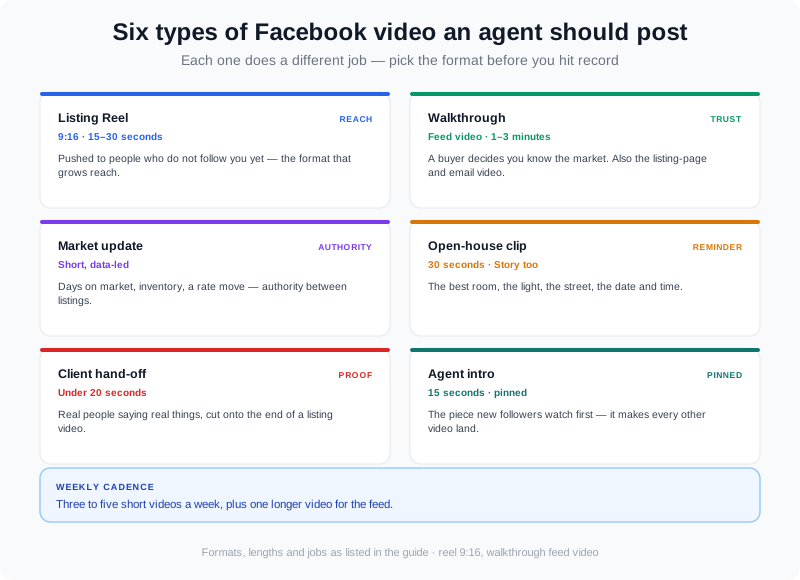
Six formats cover a full month: a listing Reel, a walkthrough, a market update, an open-house clip, a client hand-off, and one agent intro you pin to your page.
Facebook Reels vs. Feed Video vs. Live: What to Post Where
The same listing generates three different clips, and each one belongs in a different slot. Choosing the format before you hit record stops you from making one big video and hoping it works everywhere.
| Format | Best for | Length | Where it shows |
|---|---|---|---|
| Reels (9:16) | Reach & discovery of new buyers | 15–30 seconds | Reels tab, feed, and non-follower discovery |
| Feed video (1:1 or 16:9) | Trust, walkthroughs, market updates | 1–3 minutes | Followers’ feeds and your page |
| Stories | Open houses, quick reminders | Under 15 seconds | Top of the app, 24 hours |
| Live | Open houses, Q&A, market news | 10–20 minutes | Follower notifications, replay saved |
How to Make Facebook Videos Without a Full Production
The formats above do not need a videographer, and they do not need a second shoot. The fastest route starts with the photographs you already commission for every listing. A photo-to-video platform analyses those images, orders the rooms into a logical walk, adds motion and captions, and renders a finished walkthrough — the same workflow described in producing a listing video in ten minutes. From one project you export 16:9 for the listing page, 1:1 for the feed, and 9:16 for the Reel, so a single listing covers three of the six formats above.
This is what VideoGuru is built to do. It turns listing photos into a walkthrough, applies the one-click effects that carry the rest of your content — virtual staging for empty rooms, twilight, declutter, and restyle — and exports all three aspect ratios without a second edit. You can read the mechanics in how photo-to-video AI works.
Two details matter when you plan a Facebook video habit. First, the photo-to-video route is not photos-only: you can drop in your own drone shots or real-person clips and they are mixed into the same walkthrough, so a listing with aerial footage does not need a separate edit. Second, on any paid plan — not the free tier — you can composite your own face and a clone of your voice into that video, which is how the agent-intro format above becomes a regular post instead of a one-off. There is no separate avatar subscription bolted on top.
How a listing photo set becomes a captioned vertical video you can post to Facebook as a Reel.
| Plan | Price | Videos / cycle | Max resolution |
|---|---|---|---|
| Free | $0 | 2 / month | 720p, up to 15s (watermark) |
| Essential | $59/mo | ~3 / month | 1080p |
| Growth | $129/mo | ~10 / month | 4K |
| Pro | $249/mo | 25 / month | 4K |
On the annual plans, using every credit works out to roughly $12.00 per video on Essential, $10.20 on Growth, and $8.94 on Pro. Each video takes up to 20 photos and 40 clips, which comfortably covers a full listing plus any drone or real-person footage you want mixed in. Brand Kits hold your logo, colours, fonts, intro and outro cards so every Facebook post looks like it came from the same agent, and Video Studio lets you swap clips, text, and branding without opening the editor — useful when a listing price changes after you have already posted.
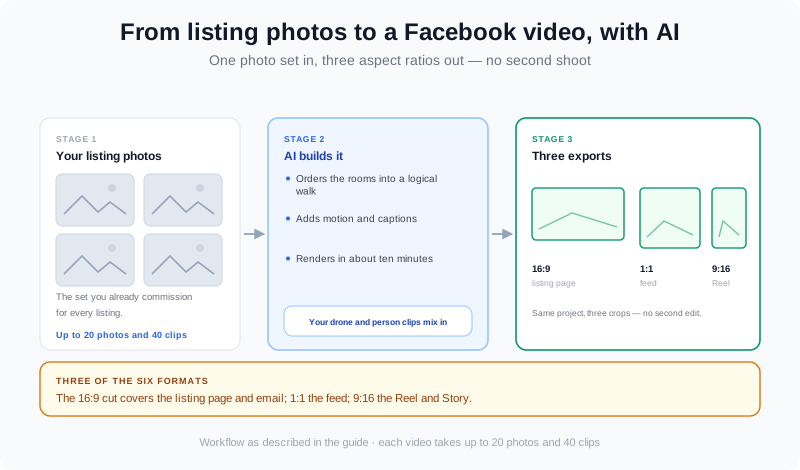
One listing photo set becomes a 16:9 walkthrough, a 1:1 feed clip, and a 9:16 Reel — three posts from one project instead of three shoots.
A Simple Weekly Facebook Video Cadence
Consistency beats volume. A habit you can keep through a busy closing week will outperform a burst of ten videos followed by a silent month. Here is a weekly rhythm that a single agent can sustain with one listing and one morning of production:
- Monday: a market update or a neighbourhood note, filmed or narrated on your phone.
- Wednesday: the listing Reel for the week’s featured property.
- Friday: the longer walkthrough for the feed, and the open-house clip as a Story if you have one.
- Any day with news: a quick Live for an open house or a Q&A, saved to your page as a replay.
- Once a month: a client hand-off or testimonial, and refresh your pinned agent intro.
If you produce the walkthrough from listing photos, that whole week is roughly one sitting: pick the listing, generate the walkthrough, cut the Reel from the first fifteen seconds, and write two lines of market commentary. Agents who batch a month at a time — the workflow behind a photo and video content calendar — spend a single afternoon and then post on autopilot. NAR’s Realtor Technology Survey has tracked how quickly agents fold tools like these into their marketing, which is why the production side of this habit gets cheaper every year.
How Facebook Video Turns into Real Estate Leads
Reach is not the goal; a conversation is. Facebook video turns into leads when the video gives the viewer an obvious, low-friction next step and when it is aimed at people who are actually in the market. Four moves do most of the work:
- Ask for a named action, not "reach out." "Comment ‘TOUR’ and I will send the full video" gets more replies than a silent clip with a phone number in the caption.
- Retarget the people who watch. A short vertical video is the cheapest creative you can put behind a local Facebook ad, and it is easy to show it again to anyone who watched more than a few seconds.
- Post where your farm area lives. Neighbourhood groups, your page, and your Reels all feed the same pipeline; a listing in a specific subdivision belongs in that subdivision’s group as well.
- Answer the questions under the video. A single thoughtful reply to a public comment often turns into a DM, and the comment thread itself becomes social proof for the next viewer.
Keep the funnel honest. A listing Reel is top-of-funnel reach; a walkthrough and a market update build the trust that makes someone message you; the agent intro is what they watch before they do. Track which videos produce saves and shares rather than only likes — the same signals covered in measuring video ROI apply here, just inside Facebook rather than on your website.
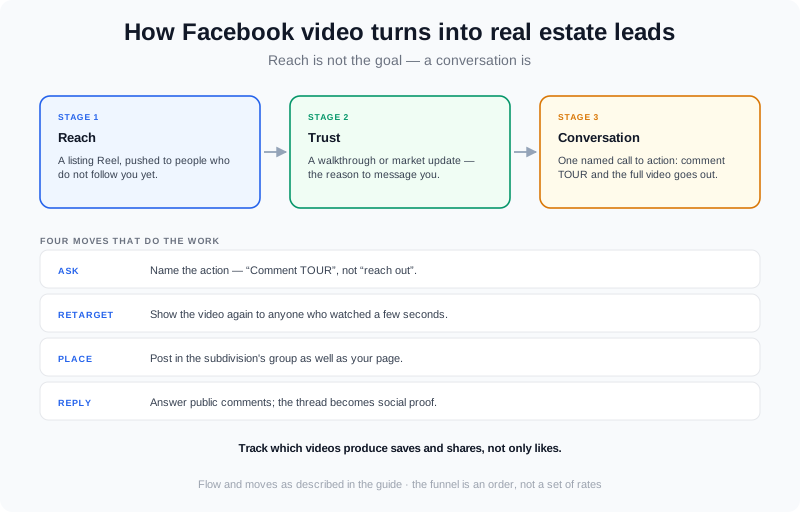
A Reel earns the reach, the walkthrough earns the trust, and one clear call to action turns a viewer into a conversation.
People Also Ask
How often should a real estate agent post video on Facebook?
Three to five short videos a week plus one longer video is a realistic, sustainable cadence for a single agent. The exact number matters less than the rhythm: the algorithm rewards accounts that post consistently, and your followers reward you for being visible every week rather than in one burst. If you can only manage two posts a week, make them a Reel and a market update rather than skipping the week entirely.
Do Facebook videos still get reach for real estate in 2026?
Yes, but the reach has shifted. Vertical short video — Reels — is the format Facebook pushes to people who do not follow you, while longer feed video mostly reaches the audience you already have. The practical takeaway is to treat Reels as your discovery format and walkthroughs as your trust format, and not to expect a single organic landscape video to reach strangers the way it might have a few years ago.
What should a real estate agent post on Facebook?
Six formats cover most of it: a listing Reel, a walkthrough of one property or neighbourhood, a market update, an open-house clip, a client hand-off or testimonial, and a pinned agent intro. Rotate them so your feed is not six listings in a row. If you want more specific hooks, see real estate video ideas for social media and unique marketing ideas.
Can you make Facebook real estate videos without filming?
Yes. Listing photos can become a narrated walkthrough through AI photo-to-video in about ten minutes, and you can mix in any drone or real-person clips you have shot so the result is not photos-only. Filming is optional, not required: the photograph set you already commission is enough to produce a Reel, a feed walkthrough, and a Story clip for every listing.
How long should a real estate Facebook video be?
Match the length to the format. Reels perform best at 15–30 seconds, feed walkthroughs and market updates hold attention for one to three minutes, Story clips should stay under about 15 seconds, and a Live for an open house or Q&A can run 10–20 minutes. The common thread is the first three seconds: if the opening hook does not tell the viewer why to keep watching, the total length will not save the video.
The Bigger Picture
Facebook is not the future of real estate video on its own — it is one channel in a set. The agents who win at it treat video as a production habit tied to every listing, then cut the same footage for Reels, Shorts, and TikTok rather than treating each platform as a separate project. That reuse is what makes a daily or near-daily video presence affordable; the platform guide for Instagram, TikTok, and YouTube Shorts and the reels playbook cover the sibling channels, and the formats barely change between them.
If you already shoot or commission a listing video, you already have the raw material — the work is in cutting it into a vertical Reel and a feed walkthrough and posting them on a rhythm. If you do not, the photo-to-video route means the listing photo set you are already paying for can carry the whole Facebook calendar. Create a free VideoGuru account to assemble your first walkthrough from listing photos, and upgrade to any paid plan when you want your own face and voice inside it. The product docs walk through creating a video in ten minutes end to end.