
Chengran (Felix) Guan
2026-08-16 · 12 min read
Scaling from Solo to Team:
How a Photographer Built a Media Business
The path from solo shooter to real estate media company is a systems problem, not a talent problem. Northern Spruce Media, an Ontario studio founded by Alex Coombs in 2016, grew from a one-person operation earning $30,000 a year to a million-dollar firm with a 20-person team and more than 600 real estate clients. Growth on that scale did not come from shooting more hours. It came from documenting every process, training every shooter to one standard, and using AI to automate the editing bottleneck.
This case study is for photographers and videographers who want to grow from solo operation to team without trading quality for volume. You will see exactly how one studio made the leap, which lessons are backed by 2026 industry data, and where AI tools remove the ceiling that usually stops a one-person business at its first hire.
Key Takeaways
- Systems before headcount. The most common scaling mistake is hiring before your workflow is documented — adding a second shooter multiplies chaos, not revenue.
- AI removes the editing ceiling. 71% of real estate photographers now use AI tools, and some report editing up to 90% faster ("Framing What's Next", iGUIDE 2026).
- Deliverables multiplied means revenue multiplied. Agents now expect HDR stills, drone aerials, floor plans, video walkthroughs, and short-form reels — so the average order value per listing is climbing (Fstoppers, 2026).
- Video is the biggest untapped line item. Listings with video get 403% more inquiries, yet only 9% of agents create listing videos (iGUIDE 2026).
- The benchmark is real. Northern Spruce Media went from $30,000 in annual revenue to over $1 million with a 20-person team — the playbook is documented and repeatable.
The Solo Ceiling: Why One Shooter Can't Keep Up
The market changed faster than most solo businesses did. According to iGUIDE's 2026 real estate photography industry report, 74% of buyers start their search online, and 86% rely on listing photos when deciding what to view. Professional photos drive 61% more views and sell homes 50% faster. Meanwhile, NAR's Profile of Home Buyers and Sellers has ranked listing photos as the single most valuable element of an online listing for years running — the baseline is now visual.
At the same time, what agents buy has expanded. Fstoppers' 2026 analysis of growing photography niches describes real estate as having "evolved from a simple 'shoot the house' proposition into a full-service visual media operation" — agents expect HDR stills, drone aerials, floor plans, video walkthroughs, and increasingly short-form social media reels. The deliverables per shoot have multiplied, and so has the average order value per listing.
Here is the solo math problem: one shooter has a hard capacity of a handful of full shoots per week, and editing each one eats the same evening hours. If a listing that used to need 20 edited photos now needs 20 photos plus a walkthrough video plus three reels, the solo operator does not earn more — they just work later. The ceiling is not demand. It is production capacity.
The Case Study: Northern Spruce Media's $30,000 to $1M+ Run
Northern Spruce Media is an Ontario-based creative studio serving 600+ real estate clients with full-service photo, video, design, and storytelling. Founder Alex Coombs started it in 2016 as a one-woman operation. By 2026 the firm had grown past $1 million in annual revenue with a 20-person team, and it appears as a featured scaling story in iGUIDE's "Framing What's Next" industry report.
The report's summary of the studio is blunt: "Growth isn't magic." What made the jump work, according to the report's analysis, was three behaviors repeated consistently — documenting the process, training consistently, and making the client experience easy from start to finish. The same three lessons show up across the other studio owners featured in the report. Cheyenne Crawford of Infinite Views went from late-night edits to leading one of the top real estate media teams in the South, and her own line from the report could be the industry motto: "ambition scales best when paired with structure."
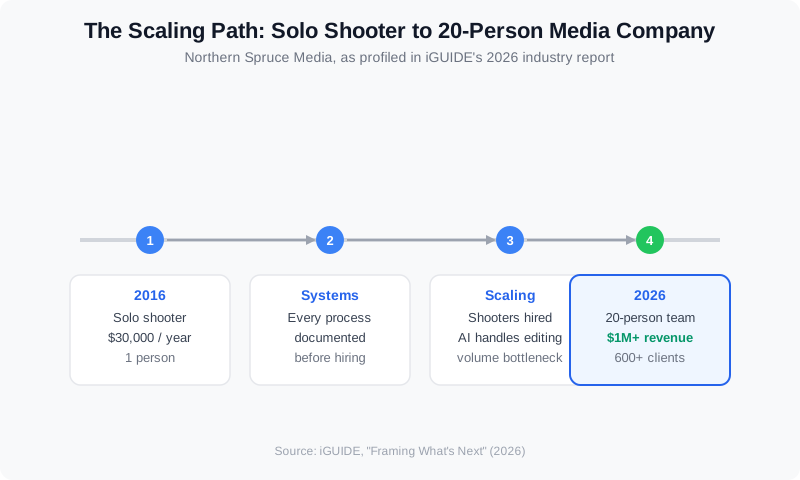
The documented scaling path: solo shooter to 20-person media company, as profiled in iGUIDE's 2026 industry report.
Watch this interview from the same report for the creators' own words on what separates studios that scale from studios that stall:
Real estate photography leaders on the systems behind successful studios (iGUIDE, 2025).
Lesson 1: Document Your Process Before You Hire
The single biggest mistake photographers make when scaling is hiring someone before their own workflow is clean. If booking happens by text message, delivery is a Dropbox link, and invoicing happens "whenever I remember," adding a second shooter does not double capacity — it doubles the chaos. This is the first principle in every scaling playbook, from Rampfox's solo-to-team guide to the studios profiled by iGUIDE.
Before you post a job ad, write down how work actually happens in your business:
- Shoot checklist: the exact exterior angles, interior room order, and must-have shots you capture on every listing.
- Editing standard: your HDR merge settings, color temperature, sky replacement rules, and the export recipe clients see.
- Delivery system: folder structure, naming conventions, gallery link, and turnaround promise.
- Client communication templates: booking confirmation, pre-shoot reminder, delivery note, follow-up.
When the process is documented, hiring becomes training instead of hoping. Your first hire's job is to reproduce your standard on a shoot you are not on. That is impossible if the standard only exists in your head. The same documentation logic applies to video: if your walkthrough workflow is locked down, handing it to a second shooter is a one-week onboarding, not a three-month gamble. See how one photographer scaled from 5 to 50 videos per week in How a Real Estate Photographer Went from 5 Videos to 50 Videos Per Week.
Lesson 2: Train Every Shooter to One Standard
Agents re-hire studios, not shooters. If listing photos look different depending on who was behind the camera, the client sees inconsistency as risk. That is why every scaled studio in the iGUIDE report treats a style guide as a core business asset. Color matching across a listing set — and across shooters — is the quality bar that separates a media company from a collection of freelancers.
A practical training loop: the first five shoots from every new shooter get reviewed shot-by-shot against the standard, with corrections logged back into the checklist. After that, reviews are spot checks. This is where AI-assisted editing earns its keep in a team model — automated color correction and enhancement applied from one preset keeps output consistent while humans focus on composition and client relations.
Lesson 3: Make the Client Experience Effortless
The iGUIDE report notes that 73% of consumers value the overall experience as much as the product itself. In real estate media, that means booking in two clicks, delivery on time every time, and proactive communication when a shoot runs late. "Reliability, communication and a clean process now separate the great from the good," the report concludes. The studios that scaled all built the client experience into their systems — it is what lets a 20-person company keep 600+ clients happy without the founder on every shoot.
Where AI Fits in the Team Model
Editing is the bottleneck that caps solo capacity, and it is the first place AI changes the team math. According to the iGUIDE report, 71% of real estate photographers now use AI tools, with some reporting editing up to 90% faster. When a team of shooters produces five times the footage and stills of a solo operator, editing cannot scale linearly with headcount — it has to be automated at the pipeline level.
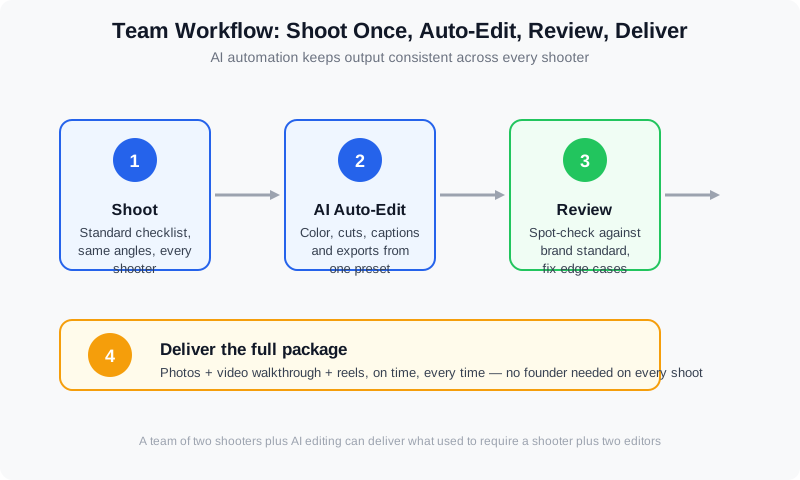
The team workflow: shoot once, auto-edit with AI, review for brand consistency, deliver.
This is exactly the gap an AI real estate media platform fills. VideoGuru's platform automates the editing pipeline end to end — turning raw walkthrough footage into finished listing videos, and handling the repetitive cuts, captions, and exports that used to consume a full editing day. Beyond video, VideoGuru's photo editing tools give you one-click virtual staging, declutter, furniture swap, and decor changes for still images too — the same AI that powers your video walkthroughs handles your listing photography. A team of two shooters plus AI editing can deliver what used to require a shooter plus two editors, which is why the automation-versus-headcount decision is central to the White Label Real Estate Video Editing: Outsource or Automate? question. For a deeper look at bulk production, see how one media company automated 200 videos per month.
How to Promote a Real Estate Business: What Agents Actually Buy
When an agent asks how to market a real estate business, the 2026 answer is visual media first. Buyers start their search online, so a listing gets promoted through professional photos, a video walkthrough, and short-form reels that stop the scroll — not a bigger open-house sign. That is the quiet shift in the solo-to-team story: your product stops being a shoot and becomes the toolset an agent uses to promote a real estate business across the MLS, Instagram, YouTube, and email. Once you see that, you stop pricing 25 photos and start selling the agent's marketing.
Reels are the fastest-growing piece of that toolset. Real estate business reels — 15 to 30 second vertical clips of a home's best rooms, the neighborhood, or a quick market stat — appear in nearly every listing pitch now, because listings with video draw 403% more inquiries while only 9% of agents create listing video. Each reel is cheap once the footage exists: the walkthrough you already shot can be cut into three or four reels with different hooks. That is why "how do I market my real estate business" increasingly has one answer for agents — hire a studio that ships reels with every listing. See our real estate video ideas for social media for the formats that perform.
For your studio, this reframes the sales conversation. Price a listing-launch package that helps the agent promote a real estate business — HDR stills for the MLS, a walkthrough for YouTube, and a bundle of reels for social — instead of pricing stills alone. Agents buy it because it maps directly to their own goal of putting the listing in front of more buyers, and you earn more per shoot because every deliverable rides on a shoot day you already paid for. See our real estate video marketing ideas for agents and our guide to building a real estate brand with video content to round out the offer.
The Revenue Model: What Actually Changes
Scaling does not mean doing the same work for more clients. It means increasing revenue per shoot by selling the full package — and the industry data says that is exactly where the market is heading. Fstoppers' 2026 analysis found the average order value per listing is climbing because the deliverables per shoot have multiplied: HDR stills, drone aerials, floor plans, video walkthroughs, and short-form reels.
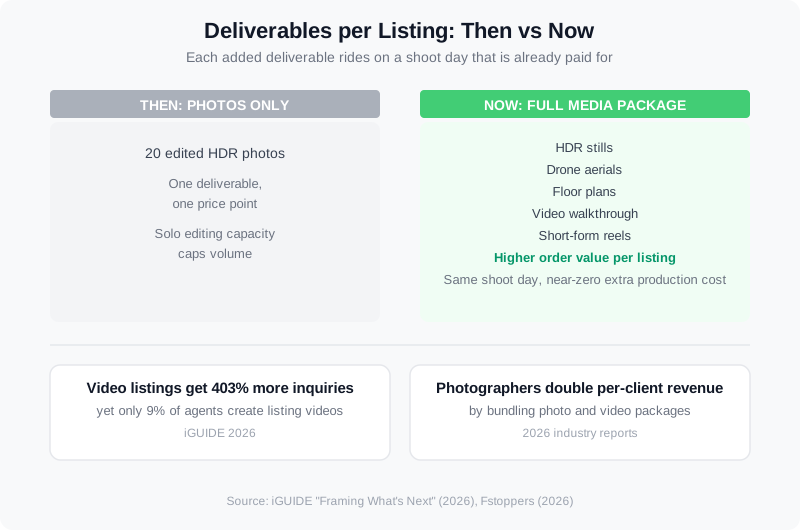
Each added deliverable rides on the same shoot day — near-zero marginal production cost, higher order value.
The economics work because the shoot day is already paid for. Adding a video walkthrough, a drone pass, or three social reels to an existing shoot costs mostly editing time — and that is precisely the cost AI collapses. The exact package prices depend on your market, so plug in your own numbers, but the shape is consistent across every studio in the iGUIDE report: more deliverables per listing, higher revenue per client, fewer new-client acquisition costs. Photographers who have done this report doubling per-client revenue by bundling photo and video — a pattern covered in How a Photographer Doubled Per-Client Revenue with Photo + Video Packages. If you are still pricing per service rather than per package, "How to Price Real Estate Video Services as a Photographer in 2026" is the place to start.
The Hiring Playbook: Order of Operations
Once the systems and the AI pipeline exist, the hiring order becomes obvious. Studios that scaled follow roughly the same sequence:
- Hire 1 — second shooter: the trigger is a booking calendar full three to four weeks out. You are leaving money on the table; a shooter on your standard multiplies shoot capacity immediately.
- Automate before hiring editors: if the bottleneck is post-production, an AI editing pipeline is cheaper, faster, and more consistent than the first editor hire.
- Hire 2 — video specialist: once video demand outgrows what the AI pipeline plus your shooters can produce, add a dedicated video shooter or a client-relations hire — whichever bottleneck appears first.
- Then systems staff: booking, delivery, and invoicing support arrive last, and only when the founder's time is the constraint.
The order matters. Shooter first, automation second, specialists third, admin last. Studios that reversed the order — hiring editors before automating the pipeline, or admin before shooters — hit the same wall: payroll with no corresponding capacity. Teams that got the order right scaled from solo to 50 videos a week and beyond, as documented in How a Real Estate Photographer Went from 5 Videos to 50 Videos Per Week and the media company that automated 200 videos per month.
Frequently Asked Questions
When should a solo real estate photographer hire their first employee?
Hire your first shooter when you are consistently booked three to four weeks out and turning down work. Before that point, more capacity will not create more revenue — you do not need it yet. The exception is hiring before you are fully booked to cover vacation or sick days, but the standard trigger is a full calendar plus documented systems. If your workflow is not written down, fix that before you post the job.
Can AI editing replace hiring editors when you scale?
For the bulk of real estate post-production, yes — and that is why AI-first studios scale faster. The iGUIDE report found 71% of real estate photographers use AI tools, with some reporting editing up to 90% faster. AI handles the repetitive work: color correction, exposure balancing, sky replacement, video cuts, captions, and exports. Human review still matters for brand consistency and client communication, but the editor headcount that used to scale with shoot volume no longer has to.
How many clients do you need before you can afford a team?
The number depends on your market and your packages, but the formula is simple: the added revenue from one more deliverable per shoot must exceed the cost of one more person. Because each added deliverable (video walkthrough, drone pass, reels) rides on a shoot day you already paid for, package revenue per client typically rises faster than headcount costs — which is why studios like Northern Spruce Media grew revenue to $1 million with a 20-person team. Model it with your own prices: if adding video to 60% of your shoots covers a shooter's salary plus margin, you are ready.
What is the biggest mistake photographers make when scaling?
Hiring before the workflow is documented. If booking, editing, and delivery each live in one person's head, a second shooter produces inconsistent results and you spend more time managing than shooting. The fix is the same at every size: document the process, train to one standard, automate the editing pipeline, and only then add headcount. Structure first, ambition second.
How do agents market a real estate business with reels?
Agents market a real estate business with reels by posting short, vertical clips — market updates, neighborhood tours, price reveals, and before-and-after staging — three to four times a week on a fixed schedule. The hook goes in the first three seconds and captions carry the message for silent viewing. One shoot can yield several reels, which is why studios that bundle reels into every listing keep agents on a recurring basis.
How can a photographer help agents promote their real estate business?
A photographer helps agents promote their real estate business by delivering the full media package — HDR stills, drone aerials, a video walkthrough, and a bundle of short-form reels — on every listing, on a reliable schedule. That turns each shoot into marketing the agent can reuse across the MLS, YouTube, and social. Agents re-hire the studio that ships the whole package on time, which is how Northern Spruce Media grew past $1 million with 600+ clients.
Ready to scale your studio without drowning in editing? VideoGuru's AI real estate media platform turns raw shoot footage into finished listing videos and handles virtual staging, declutter, and photo enhancement in minutes — so your team shoots more and edits less. Start for free at VideoGuru.
Your Scaling Blueprint
The journey from solo shooter to media company is documented, and it is not about talent — it is about sequence. Document every process before you hire. Train every shooter to one standard. Automate the editing pipeline with AI so post-production scales with volume, not headcount. Add deliverables to every shoot so revenue per client climbs. And make the client experience effortless so retention does the marketing. Northern Spruce Media turned $30,000 of solo revenue into a million-dollar, 20-person studio with exactly that sequence. Your version of the same path starts with one documented checklist and one automated workflow.