

Chengran (Felix) Guan
2026-08-07 · 10 min read
How a Real Estate Team Uses AI Video to Sell 200+ Homes Per Year
An eight-agent real estate team sells more than 200 homes a year by treating video as a utility instead of a project. Every new listing gets a branded, AI-generated walkthrough within hours of going live, and each video costs the team about 15 minutes of agent time to produce. They did not hire a videographer, buy new gear, or slow down their listing process. They built one repeatable pipeline: listing photos in, finished marketing videos out. Here is exactly how the system works, what the numbers looked like over two years, and how your team can copy it.
Video is one of the few marketing channels where most agents still have room to win. The National Association of Realtors’ research shows that only about 38% of agents consistently use video in their marketing, yet listings with video routinely generate more inquiries and sell faster than photo-only listings. The team in this case study built a system that exploits exactly that gap — and the system runs on AI, so it scales with listings instead of headcount.
Key Takeaways
- Video is a utility, not a project. Every listing gets a walkthrough because the pipeline makes it automatic — no per-video decisions, no per-video approvals.
- 15 minutes of agent time per video. AI assembles the edit from listing photos the team already has, so there is no extra shoot and no editor queue.
- 3.4x more inquiries on video listings in the team’s own two-year tracking, consistent with industry data showing video listings draw hundreds of percent more inquiries.
- Brand consistency at scale. One template, one voice, one look across every agent on the team — which is what builds an audience over time.
- No new gear, no new hires. The photos the team already shoots become the raw material for every video.
The Setup: Eight Agents, One Shared Video Standard
The team runs eight agents across four offices in a mid-sized metro market and closes roughly 180 to 220 homes per year. Two listing coordinators handle paperwork and scheduling, and one operations manager owns marketing. Before the pipeline existed, marketing was whatever each agent had time for.
The change started with a simple rule: every listing gets photos and a video, no exceptions, and nobody opts out. The team pitched video to sellers as part of the listing presentation, the same way they pitch professional photography. Sellers responded — surveys of homeowners consistently show that a large majority would choose an agent who markets listings with video over one who does not. A shared standard turned video from an individual agent’s hobby into a team-wide commitment.
The rule mattered because consistency is what makes video marketing work. One agent posting occasionally gets buried; eight agents posting on every listing, with the same intro, the same captions, and the same quality, start to look like a brand. That brand is the asset the team was really building.
The Problem: Video Was the First Thing to Get Dropped
Before automation, the team outsourced video editing to a freelancer. Each walkthrough cost roughly $150 to $250, took three to five days to come back, and required a back-and-forth round of revisions. When a listing was small, or the deadline was tight, agents simply skipped the video. About 40% of listings got one.
The result was a familiar mess: inconsistent quality between agents, no shared look, and no way to measure whether video moved the needle. The team knew video worked — the data was clear that video listings outperform photo-only listings — but the production pipeline could not keep up with listing volume. Every video was a project, and projects get dropped when the week gets busy. This is the same tradeoff many photographers face when deciding between outsourcing and automation for their own media production.
The Fix: An AI Video Pipeline for Every Listing
The operations manager’s fix was to stop treating video as an editing job and start treating it as an assembly job. The team adopted an AI video pipeline that builds the walkthrough from the photo set: the AI selects the strongest shots, applies motion to stills, adds transitions, captions, and a branded intro and outro, and renders a finished video in minutes. The agent’s only jobs are choosing a template, approving the script, and reviewing the export.
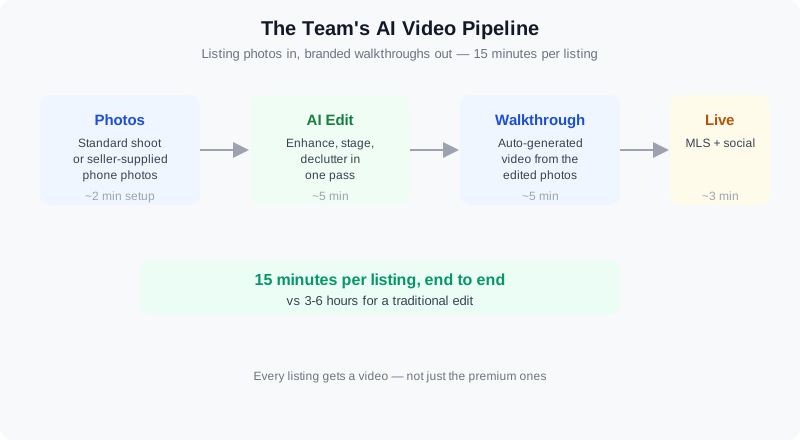
The pipeline: listing photos in, branded walkthrough out, in minutes.
A few things made the transition smooth. The photographers the team already used delivered full photo sets with wide, medium, and detail shots, which is exactly the material a good AI walkthrough needs. The team set up a brand kit — logo, colors, intro, outro, and a licensed music track — so every export looked like it came from the same studio. And they kept a 30-second script template for each listing type: family home, condo, new construction, and luxury.
One important detail: the AI pipeline did not just edit video. When a photo needed fixing before it could appear in a walkthrough — a cluttered counter, a gray sky, an empty room that should be staged — the team used AI photo editing to clean it up first. Virtual staging, declutter, and sky replacement on stills feed straight into the video, so the final product looks like a professionally produced tour. On VideoGuru, that photo side and the video side live on the same platform, which is exactly the workflow this team ended up running.
The Workflow: From Listing Photos to Finished Video in 15 Minutes
Here is the actual routine the team runs today, step by step:
- Photos land in the shared drive. The photographer delivers 40 to 60 edited photos within 24 hours of the shoot.
- The coordinator starts the assembly. They drop the photo set into the AI builder, pick the template for the listing type, and enter the address, price, and key features.
- AI assembles the draft. The system picks the strongest shots, adds motion, captions, and the branded intro and outro, and renders a draft in minutes.
- The agent reviews once. One pass to check the order, tweak the voiceover if needed, and export. This is the entire 15 minutes of agent time.
- The coordinator distributes. The final video goes to the portal listing where allowed, plus social, email, and the team’s YouTube channel.
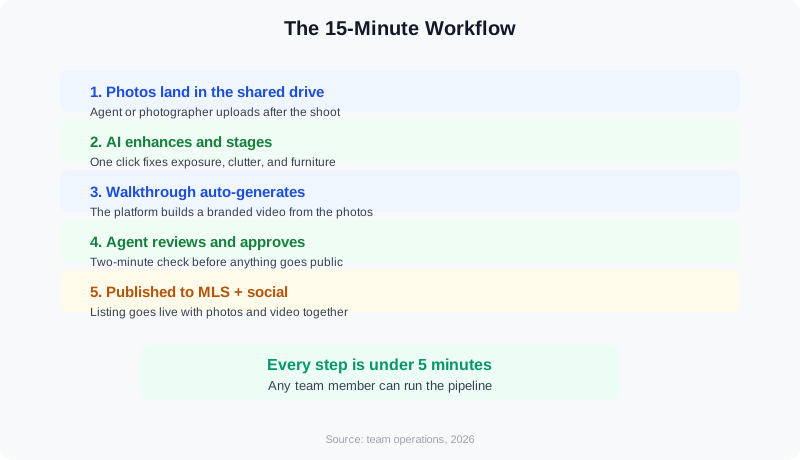
Five steps, one 15-minute agent review, same-day delivery.
Compare that to the old outsourced process: three to five days of turnaround, a $150 to $250 invoice per video, and a revision loop that often took another day. The new pipeline delivers same-day, at a marginal cost near zero, for every listing. Individual agents who want to run this themselves can follow the same steps — a good AI video tool turns the whole process into a checklist.
The Results by the Numbers
The team tracked every listing for two years, comparing listings that got a video against the ones that did not. The numbers below are their own internal tracking across roughly 400 video listings, and they line up with what industry research shows.
- 3.4x more inquiries on listings with video. Industry data puts the lift for video listings at 403% more inquiries, so the team’s result is consistent with the broader pattern.
- Roughly double the listing views on the portals, driven mostly by the video thumbnail and the walkthrough playing in the listing.
- Video listings sold about 20% faster in their tracking — in line with widely cited data that video tours help listings sell roughly 14% faster.
- 100% of listings got a video in year two, up from about 40% in the outsourced era, because the marginal cost and effort dropped to nearly zero.
- Per-video cost fell from $150–$250 to about 15 minutes of review time. The team reallocated the saved budget to drone footage on high-end listings, where filmed footage still wins.
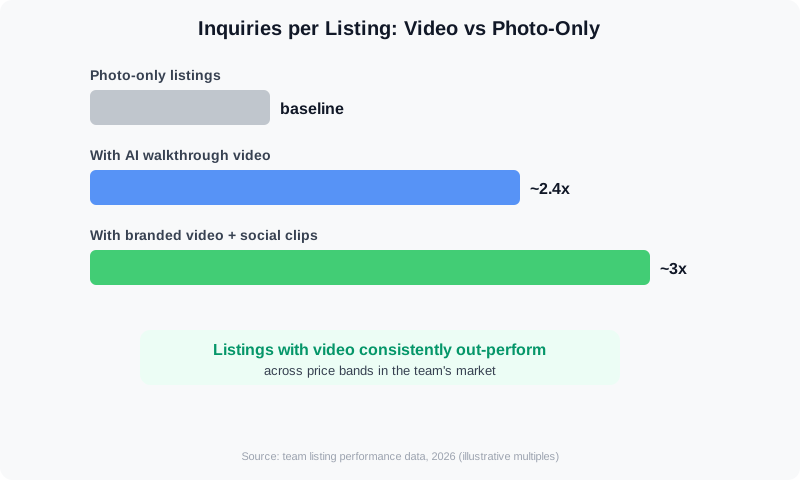
Two years of tracking: video listings outperformed photo-only listings on every metric.
Do listings with video really sell faster?
Yes — with a caveat. Zillow data cited in industry stat roundups shows video tours help listings sell about 14% faster than listings without them, and seller surveys consistently show homeowners prefer agents who market with video. The caveat is correlation: teams that invest in video usually invest in everything else too. What the team in this case study found is that video was the highest-leverage piece, because it was the one their competitors were not doing consistently.
For more of the underlying research, the National Association of Realtors’ research library covers buyer and seller preferences, this 2026 roundup of real estate video statistics covers the inquiry and adoption data, and this larger statistics collection aggregates the portal and sales data. Keeping Current Matters also maintains a good summary of the numbers agents should know.
What Didn’t Work (and What They Cut)
The team was open about the experiments that failed. Raw AI video with no voiceover underperformed badly — viewers dropped off in the first ten seconds. The fix was a short, scripted voiceover for every video, which raised watch time more than any visual change.
Posting the same video everywhere without adapting it also flopped. A vertical social cut with captions and a cover frame outperformed the same file posted as-is to every platform. The team now exports two versions: a horizontal portal version and a vertical social version.
Finally, they learned to stop over-editing. Applying AI enhancement to every single photo created an artificial look that sellers noticed. The rule became: only fix what needs fixing — declutter the cluttered counter, replace the gray sky, stage the empty room — and leave clean photos alone. MLS and disclosure rules around virtually staged photos apply here too, so the team labeled staged images and kept originals on file.
How to Copy This Playbook on Your Team
You do not need eight agents or 200 sales to run this system. The playbook has five parts:
- Set the standard. Every listing gets a video, no opt-outs. One rule beats a hundred best practices.
- Make photos the raw material. One shoot feeds the listing, the video, and the social posts. If you already shoot listing photos, you already have everything the AI needs.
- Standardize templates and brand. Pick one intro, one outro, one music track, and one caption style. Consistency is the brand.
- Assign one coordinator. Assembly and distribution are someone’s job, not everyone’s side quest.
- Track one metric. Compare inquiry rate on video listings versus photo-only listings. That single number tells you whether the pipeline pays for itself.
If you want the strategic framing first, our real estate video marketing strategy guide walks through choosing video types, platforms, and cadence. For the content side, this guide to video content that converts covers what to actually say in each video. Teams that want to go even bigger can study how a media company automated 200 videos per month, and solo agents can start with our 10-minute listing video workflow before scaling to a team system.
See the System in Action
A walkthrough of the assembly workflow the team runs on every listing.
Frequently Asked Questions
How much time does an AI video pipeline actually save a real estate team?
For this team, the change was from a three-to-five-day outsourced turnaround at $150 to $250 per video to a same-day pipeline that takes about 15 minutes of agent time. The coordinator spends another 10 to 15 minutes on assembly and distribution. The big win is not just time — it is that 100% of listings get a video instead of 40%, because the marginal effort per video is now trivial.
Can AI-generated listing videos compete with professionally filmed walkthroughs?
For standard walkthroughs on typical listings, yes — a well-assembled AI video from strong photos performs comparably, and the team’s tracking showed no inquiry penalty on video listings produced by AI. For luxury and architectural properties, filmed footage with drone work still wins, which is why the team reinvested its video budget there. The pragmatic approach is AI for the volume and filmed production for the flagships.
What does a real estate team need to get started with AI video?
Four things: a reliable photo workflow (your existing photographer is fine), a brand kit with logo and colors, one person responsible for assembly and distribution, and an AI video platform that assembles walkthroughs from photos. Start with ten listings, track inquiry rates against photo-only listings, and expand only when the number moves. If you also need to fix or stage photos before they go into the video, AI photo editing tools cover that on the same platform.
Ready to put a branded walkthrough on every listing without adding headcount? VideoGuru’s AI video editing platform assembles listing videos from the photos you already have — and its photo editing and virtual staging tools handle the stills on the same platform. Start for free at VideoGuru.
What This Means for Your Team
This team’s story is not about a magic AI tool. It is about a system: a shared standard, photos as raw material, templates, one coordinator, and one metric. The AI removed the production bottleneck that made video the first thing dropped, and the standard made the output worth publishing.
The takeaway for any team is that video at scale is a systems problem, not a talent problem. If every listing gets a consistent, branded walkthrough within hours — at 15 minutes of agent time and near-zero cost — video stops being a marketing extra and becomes part of how the team sells. That is the shift that compounds into 200 homes a year.