

Chengran (Felix) Guan
2026-08-26 · 8 min read
The State of AI Real Estate Video in 2026:
What AI Does Well, Where It Struggles, and What's Next
AI real estate video has crossed from experiment to expectation. In 2026, AI tools reliably handle the tedious 80% of listing video work — cutting clips, color matching, captions, and multi-format exports — while humans still own the creative 20%: shot selection, story, and the final quality pass. The honest answer to "is AI video good enough for real estate?" is yes for most agent and photographer workflows — if you treat AI as an editing partner, not an autopilot.
Key Takeaways
- AI excels at the repetitive pass: cutting, stabilization, color matching, captions, and resizing for every platform.
- AI still struggles with nuance: faces, reflections, complex floor plans, and brand-consistent storytelling need human review.
- The winning pattern is hybrid: shoot once, let AI draft the edit, then do a focused human polish pass.
- Turnaround is the real change: edits that took hours now take minutes, which changes what agents and photographers can promise.
- Disclosure rules apply: AI-generated or AI-altered content still needs to follow MLS and local requirements.
What AI Video Does Well in 2026
The biggest shift in the last 18 months is reliability. Early AI editing tools could produce a decent draft on a good day. The current generation produces a usable first cut almost every time, which is what makes it practical for production work rather than a demo trick.
- Draft assembly: AI orders your clips into a watchable walkthrough — room order, transitions, and pacing — in seconds.
- Color and exposure matching: footage shot at different times of day gets normalized to one consistent look, which is the single most visible quality fix in listing video.
- Captions and graphics: auto-generated captions, lower thirds, and agent branding are now accurate enough to ship with light review.
- Format adaptation: one edit becomes a YouTube walkthrough, an Instagram reel, and a TikTok cut — each resized, cropped, and re-paced automatically.
- Repair work: stabilization, glare reduction, and dead-time trimming that used to be manual fine work are now one-click operations.
In practice, editors and agents report cutting the editing portion of a listing video by 60–80% — the difference between a 90-minute edit and a 20-minute one. The exact number depends on the footage, but the direction of travel is consistent across the industry, and it matches what Google and other researchers describe for generative media workflows overall.
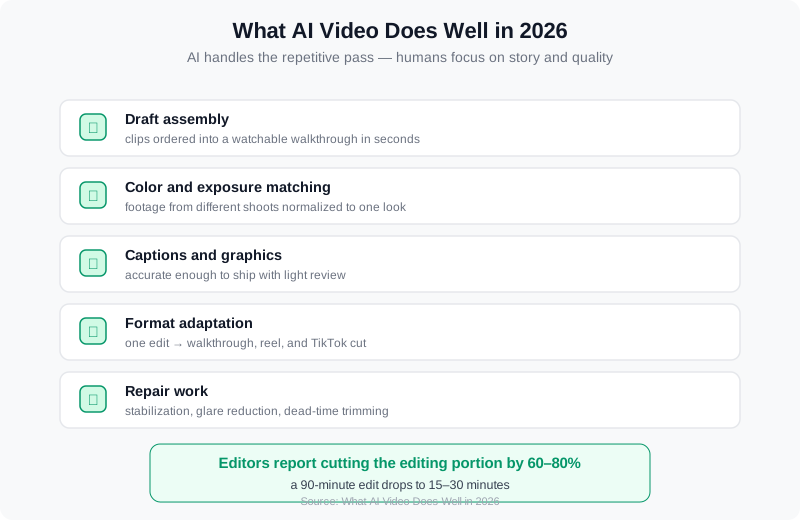
AI handles the repetitive pass so humans can focus on story and quality.
Where AI Video Still Struggles
A state-of-the-industry review would not be honest without the limits. Knowing where AI falls short is what keeps you from shipping something embarrassing.
- People: faces, hands, and movement of people in frame are still the weakest area. Hosted tours and agent introductions need a careful human eye.
- Reflections and glass: windows, mirrors, and water are where generative artifacts show up. A wrong reflection can undermine a buyer's trust in the whole listing.
- Architectural truth: AI does not truly understand floor plans, load-bearing walls, or what a space looks like from an angle it never saw. It interpolates — usually well, sometimes creatively wrong.
- Brand consistency: a one-off video is easy; thirty videos that all look and sound like the same agent still require templates and oversight.
- Disclosure compliance: MLS rules around AI-generated or AI-altered content vary by market, and the responsibility sits with the person publishing, not the tool.
None of these are deal-breakers. They are review checkpoints. The professionals who use AI well have a short checklist — check the faces, check the glass, confirm the layout, confirm the disclosure — and it takes them five minutes.
The Hybrid Workflow That Works Today
The most productive teams in 2026 run a three-stage pipeline. It applies whether you are a solo agent or a media company shipping 200 videos a month.
- Shoot once: capture the walkthrough, the exterior, and the key detail shots. The shoot does not change much — good footage is still the raw material everything depends on.
- AI drafts: upload the footage and let AI assemble the first cut, apply the color pass, add captions and branding, and export the platform versions.
- Human polishes: review the draft, fix the moments that matter, confirm compliance, and approve. This is minutes, not hours.
This is exactly the pattern VideoGuru was built around: an AI real estate video editor that takes a listing from footage to finished video in minutes, with the human in control of the final pass. The same pipeline that handles your video also extends to stills — VideoGuru's photo editing tools give you one-click virtual staging, declutter, and color correction alongside the video suite, so a listing's photos and video come out of one workflow with one consistent look. The same AI that powers your video walkthroughs also handles your listing photography.
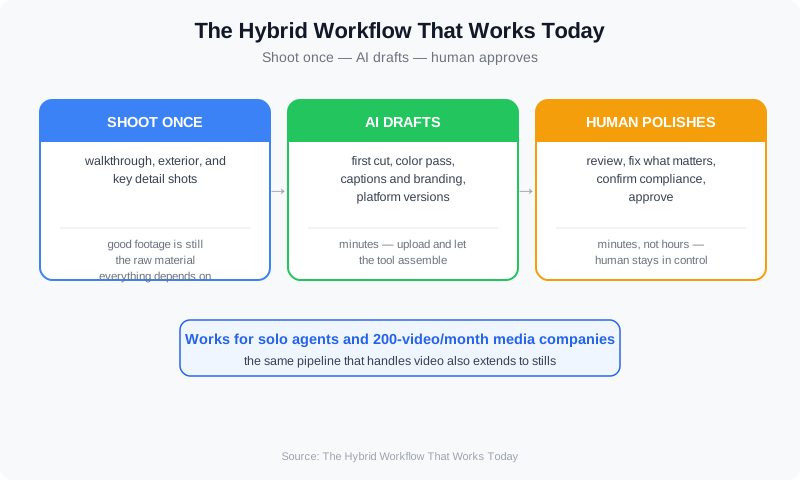
Shoot once, AI drafts, human approves — the pipeline that scales.
What's Coming Next
The roadmap for the next 12–24 months is visible in what shipped over the last year. Generative video quality keeps improving — Google's research blog documents steady gains in coherence and length of AI-generated clips, and MIT Technology Review's AI coverage tracks the same curve. For real estate specifically, the developments to watch are:
- Personalized video at scale: the same property tour, re-narrated per buyer segment — first-time buyers hear schools and commute times, investors hear cap rates.
- Agent avatars: a recorded agent can be re-used across dozens of videos, with realistic delivery, cutting the weekly filming commitment.
- Live virtual staging in video: furnishing an empty room in motion, not just in stills, is approaching usability.
- Voice-driven editing: describing the cut you want ("open on the kitchen, slow the pool shot") is becoming a real editing interface.
For a broader look at where the market is heading, our real estate video trends for 2026 post covers the forecast side in depth. The state of the technology and the trends in the market are converging on the same point: AI is becoming the default editing layer, with humans defining the creative direction.
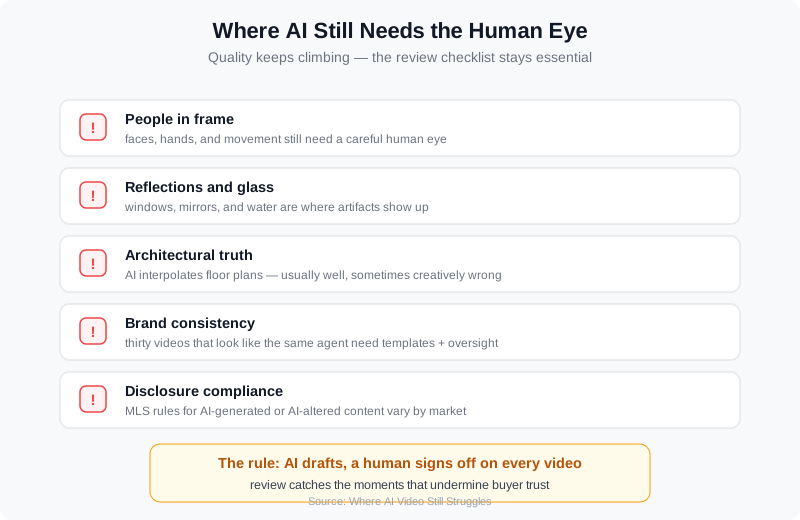
Quality keeps climbing — the review checklist stays essential.
What This Means for Agents and Photographers
For agents, the practical takeaway is that video is no longer a luxury that requires a production budget. NAR's buyer research consistently ranks photos and video among the most useful features in online listings, and Realtor.com's market research shows listing media directly influences how long buyers spend on a property. The barrier to entry has dropped to: shoot decent footage, let AI assemble it, review, publish.
For photographers and videographers, the shift is different. AI is not removing the need for professionals — it is removing the need for the slow, manual editing pass that capped how many videos you could deliver. Our case study on a videographer who went from 10-hour edits to 30 minutes shows the pattern: the shoot, the creative direction, and the client relationship stay with you; the drudgery goes to the machine. If you are still editing every video by hand, you are competing against teams who already made that switch.
And if you are an agent who has been wondering where to start, the fastest path is the one that requires the least new skill: turn the listing photos you already have into a video, then add walkthrough footage as you get comfortable. Our guide to what agents should look for in a video editing tool walks through the features that actually matter — speed, templates, brand consistency, and a quality bar you can trust.
Frequently Asked Questions
Is AI real estate video good enough for MLS listings in 2026?
Yes, for edited footage of the property itself. AI editing tools produce walkthroughs, exterior tours, and agent-narrated videos that meet MLS quality standards when the source footage is solid. The exceptions are generated (not edited) content: fully AI-generated scenes or altered layouts may trigger disclosure rules in your market, so check your MLS requirements before publishing those. When in doubt, label AI-generated content clearly — transparency protects both you and the buyer.
Will AI video editing replace real estate videographers?
Not the ones who adapt. AI replaces the manual editing pass, which is precisely the part of the job that limited how much work one person could take on. The skills that still matter — shooting well, directing the story, managing clients, and guaranteeing quality — are exactly the skills AI does not have. Most videographers using AI tools report taking on more work, not less, because turnaround times shrink.
How much time does AI video editing actually save?
Practitioners consistently report cutting editing time by 60–80% for standard listing videos. A 5-minute walkthrough that took 90 minutes of manual editing typically takes 15–25 minutes with an AI draft plus a human polish pass. The savings are largest on repetitive work — color matching, captions, and platform exports — and smallest on highly custom creative edits, which is where human judgment remains the bottleneck.
What should agents look for in an AI video tool in 2026?
Prioritize three things. First, output quality you can ship without heavy rework — test with your own footage, not demo clips. Second, brand consistency: templates, colors, and captions that make every video look like you. Third, turnaround and volume: can it deliver a finished video the same day, and does it scale when you have three listings closing in one week? The tool that fails on any of those three will quietly fall out of your workflow.
A start-to-finish look at real estate video editing — the manual baseline that today's AI tools compress into minutes.
Ready to put AI video editing to work on your next listing? VideoGuru's AI real estate media platform can draft, color-match, caption, and export your walkthrough videos in minutes — with the same AI handling your listing photos, from virtual staging to decluttering. Start for free at VideoGuru.
The Bigger Picture
The state of AI real estate video in 2026 is a story of division of labor, not replacement. Machines took the repetitive work; humans kept the judgment. The teams winning listings are not the ones with the most expensive gear or the fanciest AI — they are the ones with a reliable pipeline: shoot once, draft with AI, polish what matters, publish everywhere.
The buyers on the other side of the screen only see the result: a listing that looks professional, moves well, and tells them what they need to know. In 2026, that result is within reach of any agent or photographer who adopts the hybrid workflow — and it is getting easier every quarter.