

Chengran (Felix) Guan
2026-09-24 · 14 min read
Turnkey Video Marketing Packages for Agents:
What's Inside and What They Cost
A turnkey video marketing package is a fixed-price bundle in which someone else shoots or assembles the video, edits it, and hands you finished files sized for the MLS, Instagram Reels, and YouTube. Published US pricing in 2026 runs about $300-$800 for a single edited listing walkthrough, $2,000-$5,000 per month for a retainer covering 4-8 finished videos, and $1,500-$3,500 for a scripted brand video. The lowest cost per delivered video is not a package at all - it is an AI photo-to-video platform, where an annual plan works out to $8.94-$12.00 per video.
That spread is not a quality gap. It is a difference in who does the work, what you have to hand over, and how the price behaves when your listing count changes. An agent closing two deals a month and an agent closing twelve need different answers, and so does a photographer adding video to an existing photo business. This guide breaks a turnkey package down into its parts, prices each model with sources, and shows where the per-video math actually lands.
Key Takeaways
- Turnkey means one vendor owns the whole chain. Pre-production, the shoot, the edit, and the final file formats. You approve the work; you do not operate the tools.
- Sourced 2026 ranges: $300-$800 for a single listing walkthrough, $1,500-$3,500 for a scripted brand or authority video, and $2,000-$5,000 per month for a retainer of 4-8 finished videos.
- Add-ons reset the price. Drone footage adds roughly $300-$800 per project, and a cinematic cut runs $800-$2,500 compared with $150-$500 for a straight walkthrough.
- Judge a package by cost per delivered video, not cost per shoot. A $5,000 retainer for 8 videos is $625 a video. On an annual AI plan the same walkthrough costs between $8.94 and $12.00.
- Get the deliverable list in writing. The number of aspect ratios, the revision rounds, the music license, and whether you keep raw footage decide whether the price is fair.
- Realtors are buying time, not software. In NAR's 2026 technology survey, 81% of agents said saving time is their main reason for adopting new tech, up from 66% a year earlier - and 63% named the learning curve as their biggest obstacle.
What "Turnkey" Actually Means in a Video Package
Turnkey is a scope word, not a quality word. A turnkey package means you hand over an address and a calendar slot and receive finished, upload-ready video. Everything between those two points - the shot list, the lighting, the edit, the colour, the captions, the file sizes - is somebody else's problem.
Three things separate a real turnkey package from a service that looks like one on the invoice:
- You do not have to create the raw material. If the provider needs your footage, your photos, or your edit, it is a processing service, not a turnkey package.
- The deliverable set is specified up front. Master cut, vertical cut, square cut, thumbnail, captions, and the MLS-compliant file are named in the quote, not discovered afterwards.
- One vendor is accountable for the finished look. No gaps between a photographer, an editor, and whoever exports the final file.
The route changes with who you are. An agent with one or two listings a month is buying a per-listing shoot and an edit. A photographer adding video to an existing photo business is buying an editing pipeline, because the shoot already happens on every job - and those pricing models are covered in our guide to pricing video services as a photographer. A media company producing 40-200 videos a month is buying throughput, and at that volume the retainer model gets expensive fast - a different problem with a different fix.
It is worth knowing why sellers keep paying for this. In NAR's 2025 Profile of Home Buyers and Sellers, 91% of sellers sold with the assistance of a real estate agent, and among the tasks sellers ranked as high priority, marketing the home to potential buyers came first. Video is the most visible line in that marketing - and the reason a package is easy to sell into a listing appointment, even when the economics need a second look.
What's Inside a Turnkey Video Package
Most quotes describe a price and a video length. Few describe the four stages you are actually paying for. Here is the full chain, and the question to ask about each stage before you sign.
| Stage | What the package should include | What to ask |
|---|---|---|
| Pre-production | Shot list, shoot time booked, staging and declutter notes, weather and light planning, drone clearance if the listing needs aerials. | Who writes the shot list - and does it cover the rooms that sell the home (kitchen, primary, exterior)? |
| The shoot | On-site capture: interior walkthrough, exteriors, aerials if included, optional agent on-camera intro and a client hand-off or testimonial to close. | How many shoot hours are included, and what does a re-shoot cost if the property is not ready? |
| The edit | Cut and pacing, colour correction, licensed music, titles and lower thirds, logo placement, captions, thumbnail frame. | Is the music license cleared for social and MLS use, and how many revision rounds are included? |
| Deliverables | 16:9 master, 9:16 vertical, 1:1 square, an MLS-length cut, thumbnail image, and file sizes the listing platform accepts. | How many aspect ratios are in the price, and does it include platform-specific cuts or just one master file? |
The deliverable row is where packages quietly differ by hundreds of dollars. A single 16:9 master that you then crop yourself on your phone is not the same product as a set of finished cuts for the MLS, Reels, and YouTube. Ask for the file list before the price, and the quote becomes comparable.
An orientation to how real estate video work is structured - the formats, the moving parts, and who typically handles which stage.
What is usually not in the price: additional revision rounds, re-shoots, paid ad spend, ongoing posting and captioning, and raw footage. Raw footage in particular is worth naming in the contract - if you ever want to re-cut a walkthrough or feed clips into another workflow later, you want the files, not a permission slip.
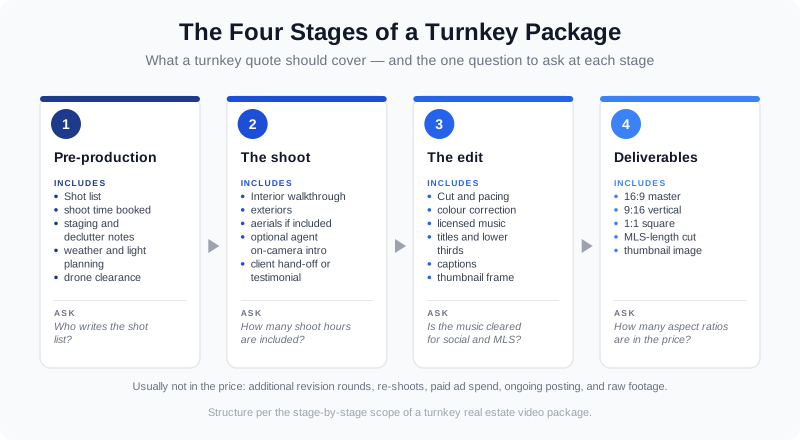
Fig 1 - The four stages a turnkey quote should cover: pre-production, the shoot, the edit, and the finished deliverables.
How Much Turnkey Video Packages Cost in 2026
These are published 2026 price lists from US real estate video production companies - a production company price guide and a by-property-type videography pricing breakdown - not survey averages. Treat the ranges as the market you are shopping in, then check them against quotes in your own metro, because production costs track local crew rates. Our own 2026 production cost breakdown covers the same ground route by route.
| Package model | Typical published price | What that buys |
|---|---|---|
| Single listing walkthrough | $300-$800 | One shoot, one edited walkthrough with transitions, interior and exterior coverage, basic music. |
| Walkthrough by video type | $150-$500 straight walkthrough; $800-$2,500 cinematic; $500-$1,500 agent-led; $100-$300 social cut | The same property priced by how much production the format needs. Agent-led adds on-camera time; social covers short vertical cuts. |
| Monthly retainer | $2,000-$5,000 per month | 4-8 finished videos per month including editing, thumbnails, descriptions, chapter markers, and a style guide. |
| Brand or authority video | $1,500-$3,500 (up to $3,000-$5,000 with scripting, on-location production and motion graphics) | The flagship piece: scripting, a production day, and motion graphics for the agent or team brand. |
| Drone add-on | $300-$800 per project (tiered options run $100-$1,500) | A licensed operator, flight logistics, and aerial footage integrated in post. |
| Luxury listing, full treatment | $1,500-$3,000+ | Extended walkthrough, multiple angles, enhanced edit and music, drone and lighting for high-end properties. |
Two ranges stand out because they are the ones agents misread. The first is the retainer: $2,000-$5,000 a month for 4-8 videos is $250 to $1,250 per finished video depending on where you land in the band, so the monthly number tells you nothing until you divide it by the deliverables. The second is the drone line: aerials are priced as a separate production element, not a filter you switch on, which is why a landmark property can carry $800 of flight cost before a single frame is edited.
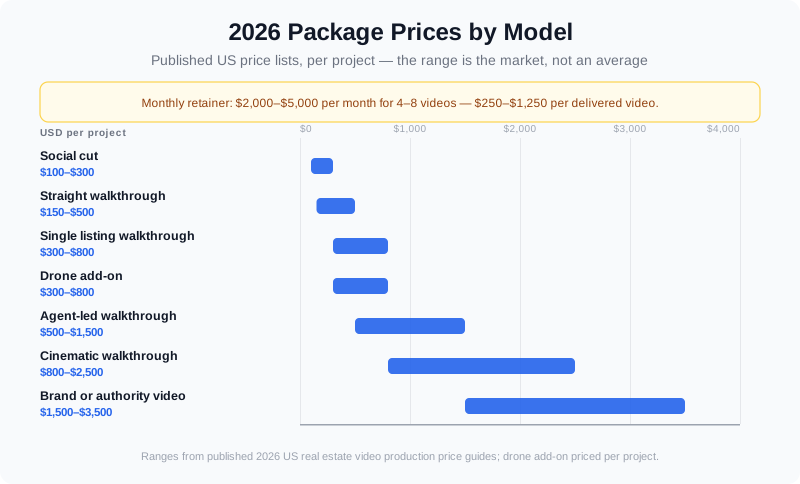
Fig 2 - Price bands by package model, from a single listing walkthrough to a scripted brand video.
The Three Pricing Models and What Each One Really Charges For
Per-listing pricing
You pay per property. This is the right model when your listing count is unpredictable and you want the cost to follow the work. It is also the model with the widest quality variance, because a $300 walkthrough and an $800 walkthrough are both described as "listing video" in the quote. Pin down shoot hours, edit revisions, and the deliverable list before comparing two per-listing prices.
Monthly retainer
You pay a fixed monthly fee for an agreed volume, usually 4-8 videos. Retainers buy priority scheduling, a consistent look, and a lower rate per video than booking project by project. They are also the only model where you can waste money: if you pay for six videos and list three properties, your effective cost per delivered video doubles. Before signing, check whether unused videos roll over and whether the retainer covers the formats you actually post, or only the master cut.
Brand and authority projects
You pay once for a flagship asset: a scripted introduction to you and your market, a neighbourhood film, or a team brand piece. At $1,500-$3,500 it is the largest single line on the budget and the one with the longest shelf life, because it is not tied to a property that will close. If your budget is tight, this is the line to defer, not the per-listing videos that support live inventory.
What Actually Drives the Price Up
- Shoot time and property complexity. A compact apartment takes a fraction of the time a five-bedroom with a multi-acre lot does, and published pricing reflects it: $150-$400 for small properties versus $800-$2,000 for large homes.
- Aerials. A licensed drone operator plus flight logistics adds $300-$800 per project, with tiered packages running from around $100 for basic shots to $1,500 for advanced flight work.
- On-camera time. An agent-led video where you present the property runs $500-$1,500, because it adds a second capture pass and usually a second edit.
- Format count. Every additional aspect ratio is another export, another caption pass, and another thumbnail. A package that ships one master file is cheaper than one that ships three finished cuts.
- Turnaround speed. Rush delivery reorders a producer's week. It is one of the few line items worth paying extra for - a listing video that lands after the first open house has already lost its audience.
- Revision rounds. One round is standard. Anything beyond that is change orders, and it is where a $600 quote becomes a $900 invoice.
The Fourth Route: AI Photo-to-Video Platforms
A package is not the only way to get a finished walkthrough. If the listing has already been photographed - and most have - an AI photo-to-video platform turns that photo set into a narrated walkthrough without a second shoot, a crew, or a scheduling window. You are not paying for someone else's edit bay; you are paying for the software that does the assembly.
That route is what our photo-to-video walkthrough guide covers end to end, and it changes the input you need: instead of booking a shoot, the deliverable starts from the stills your photographer already delivered.
VideoGuru was built for exactly that handoff. You upload the listing photos and the platform produces a professional property walkthrough. You can also drop your own video clips into the same video - drone shots or real-person clips mixed into the photo-driven walkthrough, not a separate output. Add a voiceover or an AI avatar built from a headshot and it is composited into the same property video, so the presenter, the property, and the owner's cloned voice live in one file rather than three. That capability sits on any paid plan: there is no separate avatar subscription stacked on top, which is not true of most standalone presenter tools.
On price, the annual plans are the honest comparison against a retainer. Essential is $59/mo, Growth $129/mo, and Pro $249/mo month to month; billed annually they work out to $12.00, $10.20, and $8.94 per video if you use every credit - against $250-$1,250 per video on a package retainer. Output is 1080p on Essential and 4K on Growth and Pro, in 16:9, 1:1, and 9:16, so the MLS cut, the Reel, and the YouTube upload come from one job. The full plan and credit breakdown lives in the product docs.
Two things matter beyond the render. First, the stills. The same platform handles one-click virtual staging, declutter, restyling, and twilight for your listing photos, so your lead image and your walkthrough share a look instead of reading like two vendors edited the same property. Second, brand consistency: a brand kit locks your logo, colours, fonts, and intro and outro cards so video number forty looks like video number one - the thing a retainer is really selling you.
Where a package still wins: when the marketing depends on real filmed footage of a lifestyle, a location, or a neighbourhood, or when a luxury listing needs a scripted cinematic film. Buy the package for those. Use the platform for the inventory you cannot justify booking a crew for.
Package vs. Platform: Matching the Route to Your Volume
| Who you are | What you actually need | Route that fits | Cost per delivered video |
|---|---|---|---|
| Agent with 1-2 listings a month | A finished walkthrough per listing, minimal admin, no new software to learn. | Per-listing package, or an AI platform on a starter paid plan. | $300-$800 via a package; $12.00 on an annual Essential plan |
| Agent or team at 4-10 videos a month | Consistent output in several formats, predictable monthly cost. | Either a $2,000-$5,000 retainer or an AI platform at volume - compare on deliverables, not headline price. | $250-$1,250 via a retainer; $10.20-$8.94 on annual Growth or Pro plans |
| Photographer adding video | Video output from shoots you already run, without hiring an editor. | An editing pipeline or AI platform layered onto existing photos. | Editing cost only - the shoot is already paid for |
| Media company at 40-200 videos a month | Throughput and turnaround without adding editors. | Automated production workflow with a human pass on the hero cuts. | Depends on automation rate - retainer pricing does not scale here |
The pattern: as volume rises, the fixed cost of a crew and an edit bay gets spread over more videos, but the headcount and scheduling load rise with it. That is why retainer pricing stops working somewhere around the point where the schedule, not the budget, becomes the constraint.
How to Buy a Package Without Overpaying
Two pieces of homework make every quote comparable: know what you are buying (our notes on what agents actually want from a video tool map the deliverable list) and know your own numbers, which is usually the harder half.
- Ask for the deliverable list in writing before the price. Formats, counts, revision rounds, music license, thumbnail, and whether raw footage is included.
- Divide the monthly fee by the videos you will actually publish. A retainer for six videos when you close three listings is a 100% premium on every delivered video.
- Buy one listing on the per-listing rate before committing to a retainer. One paid test tells you more about turnaround and revision behaviour than any sample reel.
- Confirm MLS compliance for your market. Length limits, text overlay rules, and any disclosure requirement for staged or digitally altered imagery vary by MLS - get the answer in writing.
- Check that stills and video come from one workflow. Mismatched photo and video grades on the same listing read as two different properties.
- Price the formats you will use, not the ones on the reel. If you never post square, do not pay for a square export.
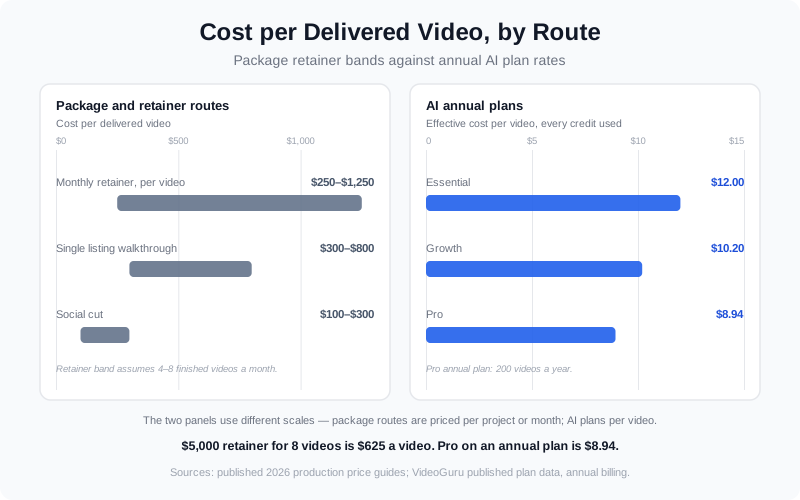
Fig 3 - Cost per delivered video: package retainer bands against annual AI plan rates.
One more question worth asking: what happens when you need a video and the crew is booked? If the answer is "wait three weeks", you have a scheduling risk as well as a cost decision - and that is the gap an on-demand route closes.
Frequently Asked Questions
How much should an agent budget for real estate video each month?
For one or two listings a month, budget per listing: $300-$800 for an edited walkthrough, plus $300-$800 if the property needs drone work. For four or more videos a month, published retainers run $2,000-$5,000 monthly, which is $250-$1,250 per delivered video. If your listing count swings, keep the fixed monthly commitment low and pay per property instead, so a slow month does not buy videos you never publish.
Are turnkey video packages worth it for a single listing?
They are worth it when the listing needs real footage that only a shoot can capture - a lifestyle location, an architectural property, or an agent-on-camera introduction for a high-value seller. They are hard to justify for a standard resale where the photos already exist, because the shoot is the largest line in the quote and the photo-driven walkthrough route produces the listing video without it.
What is the difference between a video package and a video marketing retainer?
A package is scoped to a deliverable set: a fixed number of videos for a fixed price, usually per property. A retainer is scoped to time and volume: a monthly fee for an agreed number of videos and priority scheduling. The package protects you on price; the retainer protects you on turnaround. Choose based on which one hurts more when it goes wrong.
Do AI video platforms replace a videographer?
For listing walkthroughs built from photos, yes - the platform produces the video without a second shoot, and you keep the file formats the platforms want. For work that depends on real filmed footage of people, places, or a cinematic brand film, no; a videographer is still the right hire. The practical split is to commission the flagship film once and produce listing inventory on the automated route.
Can you mix drone shots and real footage into an AI walkthrough?
Yes. VideoGuru accepts your own video clips alongside the listing photos, and they are mixed into the same walkthrough rather than produced as a separate video - drone footage and real-person clips both work this way. It is available on any paid plan, and it is not a separate purchase from the video itself.
What This Means for Your Budget
A turnkey package is a fair way to buy the marketing a listing needs. It is also the most expensive way to buy a walkthrough you could produce from photos you already own. The number that settles the decision is not the monthly fee; it is cost per delivered video, calculated against the videos you will genuinely publish this quarter - and against the turnaround you can live with, which our breakdown of how long real estate videos actually take puts in hours rather than weeks.
Run the arithmetic on one month of your own listings. Count the properties that need a video, multiply by the per-listing rate you were quoted, and place it next to the retainer. Then compare both with an on-demand route where the shoot is already done - the walkthrough built from the listing photos, with your clips mixed in and your brand kit applied. You can start that route on any paid plan; create your first listing video here and see what the per-video number looks like when the crew line disappears.