

Chengran (Felix) Guan
2026-08-02 · 11 min read
From 10-Hour Edits to 30 Minutes:
A Videographer's AI Workflow
Editing one listing video used to take this videographer 10 hours. After rebuilding his pipeline around AI, the same video ships in about 30 minutes. This is his stage-by-stage breakdown: where the hours went, what the AI actually does at each step, and what clients noticed when turnaround dropped from days to hours. If you deliver real estate video for a living, this is the comparison you need — with exact times, toolstack changes, and the parts of editing you should never automate.
Key Takeaways
- Assembly, color, and audio cleanup ate 5 of the original 10 hours. That is where AI saves the most.
- AI did not replace judgment. Shot selection, narrative structure, and final review stayed human.
- Turnaround fell from 48 hours to same-day, and clients changed how they ordered because of it.
- Template-based titles and graphics cut more than an hour per video.
- Same-day delivery became his best sales pitch for new clients.
The Before: A 10-Hour Manual Pipeline
Videography for real estate is a production job: shoot a listing, then turn 20–40 minutes of raw footage into a 1–3 minute walkthrough plus vertical cuts. How much of that you should own depends on who you are. Agents hiring it out pay a local videographer $300–800 per listing and wait 2–5 days. Photographers adding video spend 4–10 hours editing each one until they automate. Full-time videographers live or die on turnaround. Let's call him Dan. Dan shoots luxury listings in a mid-sized metro, about six videos a week in season. Before the rebuild, every video followed the same manual path. Here are his tracked times per stage, per video:
| Stage | Time | What happened |
|---|---|---|
| Ingest and backup | 30 min | Card transfers, file naming, project setup |
| Review and selects | 45 min | Watching every clip, marking keepers |
| Assembly and rough cut | 2 hrs | Timeline construction, pacing, transitions |
| Color | 2 hrs | Matching every room, window pulls, grade passes |
| Audio cleanup | 1 hr | Noise removal, leveling, music bed |
| Titles and graphics | 1 hr | Lower thirds, price cards, logo, captions |
| Export, QC, revisions | 2 hrs | Renders, review passes, client change requests |
| Total | 10 hrs | Two full evenings per video |
Ten hours a video meant six videos a week was a 60-hour editing load on top of shooting. Weekends disappeared. Revisions were the worst part: a client asking for a different music track or a reordered intro meant re-opening a project and re-rendering — another 45 minutes each time.
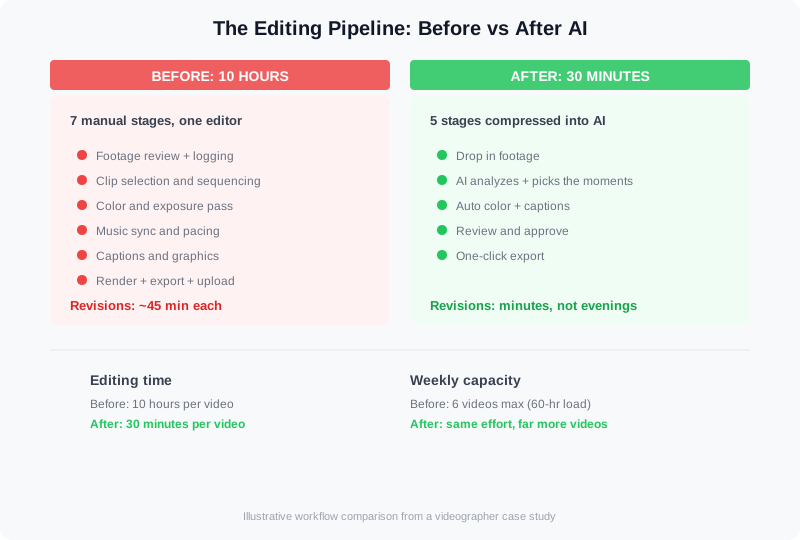
The old pipeline spread 10 hours across seven manual stages. The new one compresses five of them into minutes.
The Turning Point: When Turnaround Costs You Clients
Three things happened in the same month. He missed two open-house deadlines because renders ran long. A listing agent told him she had to pay a rush fee to a competitor to get a video same-day. And he realized roughly 60% of his editing time was mechanical — not creative, not judgment, just moving clips and matching looks by hand.
That last realization is the one that matters. The Bureau of Labor Statistics classifies film and video editing as a job where much of the day is spent on post-production labor. For real estate specifically, the work is repetitive by nature: the same shot types, the same pacing, the same grade for every listing. Repetition is exactly what AI handles well.
The After: An AI-Assisted Pipeline
Dan rebuilt the pipeline around an AI real estate media platform instead of a general-purpose editor. The same seven stages, re-timed:
| Stage | Before | After |
|---|---|---|
| Ingest and backup | 30 min | 10 min (automated) |
| Review and selects | 45 min | 15 min (human) |
| Assembly and rough cut | 2 hrs | 5 min (AI) |
| Color | 2 hrs | 10 min (AI + tweaks) |
| Audio cleanup | 1 hr | 5 min (AI) |
| Titles and graphics | 1 hr | 5 min (templates) |
| Export, QC, revisions | 2 hrs | 20 min |
| Total | 10 hrs | ~30 min |
His numbers, tracked over a month of real client work. Your mileage will vary — the takeaway is the shape of the change, not the exact minutes. Five of the seven stages are now measured in minutes instead of hours, and the two that still take human time — selects and review — are the two where judgment actually lives.
Video walkthrough placeholder: a side-by-side look at manual vs AI-assisted listing video editing.
What AI Actually Does at Each Stage
It helps to know exactly what the machine is handling, because that defines what you still do. In Dan's pipeline:
- Scene detection and assembly: the AI finds shot boundaries, picks usable moments from raw footage, and lays down a rough cut to a standard property-tour structure. Room-to-room flow, automatically.
- Auto color matching: one pass evens out exposure and white balance across every room, so a bright kitchen doesn't blow out next to a dark den. He tweaks, he doesn't build.
- Silence removal and audio leveling: dead air drops out, dialogue and music sit at consistent levels without riding faders.
- Captions and branding: auto-generated captions, lower thirds, and price cards from a saved brand kit — the same logo, fonts, and colors on every video.
- What stays human: picking the hero shot of each room, choosing the opening hook, deciding the story order, and the final full watch-through before delivery.
The Toolstack Changes That Mattered
Dan didn't just swap editors — he changed what kind of tool he edits in. A general-purpose editor gives you maximum control and minimum automation. A purpose-built platform gives you real estate workflows that assume every project is a listing. He runs the full pipeline in VideoGuru, an AI real estate media platform: upload footage, and it assembles, colors, captions, and brands the walkthrough before he touches a timeline.
The second change: templates. He built one intro, one outro, and one price-card style and saved them as a brand kit. Every video now opens and closes the same way, which is also what makes a photographer's work look like a brand instead of a batch of random edits — exactly the consistency we talk about in our guide to real estate videos that get views.
Third, he stopped treating photo and video as separate pipelines. The same platform that auto-edits his walkthroughs also handles his listing photography — AI declutter, sky replacement, and one-click virtual staging for stills. One subscription, one login, one delivery flow for both media types. That consolidation alone removed the file-shuffling between tools that used to eat 20 minutes per job.
What Clients Noticed
The interesting part of this case study is that clients did not say the videos looked different. They said the service felt different.
- Same-day previews. Videos shot in the morning were ready to review by dinner. Agents started using them for the same-day social push instead of waiting for the MLS upload.
- Faster revisions. A music swap or a reordered intro now takes minutes, not an evening. One agent told him, "you're the fastest editor we've worked with" — she was comparing him to the manual-editing market.
- More repeat orders. Two listing agents moved from "video for special listings" to "video for everything" once turnaround stopped being the bottleneck.
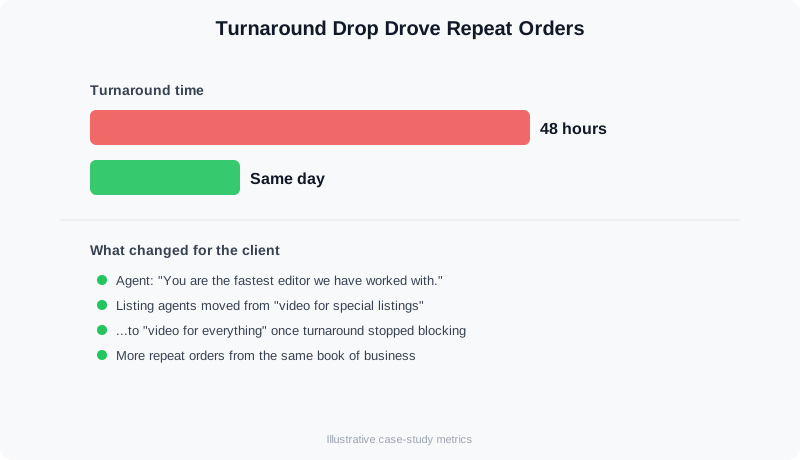
Turnaround dropped from 48 hours to same-day — and that changed how agents ordered.
This matches what the data has said about listing media for years. NAR's research and statistics program consistently finds that roughly 95% of home buyers search for properties online, and Realtor.com's research has tracked how listing content — including video — drives engagement. Faster turnaround doesn't just make you faster; it gets video onto the listing earlier, when online attention is highest.
Who Should Copy This Workflow
Three profiles benefit most from this exact rebuild:
- Photographers adding video. You already have the clients; you don't have the editing hours. An AI-assisted pipeline is the difference between offering video next month and offering video next year. Another photographer cut editing time by 80% the same way.
- Solo videographers at capacity. Dan's 10 hours to 30 minutes is effectively 20 videos of capacity per week without a single new hire. That's a 3x volume increase at the same headcount.
- Media companies standardizing output. When a team produces at scale, consistency and speed compound. See how a real estate media company automated 200 videos a month for the team-level version of this story.
If you're weighing AI tools against hiring editors instead, our white-label vs automation breakdown walks through the cost and quality tradeoffs of each path.
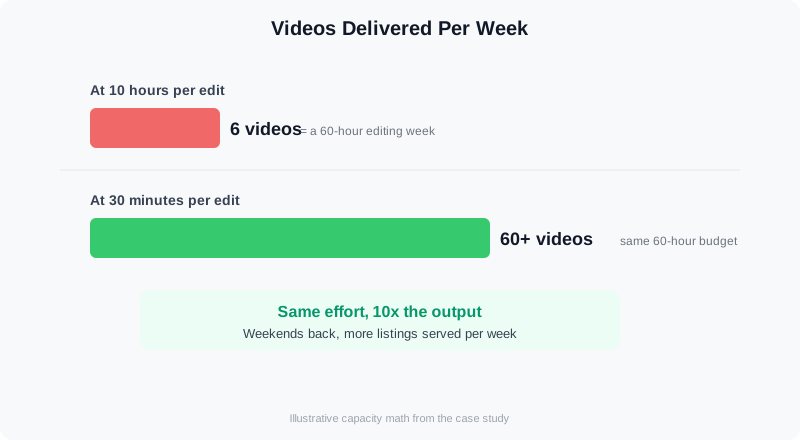
At 10 hours per edit, six videos consumed his entire week. At 30 minutes, the same effort covers a much larger pipeline.
What Should You Look For When Hiring a Real Estate Videographer?
If you are an agent reading Dan's story from the other side of the invoice, the first question is whether you need a videographer at all. Match the spend to the listing price. Under $500K: a steady phone walkthrough plus an AI editing tool is enough; buyers at this price care that a video exists, not that it was shot on cinema glass. $500K–$2M: hire a local real estate videographer. Expect $300–800 per listing for a 1–3 minute walkthrough with drone exteriors, delivered in 2–5 days. $2M+: budget $1,500–5,000 for a cinematic crew with a gimbal operator, licensed drone pilot, and a narrative edit. Searching "real estate videographer near me" will surface all three tiers mixed together, so decide the tier before you compare quotes.
Once you know the tier, check the same five things on every quote. Most bad hires fail on one of these, not on camera quality:
- Turnaround in days, in writing. Same-day to 48 hours is now achievable with an AI-assisted pipeline like Dan's. Anything over 5 business days costs you a weekend of showings.
- Vertical cuts included. Ask for at least one 15–60 second 9:16 version for Reels and TikTok. Many videographers still deliver only a horizontal MLS file and charge $50–150 extra for verticals.
- FAA Part 107 drone license. Paid drone footage in the US legally requires it. No certificate, no drone shots. Our guide to drone photography for listings covers what to ask for.
- Revision count. One or two rounds is standard. Zero means you eat every mistake; unlimited usually means slow.
- Raw footage ownership. Confirm whether you can reuse clips for social posts, neighborhood reels, and future listings. Some contracts license only the finished cut.
Photography and videography are often sold as a bundle, and the bundle is usually the better buy: a combined shoot saves a second appointment and 10–20% versus booking separately. Our guide to hiring and managing a real estate photographer covers how to brief that shoot. For agents who want walkthrough-quality video on every listing without hiring per-listing, VideoGuru turns your own phone footage or listing photos into a branded walkthrough with vertical and horizontal exports in about 10 minutes, for a flat monthly fee instead of $300–800 a shoot. For videographers and photographers, it is the same kind of pipeline Dan built, which lets you quote same-day delivery to those agents. If you are pricing that service, see how to price real estate video services.
Frequently Asked Questions
Can AI really cut a 10-hour edit down to 30 minutes?
Yes, for a standard listing walkthrough — but with an important caveat. The 10 hours included hours of mechanical work: assembly, color matching, audio cleanup, and re-rendering. AI compresses those stages to minutes. The human stages — choosing shots, structuring the story, and final review — still take real time. For a straightforward property tour, this videographer's tracked total dropped from 10 hours to about 30 minutes. For a complex custom project, expect more human time, but still a fraction of the manual cost.
Which parts of real estate video editing should stay manual?
Shot selection, narrative structure, client communication, and the final quality check. AI can assemble a competent tour, but it won't know that the kitchen's hero shot is the island at golden hour, or that this client wants the backyard first. Keep the creative decisions human and let the machine handle the repetition. The result is faster delivery with no quality loss — the combination clients actually care about.
Will AI-edited listing videos look worse than manually edited ones?
In this case, clients couldn't tell the difference — and that's the point. The videos looked consistent, which is what matters across a portfolio of listings. AI color matching applies the same grade logic to every room, and template branding keeps every video on-style. What you trade is granular control; what you gain is consistency and speed. If a specific shot needs a custom grade, you can still do it by hand in the same pipeline.
What are the best techniques for real estate videography?
Shoot at 24 or 30 fps with a stabilized camera or gimbal, walk each room in one slow 5–10 second move, and keep vertical lines straight by holding the camera at chest height. Shoot every room twice: once wide, once toward the best feature. Plan for 1–3 minutes of finished video from 20–40 minutes of raw footage, ordered entrance to backyard the way a buyer would tour. Add a 5–10 second drone exterior at the open and close, and grade every clip with the same white balance so rooms match. A listing video shot list keeps the shoot under an hour.
Can you recommend top-rated real estate videographers nearby?
No directory can vouch for a videographer in your zip code, so check three sources instead: your local MLS or photographer association listings, the credits on the best-looking listing videos in your market (agents will tell you who shot them), and Google Business profiles with 20+ reviews that mention turnaround. Ask each candidate for three recent walkthroughs at your price tier and their delivery time in days. For agents under $500K per listing, or anyone who needs video on every listing rather than a few, an AI tool like VideoGuru gets you a finished walkthrough in about 10 minutes; a local videographer is still the right call for $2M+ homes.
Ready to shrink your own editing pipeline? VideoGuru's AI editing tools can assemble, color, caption, and brand your listing videos in minutes — and its photo editing suite handles virtual staging and decluttering for stills in the same workflow. Start for free at VideoGuru.
The Bigger Picture
Dan's story is one videographer's numbers, but the pattern is industry-wide: editing time is the real bottleneck in real estate media, and AI flips its economics. A 10-hour edit becomes a 30-minute one; a 48-hour turnaround becomes same-day; a one-person business gains the capacity of a three-person team.
The videographers who treat AI as a mechanical assistant — not as a replacement for judgment — are the ones who win more listings, ship faster, and keep their evenings. The ones who ignore it are competing at a 20x time disadvantage on every single video. The toolstack decision you make this quarter will look obvious a year from now.