

Chengran (Felix) Guan
2026-10-01 · 12 min read
How to Advertise Real Estate:
A Beginner's Guide for 2026
To advertise real estate in 2026 you do not need one big campaign — you need three channels pulling on the same listing: a video ad for reach, your listing photos for search and click-through, and direct follow-up for the people who already raised a hand. Video is the piece most agents skip and the piece that changes the outcome, because one listing video can run as a paid social ad, live on YouTube, sit inside your MLS listing, and play on the property website — without a second shoot. This guide walks a beginner through the channels that still work, what to spend and where, how to produce the video from photos you already own, and the advertising rules you cannot break.
Key Takeaways
- Advertising is a channel mix, not a single buy. Run two primary channels and one support channel per listing — most agents spread themselves across five and finish none of them.
- Video ads earn their budget because one asset serves four placements. The same 30–45 second walkthrough works as a Meta or Instagram ad, a YouTube upload, an MLS add-on, and website hero.
- Budget per listing, not per month. Set the number before the listing goes live, split it across production, distribution and follow-up, and write it down.
- You can produce the video from the photos you already have. An AI photo-to-video platform turns a listing photo set into a walkthrough in about 10 minutes, in 16:9, 1:1 and 9:16, and your own drone or real-person clips mix into the same video.
- Fair housing and MLS rules apply to the creative, not just the price. Ad copy, AI-altered photos, and video captions all fall under the same advertising rules.
The Advertising Channels That Still Work in 2026
Most beginners start by asking which platform is best. The better question is what each channel is actually good at, because they fail in different ways: paid social reaches strangers, search catches people already looking, and your own database converts the fastest but is the smallest.
| Channel | What it costs | Time to first lead | Best for |
|---|---|---|---|
| Paid social video (Meta, Instagram) | Ad spend + one piece of creative | Hours to days | Reach and retargeting on a new listing |
| Short-form organic (Reels, TikTok, Shorts) | Time to produce and post | Weeks, then compounds | Local brand and discovery |
| YouTube | Time to produce | Weeks to months | Buyers researching a neighborhood |
| MLS and syndication | Your MLS dues | Immediate | Buyers already in the market today |
| Email and CRM to your sphere | Your time | Hours | Past clients and referral sources |
| Direct mail with a video landing page | Print and postage | One to two weeks | Farm areas and higher-priced listings |
| Google Business Profile and local search | Time to maintain | Weeks | "Realtor near me" and review-driven search |
The practical rule for a beginner: pick one paid channel, one owned channel, and keep your database running underneath both. Paid social buys attention now. Your listing photos and video on the MLS and website catch the buyers who are already shopping. Your CRM quietly converts the people who already know you — which is why it is the cheapest lead source you own and the one agents neglect first.
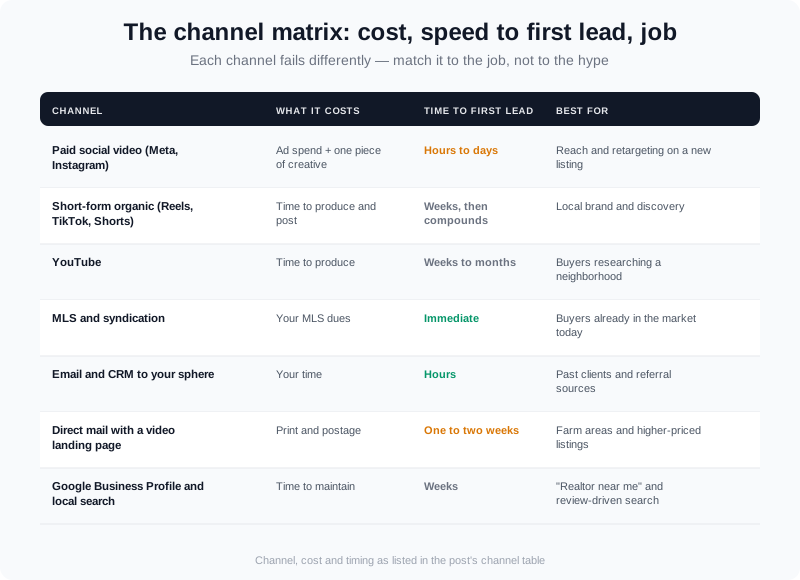
A channel matrix beats a channel list — each option fails in a different way, so match the channel to the job.
What Platforms Are Best for Distributing Video Advertisements?
There is no single best platform for distributing video advertisements — the answer depends on whether you are an agent filming your own listings, a photographer or videographer selling media services, or a brokerage running a team brand. Each of those three has a different right answer, and the creative changes with it.
1. Meta and Instagram: the default paid reach
For a single listing, Meta is still the fastest way to put a walkthrough in front of people who did not know the home existed. Its strength is targeting and retargeting: show the video to a broad local audience, then show it again to everyone who watched at least half. Because the placement runs vertically, the 9:16 version of your video does the work; the 1:1 version covers feed placements and the 16:9 version is your fallback for in-article placements.
2. YouTube: where buyers actually research
YouTube is the platform agents underestimate. Its value is not the impression count — it is the search intent behind it. Someone typing the street name, the school district, or the neighborhood into YouTube is further down the funnel than anyone on a social feed. Upload the full walkthrough there, keep the title specific to the property and the area, and embed the same video on the listing page so the view count, the page and the ad all reinforce each other.
3. TikTok and Reels: cheap attention, honest creative
Short-form is where a listing video earns the most attention per dollar spent and punishes anything that looks like an advertisement. The format that works is a 15–30 second hook — one room, one surprising detail, one reason to keep watching — not a compressed version of the full tour. Treat short form as top-of-funnel discovery and long form as the asset that closes, then let the short clips point back to the full walkthrough.
4. Your own website and email: the cheapest repeat
A video ad that only lives on a social platform stops working the moment you stop paying. Put the same file on the listing page, in your email signature, and in the follow-up sequence to your sphere. This is the one distribution channel with no marginal cost per view — and it is where the walkthrough keeps earning weeks after the ad spend ends.
One asset, four placements. That is what makes a listing video worth producing even for a modest listing: you are not buying a video, you are buying creative that can be cut, cropped and re-used across every channel on the list above. For a deeper channel-by-channel take, see our real estate video marketing strategy guide.
How to Budget Real Estate Advertising Without Guessing
The most common budgeting mistake is setting a monthly number and letting it drift across whatever is running that month. Advertising a listing works better when you price the campaign per listing, before it goes live, and split it into three lines you can actually control.
- Production. What it costs to get the video made — your time, a videographer, or an AI platform. This is the line most agents leave blank and then improvise on the day the listing goes live.
- Distribution. Ad spend, boosted posts, or mailer costs. This is the line you scale up or down listing by listing.
- Follow-up. The time and tools to answer the leads the ad creates. Skip this line and the other two are wasted.
Then substitute your own numbers rather than copying someone else's market: take the number of listings you carry at once, multiply by the per-listing budget you are comfortable with, and that is your monthly advertising ceiling. Agents who cannot state that number are the ones who overspend in a busy month and go silent in a slow one.
Cost is also the second-biggest barrier agents report. In NAR's 2026 Technology Report, 59% of agents named cost as a challenge and 63% named the learning curve, ahead of having too many options (44%) and privacy or security concerns (36%) — a reminder that the budget problem is usually a tooling problem wearing a budget costume. You can read the survey behind those figures at NAR's Realtor Technology Survey. The same report found 48% of agents now use AI at least once a week, with saving time (81%) and improving the client experience (71%) as the top reasons — covered in Real Estate News' summary of the report.
On the production line specifically, per-video pricing is now a real alternative to booking a crew. VideoGuru's annual plans work out to an effective $12.00 per video on Essential, $10.20 on Growth and $8.94 on Pro when you use every credit in the cycle — a number you can put straight into the production line of the model above instead of guessing.
The Fastest Route to Video Ads: Use the Photos You Already Have
The reason most agents advertise with photos only is not preference — it is schedule. Booking a shoot, waiting on an edit, and then discovering the ad needs a vertical cut is three separate delays. The workaround is to stop treating video as a separate production and start it from the listing photo set you already paid for.
An AI photo-to-video platform takes a standard listing photo set and assembles it into a walkthrough — camera motion, transitions and pacing included — in roughly 10 minutes, and outputs the three aspect ratios you need for advertising: 16:9 for YouTube and the listing page, 1:1 for feed placements, and 9:16 for Reels, Shorts and TikTok. If you do have footage, it does not sit on the shelf: your own drone shots or real-person clips are mixed into the same walkthrough rather than living in a separate edit. Many agents also add an AI avatar built from a headshot, plus a cloned version of their own voice, composited into the property walkthrough — one video with the presenter and the narration inside it, not a separate talking-head clip. That capability is available on every paid plan (Essential, Growth or Pro), not the free tier, and it does not require a separate avatar subscription.
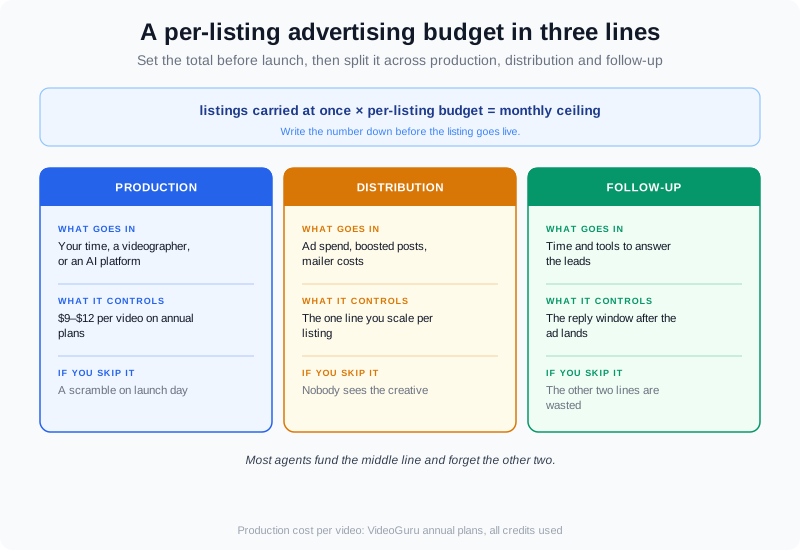
Three budget lines, one per listing: production, distribution and follow-up. Most agents fund the middle one and forget the other two.
The same platform covers the still images that carry the rest of your advertising. One-click virtual staging fills an empty room for the ad creative, declutter clears the counters before the photo runs, and furniture and decor swaps let you test a staged look without a second shoot — so the photo half of the campaign is not a separate vendor, a separate invoice, or a separate deadline. For the photo-to-video mechanics in detail, see Real Estate Photo to Video AI.
One practical consequence: because the ad creative is cheap to regenerate, you can afford to test. Run one angle for a week, swap the opening room or the hook, and re-run. That iteration loop is what a booked shoot-and-edit cycle makes impossible and what a 10-minute walkthrough makes routine. If you want a library of angles to test, start with our real estate video marketing ideas for agents.
Short Form or Long Form? Match the Format to the Channel
Beginners usually pick one format and force it everywhere. The channel should decide the format:
- 15–30 seconds, vertical — paid social and short-form feeds. One hook, one room, one reason to keep watching.
- 45–90 seconds, vertical or square — retargeting and email. This is where you can add the neighborhood context and the second-best room.
- 2–4 minutes, horizontal — YouTube, the listing page and the MLS add-on. Full walkthrough, narrated, built for the buyer who is already interested.
A veteran realtor breaks down when short form beats long form — the same format decision you are making when you choose what runs as an ad and what lives on the listing page.
If you only have time for one version this week, make the vertical cut first — it serves the paid channel that produces leads fastest, and it can be cropped to the longer format later. For more on which formats hold attention on which feed, see Real Estate Reels: The 2026 Playbook for Agents.
A 7-Day Launch Checklist for a New Listing
- Day 1 — Set the number. Write the per-listing budget and split it across production, distribution and follow-up before you order anything.
- Day 1 — Assemble the photo set. Pick the 12–20 stills that will carry the campaign, and fix the obvious problems in them first.
- Day 2 — Produce the video. Build the walkthrough from the photo set, then export 16:9, 1:1 and 9:16.
- Day 3 — Write one hook per channel. The paid-social hook and the YouTube title should not be the same sentence.
- Day 4 — Load the owned channels. Listing page, MLS add-on, email signature, CRM follow-up sequence.
- Day 5 — Launch the paid channel. Start narrow — a tight local radius beats a broad city-wide audience on a single listing.
- Day 6 — Answer everything. Reply to every comment and DM inside an hour where you can; the ad buys the attention, the reply converts it.
- Day 7 — Review and re-cut. Check watch time and click-through, keep the opening that worked, replace the one that did not.
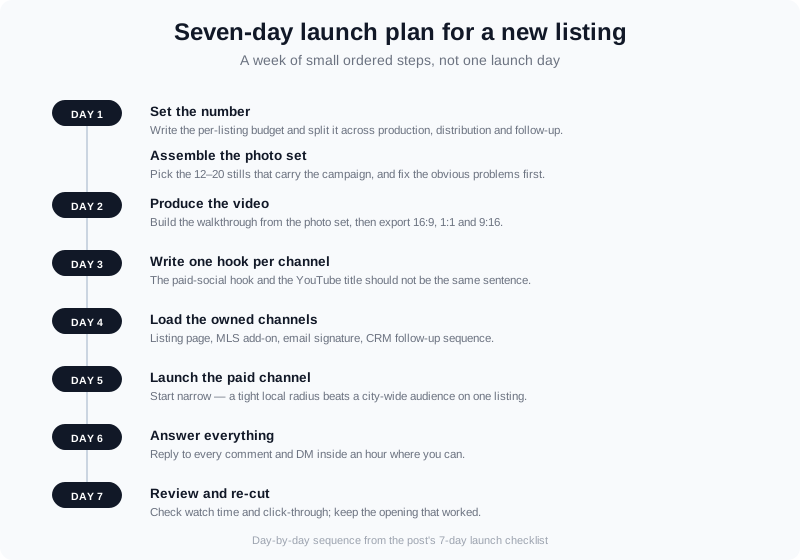
A listing campaign is a week of small, ordered steps — not a single launch day.
The Advertising Rules You Cannot Break
Advertising rules apply to the creative, not just the spend, and three of them catch beginners:
- Fair housing. Your ad copy, captions and voiceover must not describe or imply a preference based on race, color, religion, sex, disability, familial status or national origin. Phrases like 'perfect for a young family' or 'safe neighborhood' are the classic traps. The HUD Office of Fair Housing and Equal Opportunity publishes the guidance, and NAR's fair housing resources translate it for listing marketing.
- MLS rules. Watermarks, contact overlays, links and video hosted outside the MLS are all governed — check our MLS video requirements guide before you upload.
- AI-altered media disclosure. If staging or enhancement changed the property materially, the disclosure rules apply. Our AI photo disclosure guide covers what has to be stated and where.
None of this is a reason to advertise with weak creative. It is a reason to write the copy deliberately and to note what you altered in the photo set before it becomes an ad.
Three Mistakes That Waste the Budget
- Advertising a listing with the weak photos. The ad amplifies whatever you feed it — including the bad bathroom shot you meant to crop. Fix the stills first; our listing photo mistakes guide covers the common ones.
- Running five channels at once. A beginner with five half-funded channels loses to a beginner with two properly funded ones every time.
- Treating the ad as the finish line. Advertising creates leads; it does not answer them. If nobody owns follow-up, the campaign has no measurable return.
Frequently Asked Questions
How much should I spend to advertise one listing?
Treat it as a per-listing decision rather than a monthly habit: decide the total, then split it across production, distribution and follow-up. The production line is the one that has changed most — a walkthrough built from photos you already own removes most of it, and an AI platform's annual plans work out to roughly $9–$12 per video depending on tier. That leaves your distribution line as the only variable you really need to test.
Can I advertise a listing without shooting any video?
Yes. Filming is optional, not required — a photo-to-video platform assembles a walkthrough from your existing listing photo set, and you can still add your own clips later if you have them. The reason to film is usually a specific shot the photos cannot tell, not the existence of the video itself.
How long should a real estate video ad be?
Match the length to the placement, not to a universal rule: 15–30 seconds vertical for paid social and short-form feeds, 45–90 seconds for retargeting and email, and 2–4 minutes horizontal for YouTube, the listing page and the MLS. The same source video can be cut to all three.
Do AI-generated listing photos and videos need a disclosure?
When the alteration changes what a buyer would reasonably believe about the property — furniture added to an empty room, a renovation visualized, a season changed — the disclosure rules apply, and several MLSs and state bodies add their own. See our AI photo disclosure rules guide for the current position before the creative goes live.
Final Thoughts
Advertising real estate well is less about finding a secret platform and more about running a short, repeatable loop: good photos in, one video that serves every channel, two channels funded properly, and follow-up that actually answers the leads. Agents who run that loop every listing get compounding reach; agents who improvise a campaign at launch get a spike and a bill.
Start with the listing you are marketing right now. Set the per-listing number, build the walkthrough from the photos you already own, and put it on the two channels you can actually maintain. You can create your first listing video at videoguru.ai, and the product docs walk through the workflow end to end.