

Chengran (Felix) Guan
2026-09-08 · 11 min read
How to Create Real Estate Market Update Videos That Win Listings in 2026
A real estate market update video is a short, data-driven video in which an agent explains what is happening in their local market: prices, days on market, inventory, and what it means for buyers and sellers. Posted once a month, it does three jobs at once — it keeps you in front of past clients, positions you as the local expert, and gives sellers a reason to call you when they decide to list. You do not need a film crew, a broadcast voice, or a fancy studio. You need five numbers, a 45-second script, and a monthly habit.
Most agents never post a market update at all. That gap is the opportunity: the few who publish local numbers on a regular schedule become the ones buyers and sellers already trust before the conversation turns to listing. This guide gives you the exact format, the data to pull, a script you can fill in, and a production workflow that fits in under an hour a month.
Key Takeaways
- A market update is authority content, not listing content. Its job is to make you the obvious local expert so sellers call you first — it rarely sells a specific home.
- Five numbers carry the whole video: median sale price, days on market, inventory or months of supply, list-to-sale ratio, and the mortgage-rate context.
- Keep it to 45–60 seconds. Short, structured, and regular beats long and cinematic. Monthly consistency is what compounds.
- AI removes the production excuse. Photos-to-video assembly, AI voiceover, captions, and brand templates turn the build step into minutes — the data and the habit are the real work.
Why Market Update Videos Win You the Next Listing
Listing conversations rarely start when the sign goes in the yard. Sellers usually think about selling for months, and during that window they pay attention to which agents appear in their feed, their inbox, and their neighborhood. A market update video is one of the few formats that shows up on a predictable schedule with information instead of promotion.
The National Association of Realtors publishes annual research on what sellers value when choosing an agent, and the pattern holds every year: sellers interview agents they already know or who come recommended, then pick the one who seems most on top of the local market. A monthly video that quotes real neighborhood numbers demonstrates that competence in public, weeks before the listing appointment. It also gives past clients a reason to stay subscribed — they will refer you because you made them look informed about their own biggest asset.
None of this works if the video is all about you. The format only earns trust when the data is real, the interpretation is honest, and the call to action is gentle. We covered which video formats actually drive calls and showings in real estate video content that actually converts — the market update is the strongest recurring format on that list because it is useful to every buyer and seller in your farm, whether or not they have a transaction in mind.
The Five Numbers Every Market Update Needs
Resist the urge to show ten statistics. Viewers remember one or two numbers from a 45-second video, so choose five that tell a coherent story about your market, and pull them from the same source every month so the trend line is honest.
| Number | What it tells buyers and sellers | Where to get it |
|---|---|---|
| Median sale price (and price per square foot) | The headline. Up, down, or flat — this is the number your market is known by. | Your MLS or local association market report |
| Days on market | Pace and urgency. Falling days on market favor sellers; rising days on market give buyers room to negotiate. | Your MLS or local association market report |
| Inventory and months of supply | Months of supply is the clearest supply-and-demand gauge. Below six months generally favors sellers; above six favors buyers. | Your MLS or local association market report |
| List-to-sale price ratio | How close homes sell to asking price — the most persuasive number for a nervous seller. | Your MLS or local association market report |
| Mortgage rate context | Rates decide affordability. One sentence of national context makes the local numbers actionable. | A weekly rate survey or your lender partner |
Your MLS report is the only source that reflects your actual farm, so it comes first every month. National series add context when local data is thin: the U.S. Census Bureau publishes new residential sales data that shows the national new-home picture, and the Federal Housing Finance Agency's House Price Index tracks price movement in nearly every metro. The NAR research library is the reference point for national buyer and seller behavior when you want to add a line about the bigger picture. Pull the same five from the same sources each month and the trends in your videos will match reality — which is the entire point.
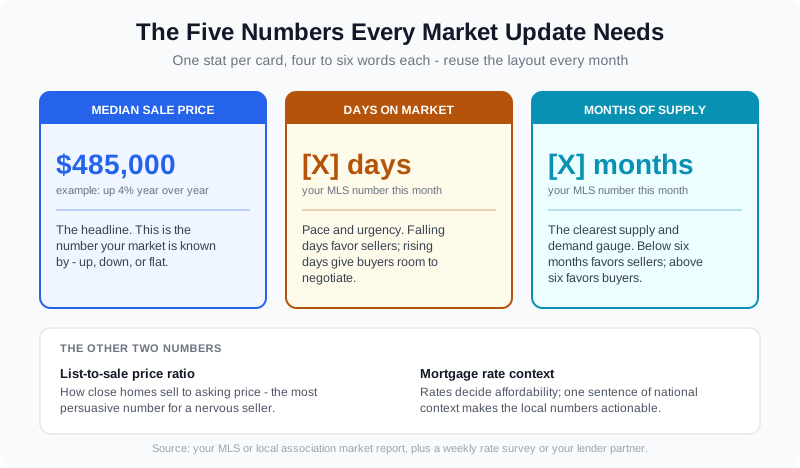
One stat per card, four to six words each — reuse the same layout every month and your audience learns to read it instantly.
The 45-Second Script Template
You do not need to be a writer. Fill in the blanks, read it once out loud, and adjust anything that does not sound like you. The structure does the heavy lifting:
- The hook (0–5 seconds): "Here's what happened in [your market] last month — and what it means for you."
- The headline number (5–15 seconds): "The median home sold for [amount], [up/down/flat] [X%] from this time last year."
- The market read (15–35 seconds): "Homes are taking [X] days to sell, and sellers are getting [X]% of asking price. Inventory sits at [X] months, so it's still a [buyer's/balanced/seller's] market."
- The meaning (35–45 seconds): "For buyers: [one honest piece of advice]. For sellers: [one honest piece of advice]."
- The soft call to action (last line): "If you'd like to know what this means for your home specifically, my inbox is open — no pressure, just answers."
How long should a market update video be?
Forty-five to sixty seconds is the sweet spot for social platforms, and it forces you to be selective about what you say. A 30-second version works for stories and short-form feeds; a 90-second version is acceptable for YouTube and email when you add one neighborhood or price-band breakdown. If you cannot say it in 90 seconds, cut a number rather than rambling — the video's power comes from clarity, not completeness.
What do you say when the market is slow or prices are down?
Say it plainly. A market update that spins bad news reads as dishonest, and one honest down-market video builds more trust than a year of cherry-picked numbers. Frame decline with perspective — "prices are off their peak but still above where they were two years ago" — and give each side one constructive takeaway. Sellers respect the agent who tells them the truth about timing before the listing appointment, even when the truth is "wait" or "price it carefully."
Make the Numbers Visual: Cards Over Charts
Every number you say should appear on screen as you say it. Viewers watch social video on mute more than half the time, so the caption text and the on-screen cards carry the message when the audio cannot. Keep each card to a label, a value, and four to six supporting words — "Median price · $485,000 · up 4% year over year" — and let the card sit on screen for the full sentence that explains it.
Simple stat cards beat elaborate charts for a 45-second format. A line chart showing twelve months of median price is the one chart worth including, because a trend line tells the story faster than words. Everything else works better as a clean card or a short comparison. Fill the remaining seconds with b-roll: a neighborhood street, a home exterior, a local landmark. You already own the best b-roll — the listing photos and clips from homes you have sold this year — and your past clients love seeing their former home in your update.
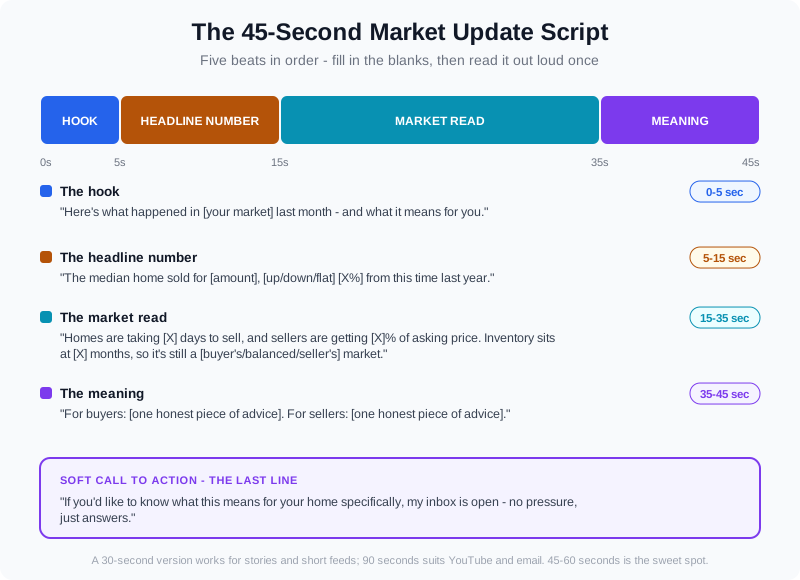
Five beats: hook, headline number, market read, the meaning, and a soft call to action.
If you are building a video from still photos, the photos themselves need to look sharp — a blurry or poorly lit exterior undercuts the authority of your data. That is where AI media platforms earn their keep: the same platform that edits your video can enhance the listing photos behind your cards, with one-click corrections, declutter, and virtual staging for stills when a room needs help. Keep the asset pipeline simple: good photos in, clean cards over them, honest numbers on top.
The Under-An-Hour Monthly Workflow
The first market update takes the longest because you are building templates. By the third month, the whole cycle — data, script, video, posting — should fit in under an hour. Here is the workflow we recommend to agents:
- Pull the numbers (20 minutes, then 10). Download your association's monthly report, fill the same five slots, and save the trend from last month so you can state the change.
- Fill the script (10 minutes). Drop the numbers into the template above and read it aloud once. Edit for your voice, not for perfection.
- Record or assemble (20 minutes). Two good options: record one 45-second take on your phone against a window or in front of your listing sign, or build the video from photos and cards with AI. If you already shoot listing video, see how fast a photo-driven cut comes together in our guide to turning listing photos into listing videos — and if you want narration without recording, AI voiceover reads your script in a natural voice while captions and your brand colors render automatically, the same way AI can produce a listing video in under 10 minutes.
- Post everywhere from one export (10 minutes). Export the vertical version for feeds and stories, the square version for Facebook and email, and post. Save every monthly card so next month's comparison is one click.
Record a batch when you can. Two or three updates filmed in one sitting — same backdrop, different month's numbers — turn the recording step into a quarterly appointment instead of a monthly one. The videos stay relevant because the data is what changes, not the set.
Where to Post It — and How to Know It Is Working
Your sphere of influence is the primary audience: past clients, current clients, and the people in your farm who will list in the next 24 months. Post the video to Instagram and Facebook feeds, drop a cut-down version in stories, publish it on YouTube for search, and send it in a short email to your database. The email list is the part agents skip, and it is the part that converts — a market update is the ideal monthly newsletter because it is useful rather than promotional. For a full channel-by-channel breakdown, our real estate video marketing strategy guide covers where each video type belongs, and 30 days of real estate video ideas shows how the update slots into a broader content rhythm.
One video a month becomes a content system when you repurpose it. The same data becomes an Instagram carousel, a LinkedIn post, a one-page market snapshot for your listing presentation, and a follow-up email to every seller you met this month. Our guide to repurposing one listing into 30 pieces of content applies the same logic to market updates — the data is the asset, and the video is only the first cut.
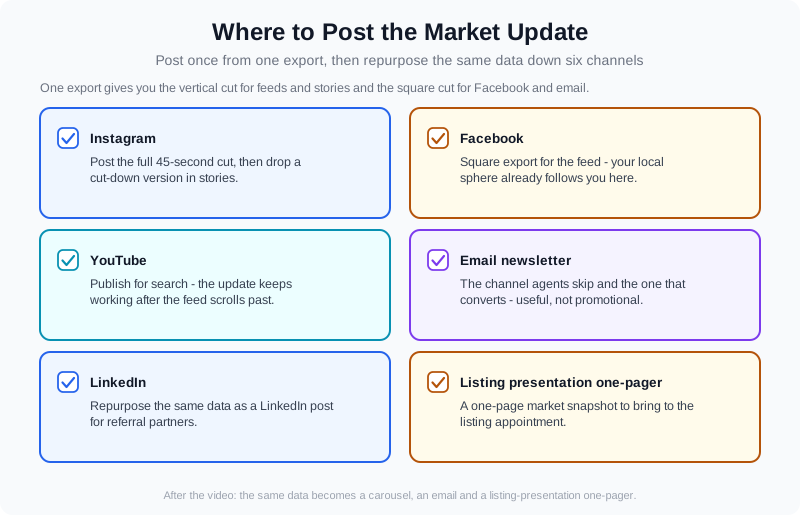
Post the video, then repurpose the same data into a carousel, an email, and a listing-presentation one-pager.
Measure the update like a lead source, not a content score. Track three things each month: how many new inquiries mention the video or the market data, how many past clients replied to the email, and — over two or three quarters — how many listing appointments came from the people who watch consistently. Views and likes are vanity for this format; the question is whether the person who watched in March calls you in September. If you want a deeper framework for tying video to results, our post on video content that actually converts breaks down the metrics that matter for each stage of the funnel.
Ready to put your first market update in front of your sphere this month? VideoGuru's AI platform assembles your photos and clips into a finished, captioned video — with AI voiceover, your brand colors, and export sizes for every platform — plus photo editing tools for the stills you pair with the cards. Start for free at VideoGuru.
Frequently Asked Questions
How often should real estate agents post market update videos?
Once a month is the standard that works: it matches the cadence of local market reports, gives you a clean trend line to report, and is sustainable for years. If you are just starting, commit to a quarterly update for the first two quarters so the habit forms without pressure, then move to monthly. Posting more often than monthly rarely adds value because the local data does not change meaningfully week to week — consistency on a monthly schedule beats bursts of activity.
Where do agents get the data for a market update video?
Your MLS or local association market report is the primary source — it reflects your actual farm, and most associations publish a monthly summary you can quote. National context comes from the U.S. Census Bureau's new residential sales data, the FHFA House Price Index, and the NAR research library. Whatever you use, pull the same five numbers from the same sources every month and never round in a way that changes the story. If you are unsure whether you may quote a statistic, your association's rules and your broker are the right checkpoints.
Can AI really make a market update video for me?
Yes, for the production part. AI assembles your photos and clips into a sequence, generates captions, reads your script as a natural-sounding voiceover, applies your brand colors and logo, and exports the vertical, square, and widescreen versions in one pass. What AI cannot do is supply the numbers — the data must come from your MLS report, and you should review every figure before the video goes out. Agents who use this workflow typically go from data to finished video in well under an hour, and the result looks consistent month after month because the template does not change.
Putting It All Together
Market update videos are not a content trend; they are a professional habit. Five numbers from your MLS, a 45-second script, cards that put each stat on screen, and one export posted to your feed and your email list — repeated every month — will do more for your authority in your farm than any single polished video ever will. The data is already published every month. The production is now a template that takes minutes. The only missing piece is the calendar reminder. Pick a day, pull your numbers, and let your market hear from you before they need you.