

Chengran (Felix) Guan
2026-10-05 · 10 min read
How to Become a One-Person Real Estate Video Creator
Becoming a one-person real estate video creator in 2026 means owning the whole pipeline yourself — winning the listing, capturing the property, cutting the video, and publishing it — with no crew and no hired editor. What makes that realistic now is not working faster by hand; it is that AI took over most of the labour. A platform like VideoGuru turns the listing photos you already have into a narrated walkthrough in about 10 minutes, and you can composite your own face and a clone of your own voice into that same video. The rest of this guide — the outputs, the weekly rhythm, the costs, and how to price the work — serves that one-person model.
Most people searching this question are one of three readers: an agent who wants to stop paying per video, a photographer adding motion to a stills business, or a videographer who wants to leave the edit bay and keep the client. The steps are the same for all three, but the maths differ, so this guide keeps them separate where it matters.
Key Takeaways
- A one-person real estate video creator runs the full pipeline solo: capture (or existing photos), edit, brand, and publish.
- The three products that sell are the listing walkthrough, the vertical social cut, and the presenter or market-update video.
- AI photo-to-video collapses the longest stage — editing — from hours to minutes, which is what makes a solo practice viable at volume.
- VideoGuru covers both halves: photo-to-video walkthroughs plus an AI avatar with real-person voice cloning, available on any paid plan (not the free tier).
- Price from a cost stack plus a margin, not from another creator's rate card.
What Is a One-Person Real Estate Video Creator?
A one-person real estate video creator is a single operator who produces listing and marketing video end to end: they plan it, capture the property, edit it, brand it, and publish it. There is no second shooter, no outsourced editor, and no separate producer. You are simultaneously the strategist, the camera operator, the editor, and the publisher.
That definition is what separates this role from a traditional videographer and from an agent who occasionally points a phone at a kitchen. A traditional videographer scales by adding crew and edit capacity, which raises cost and coordination. A one-person creator scales by systematising the work: repeatable shot lists, reusable branding, and increasingly, AI that handles the stages a crew used to. Photographers who add video to a stills business usually start here, because they already own the clients and the access.
The reason the role exists as a business now, rather than as a hobby, is a supply-and-demand gap. Buyer attention has moved to video, while the number of people who can produce a clean listing film at a price an agent will pay is still small. That gap is the opening.
The Three Outputs a Solo Creator Sells
You do not sell “a video.” You sell three distinct products, each with its own aspect ratio, its own platform, and its own price. Getting this right is the difference between a busy freelancer and a business that renews every month.
- 1. The listing walkthrough (16:9). The full property tour for the MLS, the listing page, and YouTube. This is the flagship deliverable and the one agents judge you on.
- 2. The vertical social cut (9:16 or 1:1). A 15–60 second edit built for Reels, TikTok, and Shorts. This is the marketing workhorse — it earns reach and it is what retainer clients want weekly.
- 3. The presenter or market-update video. You on camera (or an avatar of you) talking to buyers, with your own cloned voice. This is the trust builder that turns a video vendor into “the agent's agent.”
VideoGuru exports all three aspect ratios — 16:9, 1:1, and 9:16 — from a single project, so you shoot or upload once and publish in every shape the listing needs.

A solo creator sells three shaped products from one property: the 16:9 walkthrough, the 9:16 social cut, and the presenter video.
The Traditional Solo Pipeline (and Where It Breaks)
Run the old way, a single listing video moves through four stages. Pre-production is the shot list, the script, and the schedule. Capture is the on-site shoot — typically a couple of hours once you include travel, setup, and re-shoots. Editing is the long pole: sequencing clips, cutting dead air, colour, music, titles, and export. Publishing is the upload, the caption, and the distribution.
Three of those four stages scale linearly with the number of listings. Editing is the one that becomes the ceiling. A creator who spends an evening in the edit for every video can serve a handful of clients; past that, either quality drops or you stop sleeping. This is exactly the trap described in what a real estate video editor actually does — and it is why so many solo operations outsource the cut and quietly lose their margin to it.
New to real estate video? A working orientation to the formats, the moving parts, and who typically handles which stage — the baseline every one-person creator starts from.
The manual baseline is worth learning even if you plan to automate. You need to know what good sequencing, pacing, and colour look like before you trust a machine to do them — the same instinct is what lets you reject a bad AI output in three seconds.
How AI Changes the One-Person Math
AI does not remove the need for taste; it removes the need for hours. Four changes matter for a solo creator, and they compound.
- Photo-to-video. Instead of cutting footage, you assemble a narrated walkthrough from the listing photos you already have. This is the single biggest change, because it means a property you never filmed can still become a listing video — see how photo-to-video AI works.
- Avatar and voice cloning. VideoGuru can composite your face and a clone of your real voice into the walkthrough, so every property carries your personal brand. This is a paid-plan feature, available on Essential, Growth, and Pro — not the free tier, and with no separate avatar subscription bolted on top.
- Your own clips mixed in. The photo-to-video route is not photos-only: you can drop in drone shots or real-person clips and they are mixed into the same walkthrough, on any paid plan.
- One-click effects. Twilight, virtual staging, declutter, restyle, furniture drop, renovation, and seasonal looks apply from a single click, replacing an effects editor.
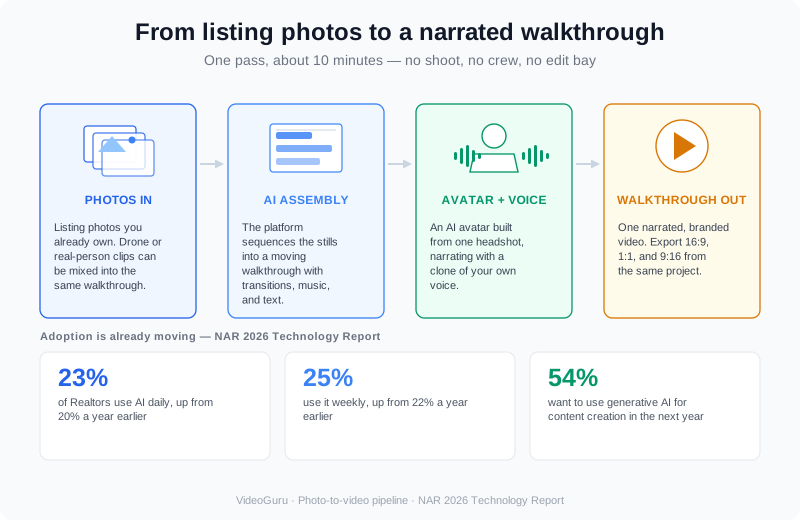
The editing stage is where AI pays off: photos in, a narrated, branded walkthrough out, in about ten minutes.
The payoff shows up in adoption, not just in saved time. NAR's 2026 Technology Report found that 23% of Realtors now use AI daily and another 25% use it weekly, up from 20% and 22% a year earlier, and that 67% say they are using emerging tools like AI but are still learning to use them well (NAR 2026 Technology Report). The same survey found 54% of Realtors want to use generative AI for content creation over the next year — content a creator can produce on demand. That shift runs across the technology NAR tracks (NAR technology research), and demand is moving too: one in five buyers now uses AI tools for homebuying research (NAR Tech & Innovation).
A Realistic Week for One Creator
The rhythm below is the one that keeps a solo creator sane: it batches the work that benefits from batching and keeps you out of the edit every single evening. Adjust the days to your market, but keep the batching.
- Monday — capture day. Shoot the properties that need footage, back to back. One trip, one camera setup, multiple listings.
- Tuesday — assembly day. Turn photos and clips into drafts. For photo-driven properties, run them through the photo-to-video route and let the first cut build itself.
- Wednesday — edit and brand day. Review the drafts, fix the pacing, apply the brand kit, and export the walkthrough plus the social cut.
- Thursday — delivery day. Publish, caption, schedule, and send the client their files. The real time a listing video takes with AI is short enough that this fits in a single sitting.
- Friday — pipeline day. Invoice, pitch the next batch, and plan the following week's shoots. Going from ten-hour edits to half-hour edits is what buys you this day back.
What It Costs to Run Solo
Your cost base has two halves. The first is the physical kit: a camera or a modern phone, a wide lens, a gimbal or tripod, storage, and music licensing. Most photographers and videographers switching into this already own that half. The second half is the software that does the production work — and that is where the numbers are knowable, because they are published.
VideoGuru's plans are designed around output volume rather than seats, which suits a one-person operation. The numbers below are the current published tiers:
| Plan | Price | Videos per cycle | AI photo edits | Max resolution |
|---|---|---|---|---|
| Free | $0 | 2 / month | — | 720p (watermarked) |
| Essential | $59 / month | ~3 / month | 20 / month | 1080p |
| Growth | $129 / month | ~10 / month | 80 / month | 4K |
| Pro | $249 / month | 25 / month | 200 / month | 4K |
Annual billing lowers the effective per-video cost: about $12.00 on Essential, $10.20 on Growth, and $8.94 on Pro when you use the plan’s full annual allowance.
Read that against what you charge. If a single listing video sells for several hundred dollars, the software line is a small fraction of one job — which is the whole point. Your margin comes from volume, and volume is only possible because the edit no longer costs you an evening. The tool you choose should fit your workflow, not the other way around.
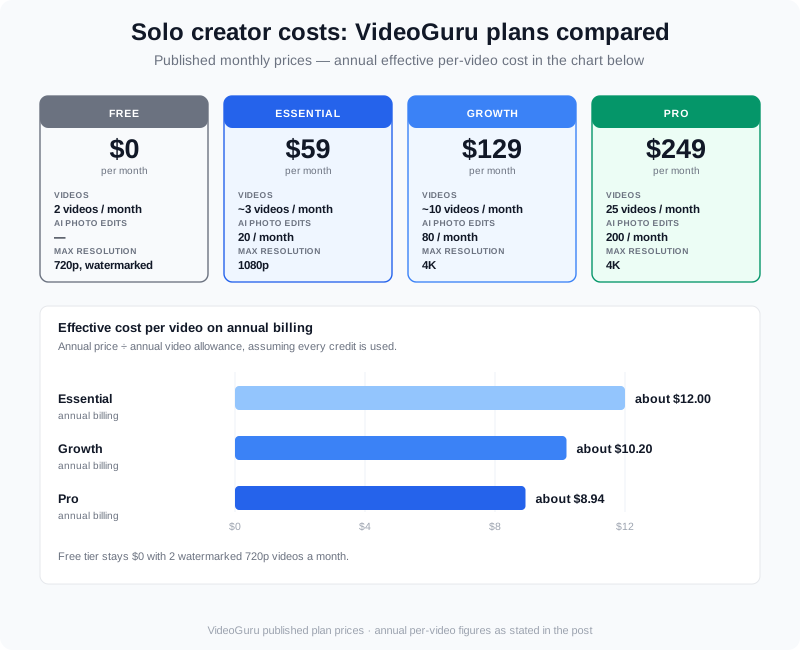
The published plan tiers map directly onto output volume: roughly 3, 10, or 25 videos a month.
How to Price Your Video Work
Do not anchor your prices to another creator's posted rates; their market is not yours. Build the number from the bottom up instead. Add up your cost stack — software, storage, music, travel, and the value of your own time per deliverable — then add the margin that makes the work worth doing at your volume. Quote the result as packages, not as hours.
- Single listing package: one walkthrough plus one vertical social cut. The entry offer that wins the first client.
- Monthly retainer: a fixed number of listings per month at a per-listing rate that drops as volume rises. This is the one that turns a working month into a predictable income.
- Add-ons: rush turnaround, extra aspect ratios, drone, and presenter or avatar videos. Price each one once, then reuse it in every proposal.
Where a number depends on your market, keep it a number you plug in. A formula you control beats a precise-looking figure copied from someone else's website.
Fair Housing and Disclosure: The Non-Negotiables
Two rules protect you as a creator, and both are cheap to follow. The first is fair housing: property advertising, including video, must not discriminate or signal a preference. Know the standard set out by HUD's Fair Housing guidance before you publish anything that depicts people or neighbourhoods.
The second is disclosure of synthetic media. AI staging, AI editing, and avatar presenters are all legitimate when they are not misleading, and the rule is simply to be transparent where it counts. The current disclosure rules for AI listing media are worth reading once and building into your delivery checklist, so it is never a judgement call on a deadline.
People Also Ask
Do you need your own camera to become a real estate video creator?
No. A modern phone with a stabiliser is enough to start, and for listings you cannot visit, the photo-to-video route means you do not need to film at all. A dedicated camera and wide lens help once you are shooting several properties a day, but they are an upgrade, not a prerequisite.
How many listing videos can one person really produce in a week?
The honest answer depends on the edit, and the edit is what AI changes. A creator still editing every frame by hand caps out at a handful of videos per week. A creator assembling drafts from photos and finishing by hand can serve several times that, because the raw cut arrives in minutes instead of hours.
How do one-person real estate video creators get paid?
Three models dominate: per listing, per package (a walkthrough plus social cut), and a monthly retainer for a set number of listings. Retainers are the goal because they smooth income, but most creators win their first clients on per-listing work and convert them upward.
Is it worth becoming a real estate video creator in 2026?
The demand side is moving in your favour and the cost side has fallen. Realtor adoption of AI is rising sharply year over year, and the production work that used to require a crew can now be done solo. The remaining gate is consistency — showing up for clients weekly — which is a discipline problem, not a production problem.
What is the difference between a real estate video creator and a videographer?
A videographer is hired to shoot; a creator owns the outcome from idea to published video, and usually keeps the client relationship. The distinction matters commercially: the creator is paid for a result, which is a stronger position than being paid for a session.
Final Thoughts
Becoming a one-person real estate video creator is less about buying the right camera and more about deciding which stages you will still do by hand. Keep the parts that create taste and trust; let AI carry the parts that only cost time. Do that, and the one-person model stops being a compromise and starts being the advantage.
You can start today with the photos you already have. Create a free VideoGuru account to assemble your first walkthrough, then upgrade when the volume justifies it — the product docs walk through creating a video in ten minutes.