

Chengran (Felix) Guan
2026-09-17 · 14 min read
9 YouTube Shorts Examples Real Estate Marketers Should Steal
Nine YouTube Shorts formats carry most of the short-form results real estate marketers get in 2026: the empty-room reveal, the price-point tour, the photo-to-video walkthrough, the agent intro, the one-objection answer, the neighborhood drive, the before-and-after restyle, the micro-detail shot, and the open house countdown. Every one of them is vertical, runs under 60 seconds, and hooks a viewer in the first three seconds. None of them requires a film crew — and roughly half can be built from the listing photos you already have on file.
This guide breaks each example down the way you would actually use it: what the format is for, what happens in the first three seconds, and how to produce it this week. If you are an agent posting between showings, the assemble-from-photos route is your fastest path. If you are a photographer or media company producing for clients, the same nine formats are a sellable Shorts package.
Why it is worth the effort now: unlike a Reel that lives and dies inside one feed, a Short is indexed by YouTube and can surface in YouTube search and Google video results for months, so one 30-second clip about a neighborhood keeps answering local queries long after you post it. And the channel is already where your peers are working — NAR’s Real Estate in a Digital Age report found 75% of REALTORS® use social media, 52% use drone photography or video, and social media is their top lead-generating technology at 39%.
Key Takeaways
- A Short is a search asset, not just a feed post. Because YouTube indexes Shorts, one clip about a street, a price band, or an objection keeps working for months.
- Nine formats, one shoot day. The same 20 photos and a handful of phone clips can feed a week of Shorts when you cut each one to a single idea.
- The first three seconds are the whole test. Motion plus on-screen text in the opening frame decides whether the rest gets watched; voiceover and music come after.
- You do not need to film to post Shorts. On VideoGuru, a video takes up to 20 photos and up to 40 clips — your own drone passes or real-person footage can be mixed into the same walkthrough — and it exports in 16:9, 1:1, and 9:16.
- Cost stops being the excuse. On annual billing with every credit used, videos work out to roughly $12.00 on Essential, $10.20 on Growth, and $8.94 on Pro — and the free tier covers 720p shorts up to 15 seconds.
What Actually Makes a Real Estate Short Work
A real estate YouTube Short is a vertical video, up to three minutes long, that YouTube can serve to viewers who have never heard of you (YouTube’s Shorts specs are here). The technical bar is low; the editorial bar is not. Four rules separate the Shorts that generate showings from the ones that just fill a grid:
- One idea per Short. A 40-second clip cannot sell the kitchen, the price, the schools, and your commission structure. Pick the single question a buyer would ask out loud and answer only that.
- A motion hook in the first frame. Pan, push in, or start mid-walk. Static photo openings get scrolled even when the house is beautiful.
- Text on screen the whole way. Most viewers are watching on mute in a car or a hallway. The address band, the price, the square footage, and the punchline should all be readable without sound.
- A spoken reason to keep watching. Even 20 seconds of voiceover — yours, or a cloned voice reading a script you wrote — holds attention far better than music alone.
The reuse discipline matters as much as the format. Cutting a 45-second Short out of a longer walkthrough, then cutting a second and third version for different platforms, takes minutes and is the difference between one post and a week of posts. Our guide to repurposing listing content covers the pipeline end to end; the nine formats below are what to feed into it.
9 YouTube Shorts Examples for Real Estate Marketers
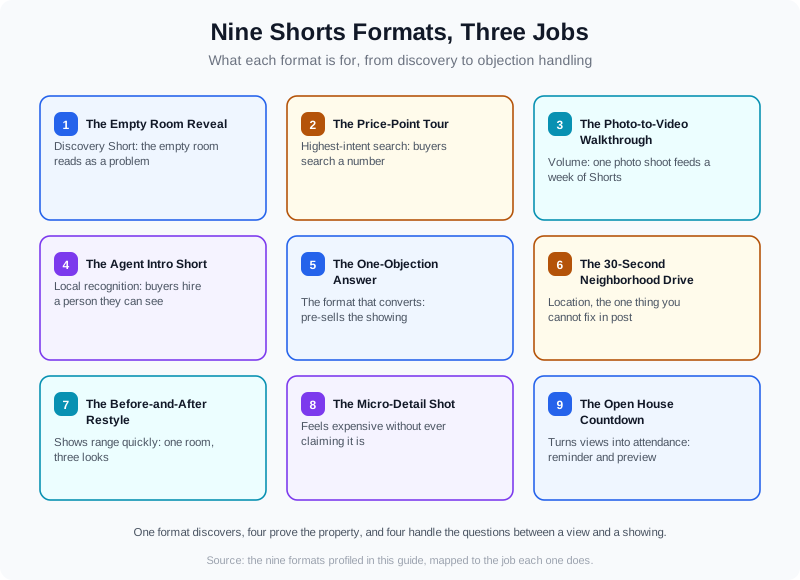
Nine formats, three jobs: get discovered, prove the property, or answer the objection. Most agents only ever post the second type.
1. The Empty Room Reveal (12–15 seconds)
What it is for: the discovery Short. An empty listing reads as a problem to a buyer; the same room furnished reads as a home. This format earns saves and shares because it resolves a tension in under 15 seconds.
First three seconds: the empty room, wide, with the text “nobody wanted this listing.” Then the cut.
How to produce it: you need one empty-room photo and a furnished version of the same angle. VideoGuru’s photo editing includes one-click virtual staging — furniture, declutter, restyle — so you can build the after-frame from the same shot rather than booking a stager. Vertical crop, hold the empty frame for two seconds, cut on the beat, and keep the address in a text band at the bottom.
2. The Price-Point Tour (“What $650,000 Buys You Here”)
What it is for: the highest-intent local search a Short can satisfy. Buyers do not search your name; they search a number and a neighborhood. A price-point Short is a search result that happens to be video.
First three seconds: the number, on screen, over the best exterior shot — then “$650,000. Three bedrooms. Two blocks from the park.”
How to produce it: five to seven photos, 30 seconds, one price band per Short. Shoot the same property once and you can cut a different price-band Short for each buyer segment you work with — entry level, move-up, and investor. Use NAR’s research and statistics hub when you want a market figure to anchor the claim instead of inventing one.
3. The Photo-to-Video Walkthrough
What it is for: volume. This is the format that lets one photo shoot feed a week of Shorts instead of a single post, and it is the one most agents skip because they assume it requires a shoot day.
First three seconds: a moving push into the front elevation with the address and price already on screen, then the entry sequence.
How to produce it: upload the listing photo set and let the platform assemble a paced, narrated walkthrough, then export it in 9:16 for Shorts, 1:1 for feed, and 16:9 for YouTube long-form. On VideoGuru each video takes up to 20 photos, and you can mix in your own clips — a drone pass, a clip someone filmed on site, a real-person piece to camera — rather than working from stills alone. Filming stays optional, not required. If you want to see the output before committing to a plan, the free tier produces 2 videos a month at 720p, up to 15 seconds — which is exactly Shorts length.
A veteran realtor breaks down when short form beats long form — the strategy behind choosing which Shorts are worth making.
4. The Agent Intro Short (Face and Voice, No Retakes)
What it is for: local recognition. Buyers and sellers hire a person, and the agents who post a face are the ones whose names come up in the neighborhood group chat.
First three seconds: direct to camera, one sentence about the street you are standing on. No “hey guys.”
How to produce it: the barrier used to be camera comfort, which is why so many agents never post one. VideoGuru generates an AI avatar from a photo you upload — a headshot is enough — and clones your voice, then composites the presenter into the property walkthrough as one integrated video rather than a separate talking-head clip. It is included on any paid plan with no separate avatar subscription, which is the piece most presenter tools bill as their own monthly tier. Record a script once; the presenter does not need a second take.
5. The One-Objection Answer
What it is for: the format that converts. “Is this street noisy?” “Why has it been on the market for 40 days?” “Can you park a work van here?” Answering the question buyers are already asking pre-sells the showing.
First three seconds: put the objection on screen verbatim, then say it out loud. Do not soften it — the blunt version is what earns the watch.
How to produce it: keep a running list of the five questions you are asked at every showing and film one answer a week, standing in the part of the property that proves the answer. These stack into a playlist that does the pre-qualifying for you, and they are the Shorts most likely to get shared by other agents.
6. The 30-Second Neighborhood Drive
What it is for: location, which is the one thing you cannot fix in post. Buyers scrolling from out of state need to see how the street feels, not read a description of it.
First three seconds: drone lift-off or a passing tree line, with the neighborhood name and the drive time to the nearest anchor (downtown, the interstate, the school) burned on screen.
How to produce it: shoot three 20-second clips on your phone the next time you are at the property — approach, street sweep, amenity. If you already own drone footage from the listing shoot, it can be dropped into the same project: VideoGuru accepts up to 40 clips per video alongside the photos, so a drone pass and a real-person clip sit inside one walkthrough. Our drone photography guide covers the shot discipline and the rules.
7. The Before-and-After Restyle
What it is for: showing range quickly. One room, three looks, eight seconds each — proof that the space is flexible, which is what buyers with dated furniture need to see.
First three seconds: an empty or cluttered room and the words “same room, three ways.”
How to produce it: generate the variants from a single still — virtual staging to furnish, declutter to clear, and a full restyle to change the design language — then cut them together with a beat-matched track. The same pipeline that handles your video also handles your listing photography: one-click staging, furniture swap, decor changes, and declutter, so the hero image on the listing matches the Short you just posted.
8. The Micro-Detail Shot
What it is for: the Short that makes a property feel expensive without claiming it is. Nobody clips a wide living room shot; they clip the hand-poured concrete counter and the light moving across it.
First three seconds: extreme close-up, moving. Text: “the detail nobody puts in a listing.”
How to produce it: phone, macro distance, a slow push, 12 seconds. It takes four minutes on site and it is the single most saved format in most agents’ accounts, because it is the only one that is not obviously a listing ad.
9. The Open House Countdown
What it is for: turning views into attendance. A Short published 24 hours before an open house is a reminder, a map, and a preview in one asset.
First three seconds: the day and time in large text over the best exterior frame — “Saturday, 11–2” — then straight into motion.
How to produce it: take the walkthrough you already built for the listing, cut a 25-second vertical version, and front-load the logistics. Then repost the same Short the morning of. Our Reels playbook has the same format broken out for Instagram if you want to run both platforms from one edit; the difference is that the YouTube version keeps working after the weekend.
How to Produce Them: Shoot It or Assemble It
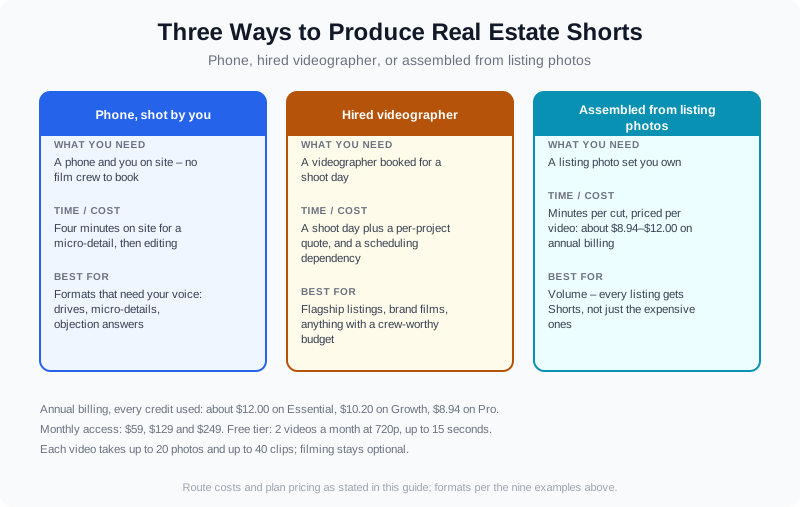
Three routes to the same eleven Shorts a month. Only one of them scales without adding a day to your week.
There are three honest production routes, and the right one depends on how many properties you market, not on how much you like filming.
| Route | What it costs you | Best for |
|---|---|---|
| Phone, shot by you | 15–30 minutes on site per Short, plus editing time | Neighborhood drives, micro-details, objection answers — formats that need your voice |
| Hired videographer | A shoot day plus a per-project quote, and a scheduling dependency | Flagship listings, brand films, anything with a crew-worthy budget |
| Assembled from listing photos | Minutes per cut, priced per video | Volume — every listing gets Shorts, not just the expensive ones |
The assemble route is where most agents get their first eleven Shorts posted, because it removes the two reasons Shorts do not happen: no shoot day, and no editing skill. On VideoGuru, you upload the photo set and the platform assembles a paced walkthrough with motion, transitions, music, and a voiceover, then distributes the same asset in 16:9, 1:1, and 9:16 — so one build covers YouTube long-form, the feed, and Shorts. Each video accepts up to 20 photos and up to 40 clips, which means your drone footage or a real-person clip can be mixed into the photo-driven walkthrough rather than kept in a separate edit.
The effects catalogue does the visual work that used to need a crew or a stager: virtual twilight, virtual staging, declutter, restyle, renovation visualisation, and seasonal changes all run from a single still. Brand kits lock your logo, colors, fonts, intro and outro so a week of Shorts looks like one account instead of six people’s. And when you want a face on the account without filming, the AI avatar generated from your photo speaks in your cloned voice inside the property video itself, on any paid plan, with no separate avatar subscription.
The economics are simple enough to plan around. Monthly access is $59 on Essential, $129 on Growth, and $249 on Pro. On annual billing, using every credit, that works out to about $12.00 per video on Essential ($360 a year for 30 videos), $10.20 on Growth ($1,020 for 100 videos, 4K output), and $8.94 on Pro ($1,788 for 200 videos). If you market six listings a month and want Shorts for all of them, the per-video number is the one that matters, not the subscription headline. Current plan detail lives in the product docs, and you can start in the VideoGuru workspace on the free tier to test the workflow on one listing.
A Seven-Day Shorts Schedule You Can Actually Keep
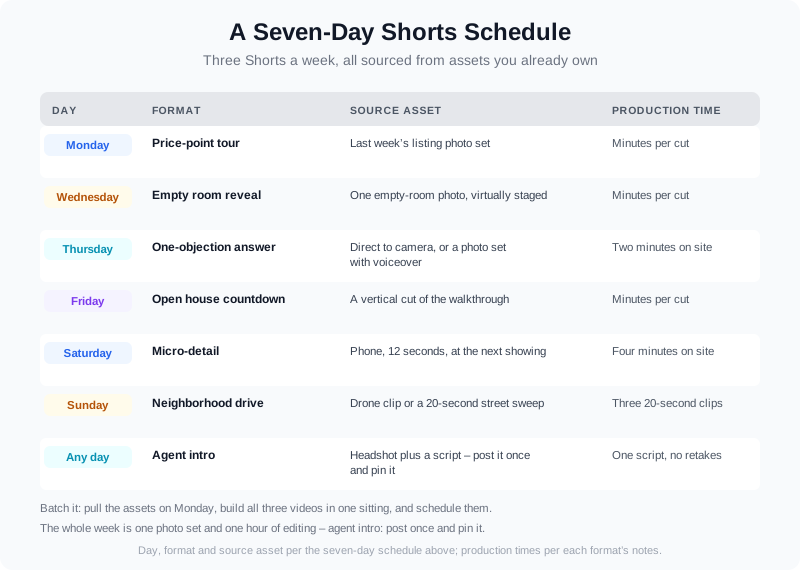
Three Shorts a week, all sourced from assets you already have. The whole week is one photo set and one hour of editing.
Posting daily is not the goal — consistency is. Three Shorts a week, drawn from assets you already own, is enough to stay in the algorithm and in front of your farm area. This is the rotation that needs the least new shooting:
| Day | Format | Source asset |
|---|---|---|
| Monday | Price-point tour | Last week’s listing photo set |
| Wednesday | Empty room reveal | One empty-room photo, staged in the editor |
| Thursday | One-objection answer | Two minutes on site, or a photo set with voiceover |
| Friday | Open house countdown | A vertical cut of the existing walkthrough |
| Saturday | Micro-detail | Phone, 12 seconds, at the next showing |
| Sunday | Neighborhood drive | Drone clip or a 20-second street sweep |
| Any day | Agent intro | Headshot plus a script — post it once and pin it |
Batch it. Pull the assets on Monday, build all three videos in one sitting, and schedule them. For a wider menu of formats to rotate in when the list above goes stale, our roundup of real estate video ideas for social media has two dozen more, and the photo-to-video workflow explains exactly what input a listing photo set needs before it becomes a video.
How to Tell Whether a Short Worked
Views are the least useful number on the dashboard. Track four things instead:
- Retention in the first five seconds. If more than half the audience is gone before the hook lands, the opening frame is the problem, not the property.
- Saves and shares relative to views. A Short that gets saved is answering a real question; a Short that only gets viewed is entertainment.
- Profile clicks and link taps. This is the step where a viewer becomes a lead. Watch it per format so you learn which of the nine earns attention.
- Showings booked from social. Ask at the door. Attribution for local real estate is a conversation, not a pixel.
Our real estate video analytics guide goes deeper on which metrics are worth a weekly look and which are noise.
Frequently Asked Questions
How long should a real estate YouTube Short be?
Aim for 20 to 45 seconds for listing content. YouTube allows Shorts up to three minutes, and the extra room is worth using for objection answers and neighborhood explainers where context is the point — but a price-point tour or an empty-room reveal that runs past a minute loses the viewer before the payoff. Build to the shortest version that answers one question completely, and check the current duration and aspect rules in YouTube’s own documentation before you plan a campaign around them.
Can I make real estate Shorts without filming anything?
Yes. A listing photo set is enough input for a vertical walkthrough: upload the images and the platform assembles motion, transitions, music, and voiceover, then exports a 9:16 cut sized for Shorts. You can also mix in clips you already own — drone footage or a real-person clip — because the platform takes both photos and video clips in the same project. Filming is optional, not required, which is why the assemble route is the one that actually gets posted consistently.
Do YouTube Shorts actually generate real estate leads?
They generate leads the way any local content does: slowly, then in a cluster. Shorts bring discovery — people who live in the area but do not know you yet — and the conversion happens when one of them asks a question in the comments, taps your profile, or mentions the video at an open house. The formats that convert fastest are the objection answers and the neighborhood drives, because those viewers are already close to a decision. Treat Shorts as the top of a funnel that includes your listings, your site, and your follow-up, not as a standalone lead machine.
How often should an agent post Shorts?
Three times a week is the practical floor for staying visible, and it is achievable from existing assets — one photo set usually yields three Shorts. Daily posting only works if your production is batch-built; if it is not, a dropped week costs more than a slower cadence would have. Pick a number you can hold for a quarter, then increase it once the workflow is automatic.
Putting It All Together
The agents winning on Shorts in 2026 are not the ones with the best cameras. They are the ones who picked a small set of repeatable formats, sourced every one of them from assets they already had, and posted on a schedule they could keep during a busy month. The nine formats above are enough to run for a quarter: one discovers, four prove the property, and four handle the questions that stand between a view and a showing.
Start with the listing you have already photographed. Cut the price-point tour from that photo set, build the empty-room reveal from one image, and post an objection answer from the questions you were asked at the last showing. That is three Shorts, one afternoon, and no crew — and it is a fair test of whether the channel deserves a permanent slot in your week.