

Chengran (Felix) Guan
2026-09-09 · 11 min read
Multilingual Real Estate Video with AI:
How to Reach International Buyers in 2026
Yes — AI now lets you turn one listing video into a dozen language versions in the time it once took to record a single voiceover. That matters more than it sounds: foreign buyers purchased $45.3 billion of U.S. existing homes between April 2025 and March 2026, according to the National Association of Realtors, and a large share of those buyers searched and negotiated in a language other than English. Multilingual listing video — translated narration, subtitles, and on-screen text produced with AI — is how agents and videographers meet those buyers on their own terms, without hiring a translator and voice actor for every market.
Most listings today are English-only media. That is the gap. An overseas buyer scrolling portals in Miami, Vancouver, or Orange County will watch a video in their own language before they will read a translated listing description, and video is frequently the closest they get to the property before they fly in. This guide covers the 2026 international buyer picture, what AI can and cannot localize in a listing video, a production workflow that scales across languages, and the quality checks that keep you accurate and compliant.
Key Takeaways
- International demand is real but concentrated: NAR's 2026 report counts $45.3 billion in foreign purchases of U.S. existing homes — down year over year, but still a market worth targeting in destination metros.
- Language is the last mile of listing media: buyers from the top origin countries — Canada, China, Mexico, and India — often search and view listings in their home language, and most listing videos never reach them.
- AI localizes three layers of a video: narrated voiceover in the target language, translated burned-in subtitles, and localized on-screen text for prices, features, and calls to action.
- Produce once, localize many times: the scalable workflow is a fast AI master edit, then per-language narration and caption passes with one native-speaker review before export.
- Accuracy and disclosure stay human responsibilities: AI handles the language; a fluent reviewer owns the real estate terms, numbers, and any AI-content disclosure your state or MLS requires.
Why Language Is a Listing Video Problem
Real estate video is a proven attention driver: buyers expect a video tour on nearly every listing, and the ones shopping from another country depend on it even more. But here is the part most agents skip: the buyers who most need that video often cannot understand it. A narrated, captioned walkthrough in English tells an English-speaking buyer everything. To a Mandarin-speaking buyer in Shanghai or a Spanish-speaking buyer in Bogotá, it is atmosphere without information.
That gap shows up in behavior, not just sentiment. International buyers who cannot visit a home in person lean heavily on photos and video to narrow their list before they ever contact an agent, and they research in the language they are most comfortable reading. If your listing media only exists in English, you are invisible until the buyer happens to ask an English-speaking contact. Content marketing in real estate is increasingly a reach game, and multilingual video is one of the few remaining channels where most of your local competition simply is not showing up.
None of this requires you to become a global operation. It requires you to recognize which of your listings have international appeal — condos and second homes in destination markets, properties near airports and universities, luxury homes priced for cross-border comparison shopping — and to localize those deliberately.
The 2026 International Buyer Numbers, in Brief
NAR's International Transactions in U.S. Residential Real Estate report, released in July 2026, covers the twelve months from April 2025 through March 2026. The headline figures for purchases of existing homes:
- $45.3 billion in total foreign buyer purchases — down 19.1% from the prior year as a strong dollar and high U.S. prices cooled cross-border demand.
- 67,100 homes purchased, a 14% drop in unit count from the year before.
- Canada was the top country of origin by share at roughly 16% of foreign buyer purchases — about 10,700 properties — retaking the lead from China.
- China generated the most dollar volume at $7.6 billion, even after slipping to third by number of purchases.
- Florida remained the leading destination state, followed by the usual sun-and-city states that dominate international searches.
HousingWire's coverage and RISMedia's summary both frame it as a demand pullback, not a disappearance. Second, the buyers who remain are concentrated in specific metros and property types, which means a targeted multilingual strategy beats a blanket one. The agent who localizes the right listings in a Florida or California beach market is competing for attention from Canada, Latin America, and Asia — not from every buyer on earth.
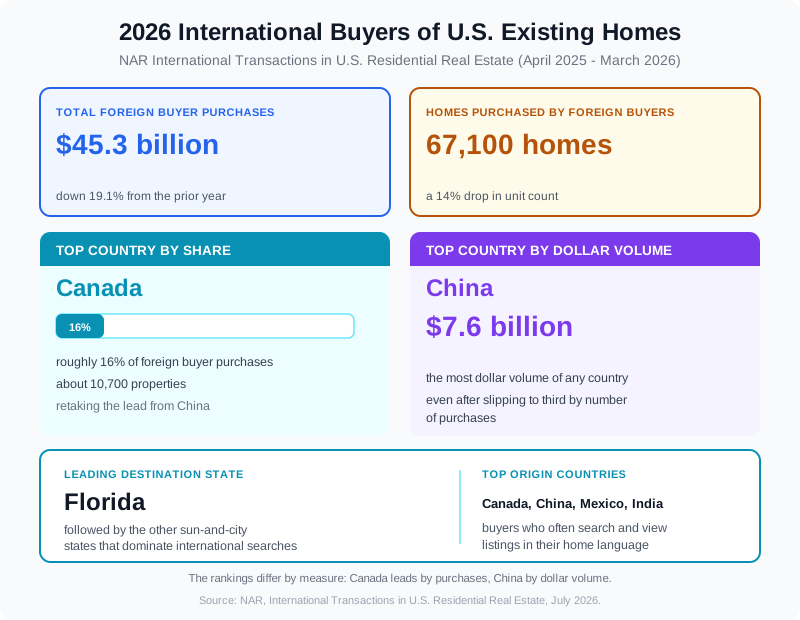
NAR 2026: foreign buyers purchased $45.3B in U.S. existing homes from April 2025 to March 2026.
What AI Can Actually Localize in a Listing Video
Localizing a video used to mean hiring a translator, booking a voice actor who speaks the target language, re-recording, and re-editing — per language, per listing. That is why almost nobody did it. AI collapses the expensive parts. In 2026 the practical toolkit for a real estate video covers three layers:
- Dubbed narration. Write the script once in English, translate it, and generate a natural-sounding voiceover in the target language from text. Modern neural voices handle the calm, descriptive register of a listing walkthrough well — room names, measurements, and neighborhood context are exactly what they do best. Each language is a separate audio track generated in minutes, not a studio booking.
- Translated burned-in subtitles. For platforms where video autoplays muted — which is most of social media — the caption track is the video. AI translates and times subtitles to the cut, and you can burn them directly into the export so they survive any platform.
- Localized on-screen text. Price, square footage, bedrooms, the call to action, and your contact details all live as text layers in modern editors. Translating those layers — and converting units where the market expects it — keeps the video coherent when the voice and captions change language.
If your master video is built from listing photos and clips with an automated editor, the localization pass rides on top of an already-fast pipeline — the same 10-minute AI listing video workflow that produces the English version produces the raw material for every language version after it. The photo-to-video AI approach matters here too: a listing that already has clean photography can be turned into a tour once, then localized without reshooting anything.
Where AI Localization Still Needs Humans
How accurate is AI translation for real estate terms?
Accurate enough to be dangerous — which is exactly why you add one review step. Everyday listing language translates cleanly: "three bedrooms, two baths," "open concept kitchen," "pool and outdoor kitchen." The trouble lives in the specialized vocabulary that real estate runs on: HOA and condo fees, easements, escrow, contingencies, property tax disclosures, "fixer-upper," and school district boundaries. A generic translation can render these words correctly but communicate the wrong idea, because the underlying concepts differ by country.
Two failure modes bite practitioners. The first is numbers: measurements, prices, and dates must be transcribed exactly, and unit conversions (square feet to square meters, acres to hectares) need a consistent convention chosen by you, not guessed by the model. The second is tone: a literal translation of an enthusiastic English script can sound pushy or even absurd in another language. The fix is cheap and non-negotiable — have a native-speaking agent, assistant, or client-side contact review the translated script and the final export before it goes live. This is the same review discipline you already apply to AI-generated listing media disclosure: the AI does the heavy lifting, and a human owns what ships.
The One-to-Many Workflow: Produce Once, Localize Often
A repeatable multilingual workflow has six steps. It assumes you already have a fast way to produce the master English video; if you do not, start there before adding languages.
Step 1 — Build the master edit. Assemble the walkthrough or photo tour, add your brand intro, captions, and music, and export the English version. Keep the project structured so scenes, text layers, and the narration track are separate — that structure is what makes localization mechanical instead of a re-edit.
Step 2 — Translate the script, not the video. Take the narration script and on-screen text, translate them into the target language, and have a fluent speaker sanity-check real estate terms before you generate audio. This is the cheapest moment to catch a wrong word.
Step 3 — Generate the dubbed narration per language. One voiceover generation per language, matched to the scene list. Keep the pacing instructions the same as the English track so the video length does not drift wildly between versions.
Step 4 — Add translated burned-in captions. Generate the caption track in the target language and style it with the same brand look as the English captions. If the platform autoplays muted, this is the layer that actually reaches viewers.
Step 5 — Review with a native speaker. Watch the full export with someone fluent in the market you are targeting. Check the numbers against the listing, confirm the tone, and verify the call to action and contact details survived translation intact.
Step 6 — Distribute where that language lives. Different language versions earn their keep on different channels, which the next section covers.
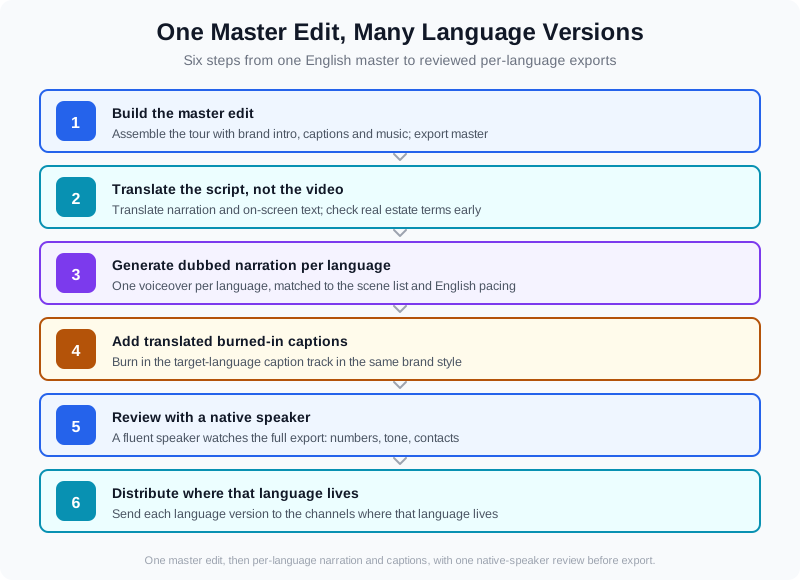
One master edit feeds many language versions; every version passes through native-speaker review.
Where Multilingual Listing Video Moves Buyers
A localized video only pays off where the right buyer can find it. Match the language version to the channel the way you would match any content to its platform — the platform-by-platform video guide gives the format specs; here is the language logic on top:
- YouTube: the default research surface for overseas buyers and the one place long-form narrated tours perform. Upload each language version as its own video with a localized title and description, not just translated captions on the English file — search in Spanish or Mandarin will not surface an English-titled video.
- Social feeds (Instagram, TikTok, Facebook): autoplay is muted, so burned-in translated captions do the selling. Short localized cuts of the best rooms outperform a full walkthrough here.
- International real estate portals and agent networks: listing syndication services that cater to foreign buyers, plus the overseas agent referral networks your brokerage already works with. A localized video file is a powerful thing to hand a partner agent who represents the buyer.
- Direct outreach: WeChat, WhatsApp, and email follow-ups to overseas buyer pools are where a short localized tour converts — send the video, not a link, and keep it under a minute.
The Second-Home and Luxury Angle
International demand concentrates in property types that are easy to shop from abroad: condos, resort-adjacent homes, and luxury listings in destination metros. NAR's report has long shown that foreign buyers skew toward vacation and investment properties, and the 2026 numbers keep that shape — which is why video-driven luxury lead generation and multilingual localization are natural partners. If your market draws Canadian snowbirds, Latin American second-home buyers, or Asian investors, the buyers themselves may not set foot in the home until the closing table — your video is their showing.
For photographers and videographers, this is also a service-tier opportunity. Localization turns a one-time shoot into a multi-deliverable package, and the language premium is easier to defend than a raw rate increase: you are delivering five finished videos instead of one. If you already sell photo plus video packages — or are considering it — multilingual delivery is a differentiation that most local competitors will not copy quickly.
Frequently Asked Questions
Is AI dubbing good enough for real estate listing videos?
For most listing content, yes. Real estate narration is short, factual, and delivered in a calm descriptive register — the exact use case modern neural voice models handle best. A 60-second walkthrough script with room names and measurements is far easier for a voice model than dramatic advertising copy. The common-sense test is the same one you would apply to any vendor: generate a sample in the target language, play it for a native speaker, and judge for yourself before you roll it out across listings.
Do I need a separate video for each language, or can I localize one?
You produce one master edit and localize it into separate exports — one video file per language with its own narration, captions, and on-screen text. Do not try to serve every language from a single file with subtitles the viewer toggles on: most platforms and listing portals handle that poorly, and a burned-in localized version always wins. The economics work because the master edit is built once; each additional language is a script translation, a narration generation, and a caption pass, not a re-edit.
Are there disclosure rules for AI-translated or AI-voiced listing videos?
The rules vary by state and MLS, and they are evolving. The disclosure discipline that applies to AI-generated listing photos — virtual staging, sky replacement, and AI enhancement — increasingly extends to AI-generated audio and video content, so check your state real estate commission guidance and your MLS rules before publishing. When in doubt, disclose that narration or imagery was AI-generated. Accuracy is a separate, non-negotiable layer: translated numbers, addresses, and legal descriptions must match the listing exactly, because a mistranslated disclosure is a liability, not a language quirk. The MLS video requirements guide covers the format and compliance side.
Ready to reach international buyers in their own language? VideoGuru's AI video editor turns listing photos and footage into a polished master video in minutes — with captions, effects, and brand assets built in — so adding a second, third, or tenth language is one more export instead of a whole new production. Beyond video, VideoGuru's photo editing tools handle the listing photography side too, with one-click enhancement, declutter, and virtual staging that keep your whole media set consistent. Start for free at VideoGuru.
The Bigger Picture
AI already solved the expensive half of real estate media: producing video that looks professional. The next competitive frontier is distribution — getting the right listing in front of the right buyer — and language is the last mile of that problem. International demand will fluctuate with exchange rates and prices, but the structural fact does not change: a meaningful share of U.S. home buying crosses borders, and those buyers consume media in their own language. The agents and media companies that treat multilingual delivery as a standard service, not a special request, are building an advantage that is hard to copy — because it is not about the tool, it is about the habit of producing media the buyer can actually understand.