

Chengran (Felix) Guan
2026-10-06 · 10 min read
20 Short Video Ideas for Real Estate Agents
Short-form video is where buyers and sellers actually discover real estate agents in 2026, and the agents who win are not the ones with the best camera — they are the ones with the most repeatable ideas. The 20 short video ideas below are built to be produced fast: most need nothing more than a phone, and the property ones can be assembled from listing photos in about ten minutes with an AI video platform. Every idea maps to one of four pillars — listings, local proof, personality, and buyer or seller value.
Three kinds of readers get value from this list: the agent who wants consistent social content without hiring a videographer, the new agent building a local brand from zero, and the busy producer who needs a week of posts finished in one afternoon. The ideas are the same for all three; where the production differs, this guide says so.
Key Takeaways
- Short-form is a discovery channel. Reels, TikTok, and Shorts are shown to people who do not follow you yet — exactly the local audience a listing agent needs.
- One idea per video. A 20 to 40 second clip that answers a single question outperforms a three-minute montage every time.
- The four pillars keep you consistent: listings, local proof, personality, and buyer or seller value. Rotate them so your feed does not look like a slideshow.
- Property shorts do not require a shoot. Listing photos can become a vertical short through AI photo-to-video in about ten minutes — see how photo-to-video AI works.
- VideoGuru exports 16:9, 1:1, and 9:16 from one project, and on any paid plan you can composite your face and a clone of your own voice into the same walkthrough — not the free tier, and with no separate avatar subscription bolted on top.
Why Short-Form Video Works for Agents
A listing page waits for someone to find it. A short video is pushed at people who have never heard of you, sorted by an algorithm that rewards watch time and volume. That is the entire appeal for an agent: short-form is the one format that can put your face and your market in front of a cold local audience without a media budget. It is also why a real estate reels strategy now sits at the centre of most agent marketing plans rather than at the edge of it.
The barrier is no longer skill or equipment. It is producing enough good posts to stay visible, week after week, without burning out. NAR's 2026 Technology Report found that 23% of Realtors now use AI daily and another 25% use it weekly, and that 54% want to use generative AI for content creation over the next year (NAR 2026 Technology Report). The same research programme tracks how quickly agents fold new tools into listing marketing (NAR technology research) and the full Realtor Technology Survey sits alongside it (NAR Realtor Technology Survey). The lesson for a short-video habit is simple: the hard part is not the edit anymore, it is having a stockpile of ideas you can produce on demand.
The Four Pillars Behind Every Short That Performs
Before the list, understand why it is grouped the way it is. A feed made only of listings stops working after a few weeks, because a listing only interests the handful of people shopping at that price in that neighbourhood. The agents who grow rotate four kinds of content, and each one does a different job.
- Listings show the product. They convert the people already looking and prove you have inventory.
- Local proof shows you know the area. They earn follows from people who are months away from buying.
- Personality builds trust. Buyers pick an agent they feel they know, and short video is the cheapest way to be known.
- Buyer and seller value earns the save and the share. Education is the most saved format, and saves feed the algorithm.
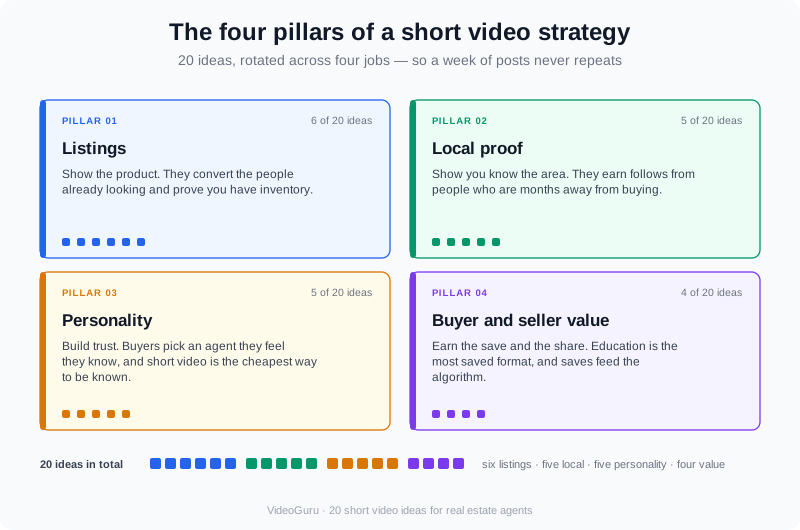
Rotate four pillars — listings, local proof, personality, and value — so a week of posts never feels repetitive.
20 Short Video Ideas for Real Estate Agents
Each idea below is written to be shot in one take or assembled from photos. Keep them short, keep them single-purpose, and keep the first two seconds doing the heavy lifting.
Listing and Property Ideas (1 to 6)
- 1. The 30-second walkthrough. One room-to-room pass in vertical with a hook on screen — “What $X buys in [neighbourhood].” Open on the single best room, not the front door.
- 2. The one unforgettable feature. Pick the thing a buyer will repeat to their partner — the kitchen, the view, the workshop — and build the whole clip around it.
- 3. Before-and-after virtual staging. Show the empty room, then the furnished version. This side-by-side is one of the most shareable formats in listing marketing.
- 4. The twilight reveal. Turn a flat daytime exterior into a golden-hour shot with a virtual twilight effect and cut it as a day-to-night transition.
- 5. Three listings in 30 seconds. A fast montage of this week's new inventory, each with a one-line hook and its price on screen.
- 6. The detail nobody films. The pantry, the mudroom, the EV charger, the dog-wash station — the small features a listing page buries at the bottom.
Local and Market Ideas (7 to 11)
- 7. “What $500K buys in [your town].” A price-point tour across two or three neighbourhoods, one property per clip.
- 8. The commute check. Time the drive from a listing to the nearest major employer or school and show it. Buyers weigh this more than they admit.
- 9. The neighbourhood in 60 seconds. The coffee shop, the park, the grocery store — the daily-life pitch, not the property pitch.
- 10. Monthly market in under a minute. One number, one sentence of context, one takeaway. Reuse the format every month so it becomes a series.
- 11. The local myth-buster. Correct a belief you hear often — “you need 20% down here,” “this market always falls in winter” — with a source on screen.
Personality and Trust Ideas (12 to 16)
- 12. The 15-second intro. Who you are, who you serve, and one reason to trust you. Pin it to your profile.
- 13. Behind the scenes. A shoot day, an open house setup, or your desk at 7am. People trust work they can see.
- 14. The client win. A five-line story of a deal you closed, told in your own voice. Story sells the relationship, not the house.
- 15. The respectful hot take. One honest opinion about your market or the buying process — informed, not clickbait.
- 16. Answer a comment. Take a real question from your comments and answer it in 30 seconds. Free ideas, delivered to you.
Buyer and Seller Value Ideas (17 to 20)
- 17. The three mistakes sellers make. Quick, specific, and no pitch until the last five seconds.
- 18. How to read a listing like an agent. Teach one skill — what to look for in listing photos, how to spot a flipped kitchen.
- 19. The first-time buyer in 30 seconds. One step of the process per video, in order, until you have covered the whole journey.
- 20. The offer walkthrough. Explain what actually happens after a buyer makes an offer. Most first-timers have no idea.
A working agent breaks down the Reels formats that actually generate leads — the same short-form playbook the ideas below are drawn from.
How to Actually Produce These Without Burning Out
Filming all 20 by hand is possible, but it is not sustainable at volume, which is what the algorithm rewards. Two habits carry most of the load. The first is batching: shoot all your on-camera ideas in one sitting with one outfit change, then post them across two weeks. The second is templating: fix your hook text, your lower-third, and your end card once, then reuse them so every video looks like it came from the same brand. Turning one shoot into many posts is the same muscle as repurposing listing content across channels.
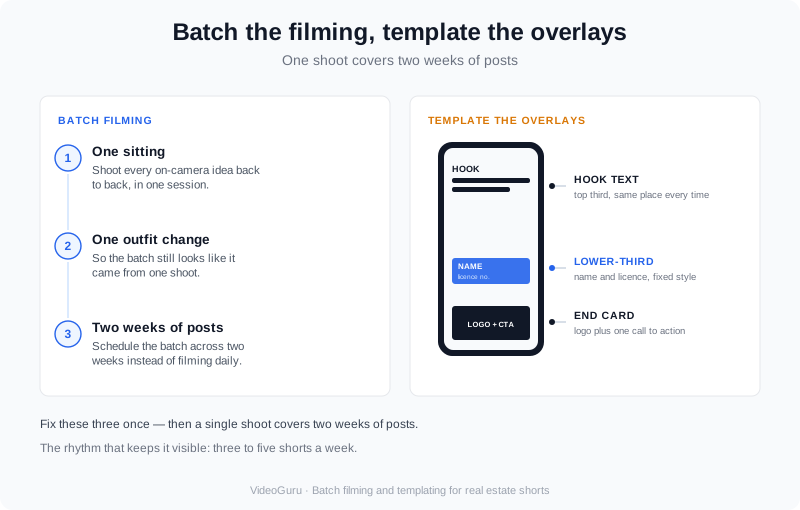
Batch the on-camera ideas and template the overlays once — then a single shoot covers two weeks of posts.
Turning Listing Photos Into Shorts
The property ideas in this list do not have to be filmed at all. A photo-to-video platform assembles a narrated walkthrough from the listing photos you already have, which is what makes idea 1, idea 3, and idea 5 realistic on a busy week. VideoGuru builds that first cut in about ten minutes, exporting 16:9, 1:1, and 9:16 from a single project so the same property becomes a feed post, a Reel, and a landscape clip without a second edit. It is the fastest path into the format described in producing a listing video in ten minutes.
Two capabilities matter for short-form specifically. First, the photo-to-video route is not photos-only: you can drop in your own drone shots or real-person clips and they are mixed into the same walkthrough. Second, on any paid plan — Essential, Growth, or Pro, not the free tier — you can composite your own face and a clone of your real voice into that walkthrough, so idea 12 and the presenter-style posts carry your personal brand automatically, with no separate avatar subscription to buy. One-click effects such as virtual twilight, virtual staging, declutter, and restyle cover the before-after formats without a separate editor.
The First Two Seconds Decide Everything
A short video lives or dies before most viewers hear a word. Open with motion, with a number, or with a question the viewer already has in their head. Put the promise on screen as text, because a large share of people watch with sound off. A few hook frames that work for the ideas above: “This is what $500K gets you here”, “Nobody films this room — they should”, “Three listings, thirty seconds”, “If you are selling this spring, stop doing this”. Write the hook first, then the rest of the video is just proof.
A Simple Posting Schedule
Consistency beats volume, but some volume is required. A workable rhythm for a working agent is three to five shorts a week, drawn in rotation from the four pillars: two listings or property clips, one local, one personality, one value. Batch the filming, schedule the posts, and keep a running notes file of comments and messages — those are your next week's ideas, pre-validated. If you publish across Reels, TikTok, and Shorts, post the same clip natively to each rather than cross-posting a watermark, because each platform suppresses another app's branding.
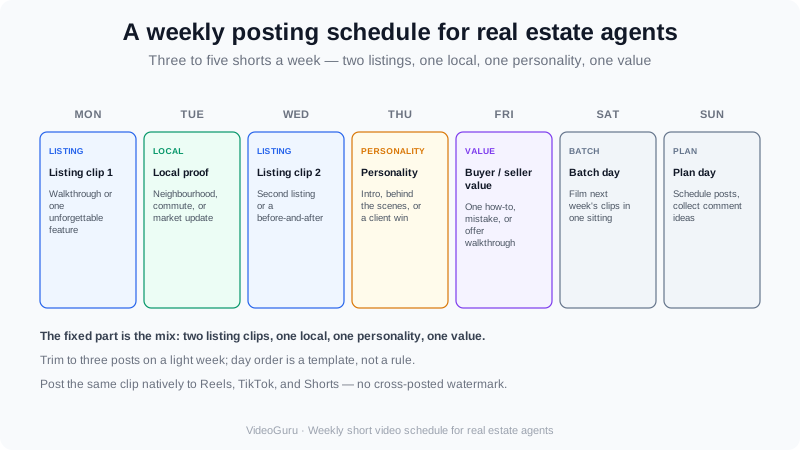
Three to five shorts a week, rotated across the four pillars, is enough to stay visible without fatigue.
Mistakes That Kill an Otherwise Good Short
- Making it too long. If the idea fits in 25 seconds, do not stretch it to 90. Watch time percentage collapses with length.
- Leading with a logo. An intro animation is where viewers leave. Start with the hook.
- All listings, no personality. A feed of nothing but property tours gives a cold viewer no reason to follow you rather than the listing.
- No call to action. Say what to do next — message a keyword, comment a neighbourhood, tap the link.
- Ignoring disclosure. If a clip uses AI staging, an avatar, or a virtual twilight, disclose it. The current disclosure rules for AI listing media are worth reading once and turning into a checklist, and all property advertising must follow HUD's fair housing guidance.
People Also Ask
How often should a real estate agent post short videos?
Three to five times a week is the sweet spot for most working agents. Below three, the algorithm does not get enough signal to keep showing you to new people; above five, quality usually drops and the habit becomes unsustainable. What matters more than the exact number is that the schedule is repeatable — a steady three beats an intense seven followed by nothing.
What should the first two seconds of my short say or show?
Open with a promise, a number, or a question the viewer already has. Show the best room or the most surprising reveal immediately, put the hook on screen as text, and save your name and logo for the end. Treat the first two seconds as a headline: if it would not stop you while scrolling, rewrite it before you post.
Do I have to be on camera to make short videos as an agent?
No. Property and neighbourhood clips work with no face at all, and listing photos can become a narrated walkthrough through AI photo-to-video. That said, on-camera posts build trust faster because buyers are choosing a person. The practical answer is a mix: let the property ideas run without you, and use the personality pillar to put yourself in front of the camera a few times a week.
Can I make short videos without filming the property?
Yes, and this is where AI changed the economics. A photo-to-video platform turns the listing photos you already have into a vertical walkthrough in about ten minutes, complete with narration and branding. You can add your own drone shots or real-person clips if you have them, but you do not need to shoot the property to publish a short about it.
Which is better, Instagram Reels, TikTok, or YouTube Shorts?
None is universally best — they reward different things. Reels and TikTok lean on local discovery and trends, while Shorts benefits from YouTube's search engine, so a how-to clip can keep getting views months later. The efficient answer is to post natively to all three and let your analytics tell you where your market actually watches. For a fuller breakdown, see YouTube Shorts examples real estate marketers can learn from and social video ideas for listings.
Putting It All Together
Short video does not reward the agent with the best equipment; it rewards the agent with the most consistent supply of specific, useful ideas. Steal the 20 above, rotate the four pillars, batch your filming, and let AI carry the property clips you would otherwise never have time to shoot. Start with the ideas you can produce today, and treat the first thirty days as a test of rhythm, not of perfection.
You can build your first property short from the photos you already have. Create a free VideoGuru account to assemble one in minutes, and upgrade to any paid plan when you want your own voice and face inside the walkthrough. The product docs cover creating a video in ten minutes end to end.